





Stanza Living interview experience Real time questions & tips from candidates to crack your interview
SDE - 1
Stanza Living


3 rounds | 5 Coding
problems

 Selected
 Interview preparation journey

Journey
In our college, there were not many opportunities available, so, the only choice I was left with was to either work hard for placements or prepare for an M.Tech. However, I was inclined towards getting a placement as I was good at DSA. I did a lot of practice on various online sites and was able to perform well in both my off-campus and on-campus interviews.
Application story
I asked a friend of mine working there to refer me for the role. He passed my resume to his team lead, and I got the opportunity to interview.
Why selected/rejected for the role?
All interview rounds went pretty well, and I was able to clear the interviews and got the offer within a week.
Preparation
Duration: 5 months
Topics: OOPS, System Design, Algorithms, Data Structures, DBMS

Tip 1 : Prepare System Design.
Tip 2 : Practice DSA Questions properly.
Tip 3 : Practice OOPS and DBMS Concepts.
Application process
Where: Referral
Eligibility: No criteria
Tip 1 : At least 4 projects on Resume
Tip 2 : Do not write false things. You always get caught. Be genuine.

Interview rounds
01
Round
Easy
Video Call
Duration60 minutes
Interview date2 Jun 2022
Coding problem2
First an introduction took place between both of us, then interviewer asked me about my internship experience and then asked 2 DSA questions.
1. Largest rectangle in a histogram
Hard
25m average time
75% success

0/120
Asked in companies



You have been given an array/list 'HEIGHTS' of length ‘N. 'HEIGHTS' represents the histogram and each element of 'HEIGHTS' represents the height of the histogram bar. Consider that the width of each histogram is 1.
You are supposed to return the area of the largest rectangle possible in the given histogram.
For example :
In the below histogram where array/list elements are {2, 1, 5, 6, 2, 3}.
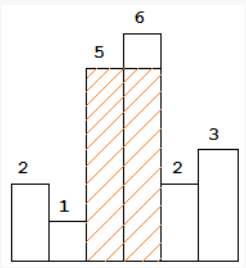
The area of largest rectangle possible in the given histogram is 10.
Problem approach
For any bar i the maximum rectangle is of width r - l - 1 where r - is the last coordinate of the bar to the right with height h[r] >= h[i] and l - is the last coordinate of the bar to the left with height h[l] >= h[i].
So, if for any i co-ordinate we know his utmost higher (or of the same height) neighbors to the right and to the left, we can easily find the largest rectangle.
2. k-th node from the end of the linked list
Easy
15m average time
85% success
0/40
Asked in companies


Given the head node of the singly linked list and an integer ‘k’, , find the value at the kth node from the end of the linked list.
For example:
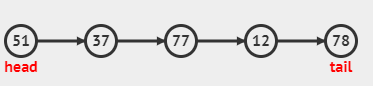
For the above-linked list, if k=2, then the value at the kth i.e second node from the end is ‘12’.
Note :
1.You don’t need to take any input. It has already been taken care of. Just implement the given function and return a pointer pointing to the k-th element from the last of the linked list.
2.It is guaranteed that k<=size of the linked list.
Problem approach
Take two nodes, slowPtr and fastPtr, such that both point to the head. Take one node to store the head; initially, it is a dummy node (start), and the next of this node will point to the head. The dummy node is used to handle the edge case where B = N (the size of the LinkedList). Start traversing until the fast pointer reaches the nth node. Then, traverse one step at a time with both pointers until the fast pointer reaches the end. When the traversal is complete, delete the next node of slowPtr. Return the next of start.
02
Round
Medium
Video Call
Duration60 minutes
Interview date8 Jun 2022
Coding problem2
This round was conducted on Google Meet. A lot of questions about Java were asked, as I mentioned it as my skill, and the team for which I was interviewing worked on microservices in Java, Spring Boot, and 2 DSA questions were asked as well.
1. Reverse Nodes in k-Group
Hard
56m average time
30% success
0/120
Asked in companies



You are given a Singly Linked List of integers and an integer array 'B' of size 'N'. Each element in the array 'B' represents a block size. Modify the linked list by reversing the nodes in each block whose sizes are given by the array 'B'.
Note:
1. If you encounter a situation when 'B[i]' is greater than the number of remaining nodes in the list, then simply reverse the remaining nodes as a block and ignore all the block sizes from 'B[i]'.

2. All block sizes are contiguous i.e. suppose that block 'B[i]' ends at a node cur, then the block 'B[i+1]' starts from the node just after the node cur.
Example
Linked list: 1->2->3->4->5
Array B: 3 3 5

Output: 3->2->1->5->4

We reverse the first block of size 3 and then move to block 2. Now, since the number of nodes remaining in the list (2) is less than the block size (3), we reverse the remaining nodes (4 and 5) as a block and ignore all the block sizes that follow.
Problem approach
The first part of this problem, reverse(), can be done using the [Easy] Reverse Linked List algorithm. However, instead of reversing the entire list, this time we are only interested in a length of K, so use reverse(head, length).
The second part of this problem involves iterating (to ensure that K groups can be formed) and attaching the reversed parts.
2. Search In A Grid
Moderate
15m average time
85% success
0/80
Asked in companies



You are given a grid ‘MAT’ of ‘N’ rows and ‘M’ columns with positive integers written in each cell.
The grid has the following properties-
• Integers in each row are sorted in ascending order from left to right.
• Integers in each column are sorted in ascending order from top to bottom.
You are also given a positive integer ‘target’. Your task is to find whether ‘target’ is present inside the grid or not.
Problem approach
The code implements a solution class that takes a board of characters and a list of words as input. It then performs a depth-first search to determine if the words are present on the board. If a word is found, it is added to the output along with its position on the board. The code uses a visited array to keep track of the cells that have been visited during the search. Finally, the function returns a vector of strings, where each string consists of a word followed by its position on the board.
03
Round
Easy
HR Round
Duration20 minutes
Interview date14 Jun 2023
Coding problem1
Managerial round with basic HR Questions.
1. Basic HR Questions
Tell me about yourself.
What are your strengths and weaknesses?
Why do you want to work at our company?


Here's your problem of the day 
Solving this problem will increase your chance to get selected in this company
Skill covered: Programming
How do you remove whitespace from the start of a string?
Choose another skill to practice
Similar interview experiences
SDE - 1
2 rounds | 3 problems
Interviewed by Stanza Living

Rejected

1011 views

0 comments

0 upvotes
SDE - 1
2 rounds | 4 problems
Interviewed by Stanza Living
Rejected
1087 views
0 comments
0 upvotes
SDE - 1
2 rounds | 4 problems
Interviewed by Stanza Living
Rejected
1036 views
0 comments
0 upvotes

SDE - 1
3 rounds | 9 problems
Interviewed by Salesforce
 Selected
 4552 views
0 comments
0 upvotes
Companies with similar interview experiences
SDE - 1
5 rounds | 12 problems
Interviewed by Amazon
 Selected
 117552 views
24 comments
0 upvotes

SDE - 1
4 rounds | 5 problems
Interviewed by Microsoft
Selected 60143 views
5 comments
0 upvotes
SDE - 1
3 rounds | 7 problems
Interviewed by Amazon
 Selected
 36138 views
7 comments
0 upvotes