





Stanza Living interview experience Real time questions & tips from candidates to crack your interview
SDE - 1
Stanza Living


2 rounds | 4 Coding
problems

Rejected
Interview preparation journey

Journey
In our college, there were not many opportunities available, so the only choice I was left with was to either work hard for placements or prepare for M.Tech. But I was inclined towards getting a placement, as I was good at DSA. I did a lot of practice on various online sites and was able to perform well in both my off-campus and on-campus interviews.
Application story
I saw an opening on Naukri.com, applied on the portal, got a call from the recruiter to schedule the test, cleared it, and was moved to the interview round.
Why selected/rejected for the role?
Rejected, I did not move forward after two interviews as I received a good offer from another company, so it did not make sense to take another chance.
Preparation
Duration: 12 Months
Topics: Data Structures, Algorithms, Database, System Design, Operating Systems

Tip 1: Practice Data Structure questions as much as you can. Also, be confident during the interview about your solution. For practice, you can refer to Coding Ninjas.
Tip 2: Read about previously asked questions by the company.
Application process
Where: Referral
Eligibility: No criteria
Tip 1: Keep it short. Mention the academic and professional projects you've worked on. Include your educational details properly, along with the percentage or CGPA obtained.
Tip 2: Only include things in your resume that you are confident about and keep practicing.

Interview rounds
01
Round
Medium
Video Call
Duration60 Minutes
Interview date24 May 2022
Coding problem2
The interviewer was very experienced, receptive, and helpful. He started the interview by understanding my tech background. After making me comfortable, he then tested my DSA skills.
1. Largest rectangle in a histogram
Hard
25m average time
75% success

0/120
Asked in companies



You have been given an array/list 'HEIGHTS' of length ‘N. 'HEIGHTS' represents the histogram and each element of 'HEIGHTS' represents the height of the histogram bar. Consider that the width of each histogram is 1.
You are supposed to return the area of the largest rectangle possible in the given histogram.
For example :
In the below histogram where array/list elements are {2, 1, 5, 6, 2, 3}.
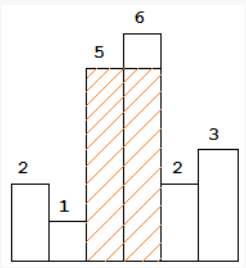
The area of largest rectangle possible in the given histogram is 10.
2. Merge Intervals
Moderate
20m average time
80% success
0/80
Asked in companies


You are given N number of intervals, where each interval contains two integers denoting the start time and the end time for the interval.
The task is to merge all the overlapping intervals and return the list of merged intervals sorted by increasing order of their start time.
Two intervals [A,B] and [C,D] are said to be overlapping with each other if there is at least one integer that is covered by both of them.
For example:
For the given 5 intervals - [1, 4], [3, 5], [6, 8], [10, 12], [8, 9].

Since intervals [1, 4] and [3, 5] overlap with each other, we will merge them into a single interval as [1, 5].

Similarly, [6, 8] and [8, 9] overlap, merge them into [6,9].

Interval [10, 12] does not overlap with any interval.

Final List after merging overlapping intervals: [1, 5], [6, 9], [10, 12].
02
Round
Hard
Video Call
Duration60 Minutes
Interview date26 May 2022
Coding problem2
This round was to test my past experience and depth of knowledge of the tech stack I have worked on. The interviewer asked a lot of questions about my resume, so it's better to know everything written on it. Then, he asked me a DSA question and one puzzle.
1. Reverse Nodes in k-Group
Hard
56m average time
30% success
0/120
Asked in companies



You are given a Singly Linked List of integers and an integer array 'B' of size 'N'. Each element in the array 'B' represents a block size. Modify the linked list by reversing the nodes in each block whose sizes are given by the array 'B'.
Note:
1. If you encounter a situation when 'B[i]' is greater than the number of remaining nodes in the list, then simply reverse the remaining nodes as a block and ignore all the block sizes from 'B[i]'.

2. All block sizes are contiguous i.e. suppose that block 'B[i]' ends at a node cur, then the block 'B[i+1]' starts from the node just after the node cur.
Example
Linked list: 1->2->3->4->5
Array B: 3 3 5

Output: 3->2->1->5->4

We reverse the first block of size 3 and then move to block 2. Now, since the number of nodes remaining in the list (2) is less than the block size (3), we reverse the remaining nodes (4 and 5) as a block and ignore all the block sizes that follow.
2. Puzzle
You have 15 Rs with you. You go to a shop, and the shopkeeper tells you the price is 1 Rs per chocolate. He also tells you that you can get a chocolate in exchange for 3 wrappers. How many maximum chocolates can you eat?
Problem approach
Tip 1: Practice previously asked puzzles.
Tip 2: Talk with the interviewer about your thought process; he is there to help.


Here's your problem of the day 
Solving this problem will increase your chance to get selected in this company
Skill covered: Programming
How do you remove whitespace from the start of a string?
Choose another skill to practice
Similar interview experiences
SDE - 1
2 rounds | 3 problems
Interviewed by Stanza Living
Rejected

1010 views

0 comments

0 upvotes
SDE - 1
2 rounds | 4 problems
Interviewed by Stanza Living
Rejected
1035 views
0 comments
0 upvotes
SDE - 1
3 rounds | 5 problems
Interviewed by Stanza Living
 Selected
 896 views
0 comments
0 upvotes

SDE - 1
3 rounds | 9 problems
Interviewed by Salesforce
 Selected
 4551 views
0 comments
0 upvotes
Companies with similar interview experiences
SDE - 1
5 rounds | 12 problems
Interviewed by Amazon
 Selected
 117551 views
24 comments
0 upvotes
SDE - 1
4 rounds | 5 problems
Interviewed by Microsoft
Selected 60142 views
5 comments
0 upvotes
SDE - 1
3 rounds | 7 problems
Interviewed by Amazon
 Selected
 36137 views
7 comments
0 upvotes