





Sterlite Technologies Limited interview experience Real time questions & tips from candidates to crack your interview
SDE - 1
Sterlite Technologies Limited


3 rounds | 10 Coding
problems

 Selected
 Interview preparation journey

Journey
I am an ICT student who had a passion for technology and programming. I spent countless hours studying, practicing coding, and working on personal projects to enhance his skills. During my final year of college, I started to apply for IT jobs at various companies.
I quickly realized that getting a job in the highly competitive IT industry would not be easy. I faced numerous rejections and struggled to stand out among the many other applicants. However, I did not give up and continued to work hard and improve my skills.
Finally, I received an interview invitation from a leading IT firm through on campus. I spent days researching the company, practicing his interview skills, and preparing for potential questions.
During the interview, I was able to showcase my strong technical skills and ability to think critically and problem-solve. I also emphasized my passion for technology and my willingness to continuously learn and improve. The interviewer was impressed with my skills and enthusiasm and offered me a position in the company.
my hard work and dedication had paid off, and I was ecstatic to have landed my dream job in the IT industry.
Application story
Preparing for the Drive: The first step is to prepare for the drive. You should research the company and the job role you are interested in. You should also practice coding problems and prepare for technical interviews.
Applying for the Drive: Once the company announces the on-campus drive, you should apply through the company's career portal or through your college's placement cell. Make sure to submit your resume, cover letter, and any other required documents.
Pre-Placement Talk: The company may conduct a pre-placement talk where they provide an overview of their company, products, and services. This is a great opportunity to learn more about the company and ask any questions you may have.
Aptitude Test: The company may conduct an aptitude test to assess your logical, quantitative, and reasoning skills.
Technical Interview: If you clear the aptitude test, you may be called for a technical interview. This interview will assess your technical skills and may involve coding problems or technical questions related to the job role.
HR Interview: If you clear the technical interview, you may be called for an HR interview. This interview will assess your soft skills, communication skills, and overall fit with the company's culture.
Job Offer: If you successfully clear all the rounds, you may receive a job offer from the company.
Why selected/rejected for the role?
here are some possible reasons why I may be selected for an IT role:
Technical Skills: Having strong technical skills is often a key requirement for IT roles.
Relevant Experience: Relevant work experience in the field, especially in a similar role, is often preferred by recruiters.
Soft Skills: Soft skills such as communication, problem-solving, teamwork, and adaptability are also important for IT roles.
Cultural Fit: my fit with the company's culture is also an important consideration for recruiters.
Passion for Technology: I have a genuine passion for technology and am up-to-date with the latest industry trends are often preferred.
Preparation
Duration: 8 months
Topics: There are many topics that are important to prepare for IT jobs, but here are some of the top topics that you should focus on:Programming Languages: To work in the IT industry, you should be proficient in at least one programming language such as Java, Python, C++, or JavaScript.Data Structures and Algorithms: This is a crucial topic for IT job interviews. You should be familiar with common data structures such as arrays, linked lists, and trees, as well as algorithms such as sorting and searching.Operating Systems: An understanding of how operating systems work is essential for many IT jobs. You should be familiar with concepts such as memory management, process management, and file systems.Networking: Knowledge of computer networking is important for IT jobs that involve developing and maintaining network infrastructure. You should be familiar with concepts such as TCP/IP, routing, and switching.Databases: Many IT jobs require a strong understanding of databases and SQL. You should be comfortable working with relational databases, understanding data modeling, and using SQL to query data.Web Development: As the internet continues to grow, web development has become an essential skill for IT professionals. You should be familiar with web development technologies such as HTML, CSS, and JavaScript, as well as frameworks such as React and Angular.

Tip 1: Review Your Resume: Make sure your resume is up-to-date and highlights your relevant experiences and skills. Review your resume and make sure you can speak confidently about everything on it.
Tip 2: Improve Soft Skills: Soft skills such as communication, problem-solving, and teamwork are important in the IT industry. Make sure to develop these skills and be able to showcase them during the interview.
Tip 3 : Practice Coding: Practicing coding problems is a great way to prepare for IT job interviews. There are many online resources available where you can find coding challenges and practice problems. This will help you improve your coding skills and prepare for technical interviews.
Application process
Where: Campus
Eligibility: Above 8 CGPA, more than 75% in class 12th
Tip 1: Highlight Technical Skills: Highlight your technical skills and experience in the field. List the programming languages, frameworks, and tools you are proficient in.
Tip 2: Keep it Concise: Keep your resume concise and to the point. It should not be more than 2 pages long.

Interview rounds
01
Round
Easy
Online Coding Interview
Duration100 mins
Interview date12 Aug 2022
Coding problem2
Timing: The round was conducted for 100 minutes from 11:30 AM.
Environment: As it was an online round, the environment would depend on the individual candidates. However, it is recommended to take the test in a quiet and distraction-free environment with a stable internet connection.
Coding Questions: The coding round had two questions, which the candidates had to solve within the given time frame. The questions could be based on any programming language, and the candidates were expected to write efficient code that could pass all the test cases.
Aptitude MCQ: Along with the coding questions, the round also included multiple-choice questions (MCQs) on aptitude. These questions could cover a wide range of topics such as quantitative aptitude, logical reasoning, verbal ability, and data interpretation.
1. Reverse Linked List
Moderate
15m average time
85% success

0/80
Asked in companies



Given a singly linked list of integers. Your task is to return the head of the reversed linked list.
For example:
The given linked list is 1 -> 2 -> 3 -> 4-> NULL. Then the reverse linked list is 4 -> 3 -> 2 -> 1 -> NULL and the head of the reversed linked list will be 4.
Follow Up :
Can you solve this problem in O(N) time and O(1) space complexity?
Problem approach
Initialize three pointers: prev = None, curr = head (points to the current node), and next = None (points to the next node).
Iterate through the linked list by updating the pointers until the current node becomes None:
a. Store the next node of the current node in the 'next' pointer.
b. Update the 'next' pointer of the current node to point to the previous node (i.e., set curr.next = prev).
c. Move the 'prev' pointer to the current node.
d. Move the 'curr' pointer to the next node (i.e., set curr = next).
e. Move the 'next' pointer to the next node (i.e., set next = curr.next).
After the loop ends, the 'prev' pointer will be pointing to the last node of the original list, which will be the new head of the reversed list.
Return the 'prev' pointer as the new head of the reversed linked list.
2. Check If The String Is A Palindrome
Easy
10m average time
90% success
0/40
Asked in companies



You are given a string 'S'. Your task is to check whether the string is palindrome or not. For checking palindrome, consider alphabets and numbers only and ignore the symbols and whitespaces.
Note :
String 'S' is NOT case sensitive.
Example :
Let S = “c1 O$d@eeD o1c”.
If we ignore the special characters, whitespaces and convert all uppercase letters to lowercase, we get S = “c1odeedo1c”, which is a palindrome. Hence, the given string is also a palindrome.
Problem approach
Remove all spaces, punctuation marks, and convert the string to lowercase to make it case-insensitive.
Initialize two pointers, one pointing to the start of the string (left pointer) and the other pointing to the end of the string (right pointer).
Iterate until the left pointer is less than the right pointer:
a. Compare the characters at the left and right pointers. If they are not equal, the string is not a palindrome. Return False.
b. Move the left pointer to the right by incrementing it.
c. Move the right pointer to the left by decrementing it.
If the loop completes without finding any unequal characters, the string is a palindrome. Return True.
02
Round
Easy
Video Call
Duration30 mins
Interview date14 Aug 2022
Coding problem5
Introduction: The interview started with a brief introduction session where the interviewer and interviewee introduce themselves. The interviewer asks about my background, education, and relevant experience.
Project Discussion: After the introduction, the interviewer asked me to explain one or more projects mentioned on my resume. I describe the project's purpose, its role, and the technologies used. The interviewer may ask detailed questions about the project's implementation, challenges faced, and the outcomes achieved.
Coding Question: Once the project discussion is over, the interviewer presents a coding question to assess my problem-solving and coding skills.
1. OS Question
Explain the concept of process synchronization and provide examples of synchronization mechanisms in an operating system.
Problem approach
Tip 1: Understand the Concept: Start by understanding the concept of process synchronization in an operating system. Process synchronization refers to the coordination and control of concurrent processes to ensure they access shared resources or perform critical sections in a mutually exclusive and orderly manner.
Tip 2: Identify Synchronization Mechanisms: Identify and explain various synchronization mechanisms used in operating systems,
Tip 3:Provide Examples: Give examples of how synchronization mechanisms are used in real-world scenarios.
2. OOPs Question
Explain the concept of inheritance in object-oriented programming and provide examples of its usage.
Problem approach
Tip 1: Understand the Concept: Begin by understanding the concept of inheritance in object-oriented programming (OOP). Inheritance is a fundamental principle that allows classes to inherit properties and behaviors from other classes. It establishes a hierarchical relationship between classes, where a subclass (derived class) inherits attributes and methods from a superclass (base class).
Tip 2: Explain the Usage: Discuss the various scenarios where inheritance is commonly used.
Tip 3:Provide Examples: Give concrete examples to illustrate the usage of inheritance.
3. OOPs Question
Explain the concept of polymorphism in object-oriented programming and provide examples of its implementation.
Problem approach
Tip 1: Understand the Concept: Begin by understanding the concept of polymorphism in object-oriented programming (OOP).
Tip 2: Explain the Implementation: Discuss the implementation of polymorphism in OOP.
Tip 3:Provide Examples: Give examples to illustrate the implementation of polymorphism. Some examples include:
Method Overloading: In a class called "Calculator," you can have multiple methods named "add" that accept different parameters, such as "add(int a, int b)" and "add(double a, double b)." This allows the calculator to handle addition operations for different types of operands.
4. Missing Number
Moderate
30m average time
70% success
0/80
Asked in companies



You are given an array/list ‘BINARYNUMS’ that consists of ‘N’ distinct strings which represent all integers from 0 to N in binary representation except one integer. This integer between 0 to ‘N’ whose binary representation is not present in list ‘BINARYNUMS’ is called ‘Missing Integer’.
Your task is to find the binary representation of that ‘Missing Integer’. You should return a string that represents this ‘Missing Integer’ in binary without leading zeros.
Note
1. There will be no leading zeros in any string in the list ‘BINARYNUMS’.
Example:
Consider N = 5 and the list ‘binaryNums’= [“0”, “01”, “010”, “100”, “101”]. This list consists of the binary representation of numbers [0, 1, 2, 4, 5]. Clearly, the missing number is 3 and its binary representation will be “11”. So you should return string “11”.
Problem approach
Stepwise Solution:
Initialize a variable total to store the sum of all integers from 1 to n+1.
Iterate through the array and subtract each element from total.
At the end of the iteration, the value of total will be the missing number.
5. Cycle Detection in a Singly Linked List
Moderate
15m average time
80% success
0/80
Asked in companies


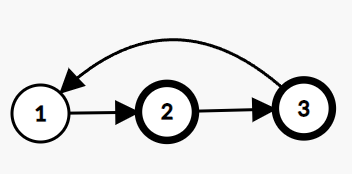
You are given a Singly Linked List of integers. Return true if it has a cycle, else return false.
A cycle occurs when a node's next points back to a previous node in the list.
Example:
In the given linked list, there is a cycle, hence we return true.
Problem approach
Initialize two pointers, slow_ptr and fast_ptr, both pointing to the head of the linked list.
Traverse the linked list using the two pointers:
Move slow_ptr one step at a time by assigning slow_ptr = slow_ptr.next.
Move fast_ptr two steps at a time by assigning fast_ptr = fast_ptr.next.next.
If a cycle exists in the linked list, fast_ptr will eventually catch up to slow_ptr.
If fast_ptr becomes null or reaches the end of the linked list, there is no cycle.
If fast_ptr and slow_ptr meet at any point during traversal, it indicates the presence of a cycle in the linked list.
03
Round
Easy
HR Round
Duration30 mins
Interview date14 Aug 2022
Coding problem3
The HR round is typically the final stage of the interview process and focuses on assessing the candidate's suitability for the organization's culture and team dynamics. The round was held for 30 min. it started with Introduction and Icebreaker. Then my overview and resume discussion. Behavioral Questions- The HR representative asks behavioral questions to assess the candidate's problem-solving abilities, interpersonal skills, and decision-making capabilities. Then The HR representative provided an opportunity for me to ask any questions I have about the company, team, or role.
1. Basic HR Question
Why are you interested in this position and our company?
Problem approach
Tip 1: Research the Company: Before the interview, conduct thorough research on the company. Explore their website, read about their mission, values, and recent achievements. Understand their products, services, and target audience. This knowledge will help you tailor your answer and show that you have a genuine interest in the company.
Tip 2: Align Your Skills and Values: Highlight how your skills, experiences, and career goals align with the position and the company's values. Discuss specific aspects of the job description that resonate with your expertise and passion. Emphasize how your background makes you a strong fit for the role and how you can contribute to the company's success.
Tip 3: Connect with the Company's Mission: Identify the company's mission or vision statement and express your alignment with it. Explain why the company's purpose and goals resonate with you on a personal and professional level. Show your enthusiasm for being part of a team that strives to make a positive impact in the industry or society.
2. Basic HR Question
How do you handle stress and tight deadlines?
Problem approach
Tip 1: Be Prepared: Anticipate questions about handling stress and tight deadlines and prepare your response in advance. This will enable you to deliver a well-thought-out answer during the interview.
Tip 2: Highlight Time Management Skills: Emphasize your strong time management skills and ability to prioritize tasks effectively. Discuss specific strategies you use to stay organized, such as creating to-do lists, setting deadlines, and breaking down complex tasks into smaller manageable steps.
Tip 3:Share Your Stress Management Techniques: Describe the techniques you employ to manage stress in high-pressure situations. Examples could include deep breathing exercises, taking short breaks, practicing mindfulness or meditation, or engaging in physical activities like exercise or yoga.
3. Basic HR Question
Can you describe a challenging situation you faced at work and how you resolved it?
Problem approach
Tip 1: Choose a Relevant Situation: Select a challenging situation that is relevant to the job you are interviewing for. Consider situations where you encountered obstacles or difficulties that required problem-solving, critical thinking, or collaboration.
Tip 2: Provide Context: Begin by providing a brief overview of the situation, including the context and the challenges you faced. Explain the importance or impact of the situation on your work or the team's goals.
Tip 3: Focus on Your Actions: Describe the specific actions you took to address the challenge. Highlight your problem-solving skills, decision-making abilities, and any innovative approaches you employed. Discuss how you analyzed the situation, gathered information, and evaluated potential solutions.


Here's your problem of the day 
Solving this problem will increase your chance to get selected in this company
Skill covered: Programming
How do you remove whitespace from the start of a string?
Choose another skill to practice
Similar interview experiences
Software Engineer Intern
4 rounds | 2 problems
Interviewed by Sterlite Technologies Limited
Selected 
2107 views

0 comments

0 upvotes

SDE - 1
3 rounds | 7 problems
Interviewed by OYO
Selected 6182 views
0 comments
0 upvotes

SDE - 1
2 rounds | 5 problems
Interviewed by Meesho
Rejected
7245 views
0 comments
0 upvotes
SDE - 1
3 rounds | 9 problems
Interviewed by Salesforce
 Selected
 4552 views
0 comments
0 upvotes
Companies with similar interview experiences

SDE - 1
5 rounds | 12 problems
Interviewed by Amazon
 Selected
 117552 views
24 comments
0 upvotes

SDE - 1
4 rounds | 5 problems
Interviewed by Microsoft
Selected 60143 views
5 comments
0 upvotes
SDE - 1
3 rounds | 7 problems
Interviewed by Amazon
 Selected
 36138 views
7 comments
0 upvotes