





TA Digital interview experience Real time questions & tips from candidates to crack your interview
Software Engineer
TA Digital


3 rounds | 12 Coding
problems

Rejected
Interview preparation journey

Journey
TA Digital humanizes the digital world and merges strategy and innovation to create authentic experiences that delight customers and solve business challenges. The company visited our college for the profile of Software Engineer. It conducted three rounds for selection: programming test, technical interview, and HR interview. Around 500 students participated in the drive, out of which 24 students were selected.
Application story
I participated in an on-campus drive when the company visited our college for the position of Software Engineer. The selection process included three rounds: a programming test, a technical interview, and an HR interview. Approximately 500 students took part in the drive, and 24 students were selected.
Why selected/rejected for the role?
I was rejected for this role after the programming test. I couldn't answer all three coding questions in the test, which led to my rejection.
Preparation
Duration: 2 months
Topics: Coding Questions, Data Structures, Databases, Operating Systems, Software Testing

Tip 1: Practice medium-level coding questions.
Tip 2: Gain knowledge of software testing.
Tip 3: Develop good projects.
Application process
Where: Campus
Eligibility: 65% throughout
Tip 1: Mention good projects in your resume.
Tip 2: Include something unique in your resume.

Interview rounds
01
Round
Hard
Online Coding Test
Duration120 minutes
Interview date21 Dec 2021
Coding problem2
This round was conducted on HackerEarth. It was a 2-hour long test in which there were 3 questions. To clear this round, you need to answer all three questions. Only 49 students cleared this round.
1. Trapping Rain Water
Moderate
15m average time
80% success

0/80
Asked in companies



You have been given a long type array/list 'arr’ of size 'n’.
It represents an elevation map wherein 'arr[i]’ denotes the elevation of the 'ith' bar.
Print the total amount of rainwater that can be trapped in these elevations.
Note :
The width of each bar is the same and is equal to 1.
Example:
Input: ‘n’ = 6, ‘arr’ = [3, 0, 0, 2, 0, 4].

Output: 10

Explanation: Refer to the image for better comprehension:

Note :
You don't need to print anything. It has already been taken care of. Just implement the given function.
Problem approach
Step 1: Initialize two pointers, left and right, to the first and last indices of the elevation map.
Step 2: Initialize two variables, left_max and right_max, to 0. These variables will track the maximum heights encountered from the left and right directions, respectively.
Step 3: Initialize a variable, water_trapped, to 0. This variable will store the total amount of water trapped.
Step 4: While the left pointer is less than or equal to the right pointer, do steps 5-8.
Step 5: If the height at the left pointer is less than or equal to the height at the right pointer, do steps 6-7; otherwise, do steps 7-8.
Step 6: If the height at the left pointer is greater than or equal to left_max, update left_max to the current height. Otherwise, calculate the water trapped by subtracting the height at the left pointer from left_max and add it to water_trapped. Increment the left pointer.
Step 7: If the height at the right pointer is greater than or equal to right_max, update right_max to the current height.
Otherwise, calculate the water trapped by subtracting the height at the right pointer from right_max and add it to water_trapped.
Decrement the right pointer.
Step 8: After the while loop, return the value of water_trapped.
2. Flatten Binary Tree to Linked List
Moderate
25m average time
70% success
0/80
Asked in companies



You are given a binary tree consisting of 'n' nodes.
Convert the given binary tree into a linked list where the linked list nodes follow the same order as the pre-order traversal of the given binary tree.
Use the right pointer of the binary tree as the “next” pointer for the linked list and set the left pointer to NULL.
Use these nodes only. Do not create extra nodes.
Example :
Input: Let the binary be as shown in the figure:
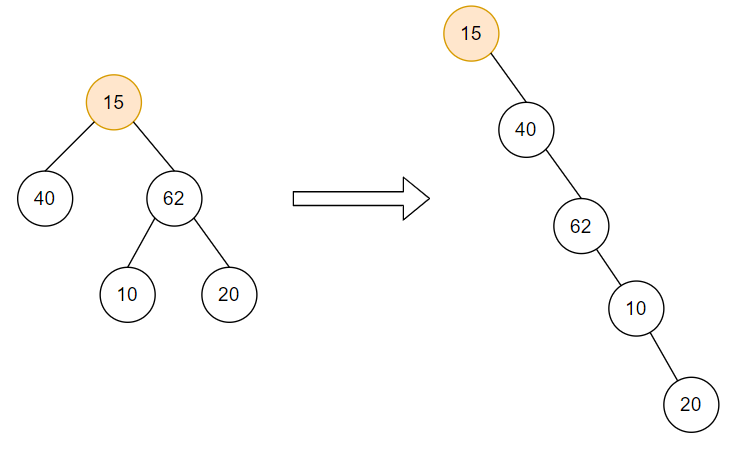
Output: Linked List: 15 -> 40 -> 62 -> 10 -> 20 -> NULL

Explanation: As shown in the figure, the right child of every node points to the next node, while the left node points to null.

Also, the nodes are in the same order as the pre-order traversal of the binary tree.
Problem approach
Step 1: If the root is None or it is a leaf node (both left and right children are None), return the root as it is already flattened.
Step 2: Recursively flatten the left subtree by calling the flattenTree function on the left child of the root.
Step 3: Recursively flatten the right subtree by calling the flattenTree function on the right child of the root.
Step 4: If the flattened left subtree exists (left child is not None), do the following:
a) Store the original right child of the root in a temporary variable, right_child.
b) Set the left child of the root as None.
c) Set the right child of the root to the flattened left subtree.
d) Find the rightmost node in the flattened left subtree.
e) Set the right child of the rightmost node to the temporary variable right_child.
Step 5: Return the root of the flattened binary tree.
02
Round
Medium
Video Call
Duration25 minutes
Interview date10 Jan 2022
Coding problem6
This round was conducted on the Superset platform. This platform is a bit different, the candidates need to be online and the interviewer will call them at the time and the candidates need to pick up the call and attend the interview. This round was scheduled for 20 minutes, but it went on for 25 minutes. The interview was mostly focused on data structures and OOPS concepts.
1. Algorithmic Question
What is the difference between BFS and DFS? (Learn)
Problem approach
Tip 1: Study about Breadth First Search and Depth First Search.
Tip 2: Hear the question carefully.
2. Algorithmic Question
What is recursion? How can you perform the recursion? (Learn)
Problem approach
Tip 1: Study recursion in detail
Tip 2: Answer confidently
3. Java Question
What is JVM? (Learn)
Problem approach
Tip 1: Study about the Java Virtual Machine.
Tip 2: Hear the question carefully.
4. Java Question
What gives Java its 'write once and run anywhere' nature? (Learn)
Problem approach
Tip 1: Study about the Java Virtual Machine
Tip 2: Hear the question carefully
6. OS Question
What is a thread in an operating system? (Learn)
Problem approach
Tip 1: Study threads in the operating system.
Tip 2: Hear the question carefully.
03
Round
Easy
HR Round
Duration15 minutes
Interview date18 Jan 2022
Coding problem4
This round was conducted on the Superset platform. This platform is a bit different, the candidates need to be online and the interviewer will call them at the time and the candidates need to pick up the call and attend the interview. 24 students were selected after this round.
1. HR Question
Give your introduction.
Problem approach
Tip 1: Prepare your introduction
Tip 2: Speak in good English
2. HR Question
How do you prioritize your work?
Problem approach
Tip 1: Answer confidently
Tip 2: Don't hide anything
3. HR Question
What are your weaknesses?
Problem approach
Tip 1: Better to tell the weakness that does not hinder the growth of the company
Tip 2: Hear the question carefully
4. HR Question
Do you have any other offers in hand?
Problem approach
Tip 1: Tell the truth, even if you have an offer
Tip 2: Answer confidently


Here's your problem of the day 
Solving this problem will increase your chance to get selected in this company
Skill covered: Programming
How do you remove whitespace from the start of a string?
Choose another skill to practice
Similar interview experiences

SDE - 1
3 rounds | 7 problems
Interviewed by OYO

 Selected
6182 views

0 comments

0 upvotes

SDE - Intern
2 rounds | 3 problems
Interviewed by Amazon
Rejected
1565 views
0 comments
0 upvotes
SDE - 1
2 rounds | 5 problems
Interviewed by Meesho
Rejected
7245 views
0 comments
0 upvotes
SDE - 1
3 rounds | 9 problems
Interviewed by Salesforce
 Selected
 4552 views
0 comments
0 upvotes
Companies with similar interview experiences

Software Engineer
3 rounds | 7 problems
Interviewed by Optum
 Selected
 8606 views
1 comments
0 upvotes
Software Engineer
5 rounds | 5 problems
Interviewed by Microsoft
 Selected
 11120 views
1 comments
0 upvotes
Software Engineer
2 rounds | 4 problems
Interviewed by Amazon
Selected 5208 views
1 comments
0 upvotes