





Tata Consultancy Services (TCS) interview experience Real time questions & tips from candidates to crack your interview
Assistant System Engineer
Tata Consultancy Services (TCS)


2 rounds | 2 Coding
problems
 Selected
 Interview preparation journey

Preparation
Duration: 3 months
Topics: Data Structures, OOPS, Algorithms, Java, Quantitative Aptitude, Logical Reasoning

Tip 1 : Never underestimate the importance of practicing aptitude and logical reasoning questions
Tip 2 : Prepare at least 2 projects and revise it's concepts about which you can explain in the interview thoroughly
Tip 3 : Practice as much DSA as you can. The more the better.
Application process
Where: Campus
Eligibility: 6.5 CGPA and above, Not more than one backlog
Tip 1 : Be honest in your resume.
Tip 2 : Tailor your resume according to the role which you are applying for. And make this a habit. Don't stick the same resume everywhere.
Interview rounds
01
Round
Medium
Online Coding Interview
Duration180 minutes
Interview date28 Oct 2020
Coding problem2
The first round(TCS NQT Test) had MCQ, programming logic questions and two hands-on coding questions. It was a proctored test that was conducted online and students could take the test from home on their personal laptops. The MCQ consisted of three subsections: Verbal Ability. Numerical Ability and Reasoning Ability. The difficulty level of these sections was medium and one can easily clear these after practising CAT material. Also, there was no negative marking. The programming language questions were a mix of theory and input-output questions with one-word answers. The difficulty level of these questions was easy. There were two hands-on coding questions in the last section of the test. The first question was easy and the second question was of medium difficulty level.
1. MCQ Questions
Numerical Ability - 26 Ques
Time - 40 mins
Topics Covered - Probability, Permutations and Combinations, AP, GP, Distance and Time.
Verbal Ability - 24 Ques
Time- 30 mins
Topics Covered - Tenses, Punctuations, Sentence completion, Comprehension
Reasoning Ability - 30 Ques
Time- 50 mins
Topics Covered - Set theory, Family relations, Seating arrangement, Assertion-Reason, Pattern matching, Code decode.
Programming Logic - 10 Ques
Time- 15 mins
No. of MCQ's - 90
2. Zigzag Binary Tree Traversal
Easy
10m average time
90% success

0/40
Asked in companies



You are given a ‘Binary Tree’.
Return the level-order traversal of the Binary Tree.
Example:
Input: Consider the following Binary Tree:
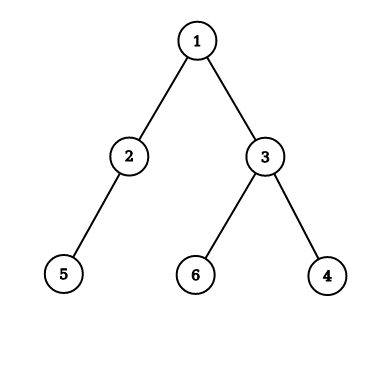
Output:
Following is the level-order traversal of the given Binary Tree: [1, 2, 3, 5, 6, 4]
Problem approach
Algorithm:
1. An ideal approach to follow for ZigZag Level Order Traversal is the Breadth-First Approach as followed in the Level
Order Traversal. I addedthe root node, which is the first visited node, to a Queue whose each element takes a Tree
Node data structure as the input.
2. Then, I iterated until the contents of the queue become empty, resetting the ‘level’ list at each level to a new empty
list. For each level, poll the visited element from the Queue. I kept a boolean flag variable that toggles between
false and true for the left to right and right to left traversal. For left to right traversal, the flag is false, in which case I
simply add the polled node’s value to the ‘level’ list, used for tracking the list of values in each particular level. For
the right to left traversal, the flag is true, in which case I added the polled node’s value at the 0th index of the
‘level’ list.
3. Once a visited node’s value was added to the level list, I explored it’s neighbours, i.e. its left and right children, by
adding them to the queue, if they exist.
4. Once an entire level of nodes has been visited, I added the level list to the final result list while toggling the flag’s
boolean value to achieve zig zag level order traversing. I continued to iterate the above mentioned steps until the
queue is completely empty and then returned the result list.
02
Round
Easy
Video Call
Duration30 minutes
Interview date5 Dec 2020
Coding problem0
This round was the final video call interview round which was scheduled on Google Meet. There were 3 panellists namely HR, MR, and TR.
After I joined the meeting, HR welcomed me and asked me to show my ID proof(I showed my Aadhar card). And then TR started asking me questions. They were:
1. Tell me about yourself: I told him my marks and told him I am interested in coding and told him about my internship and
projects in machine learning and data science.
2. In which programming languages are you good?: I told Java and Python.
3. What is the unique advantage in Java that the other programming languages don't have? : I answered that Java is an
architecturally neutral programming language which basically means that it can be easily interpreted across different
devices without having the need to install different compilers on one of those devices.
4. What is a class, What are the data types? : I answered the definition with some examples.
5. Write a program to reverse a string. : I wrote the code and the interviewer was satisfied.
6. Tell me about your project: I explained my machine learning project on Image classification using Convolutional Neural
Networks. Then he went on to ask questions on the terminologies related to my project such as accuracy, learning rate,
neural network and how it predicts and corrects the prediction as it trains on the data. I explained the whole process and
the interviewer was satisfied.
7. What is inheritance? Explain with an example. : I explained it in detail.
MR Round:
1. What do you know about TCS?
2. Which is your favourite subject?
3. What are your aspirations?
That's all for MR
HR Round:
1. Tell me your five strengths and five weaknesses.
2. Have you ever faced any challenges in executing a project? Please elaborate in detail how you overcame it.
3. You said that you have an interest in machine learning. Also, you have done some really good projects in the same domain. Can you work on different projects in TCS other than machine learning?
4. Are you ready to relocate?
5. Are you ok with night shifts?
6. You have to work from home or come to the workplace, Are you having any problems?
7. There is a service agreement stating “You have to work in TCS for at least one year or pay 50K”. Are you willing to sign the service agreement?
The whole interview lasted for 30 minutes. Finally, on 19th January 2021, I received the offer letter stating that I have been selected for the role of Assistant System Engineer-Trainee at TCS. I would say the entire on-campus recruitment process was pretty smooth and the panellists were interactive, supportive and encouraging.


Here's your problem of the day 
Solving this problem will increase your chance to get selected in this company
Skill covered: Programming
To make an AI less repetitive in a long paragraph, you should increase:
Choose another skill to practice
Similar interview experiences
Assistant System Engineer
2 rounds | 2 problems
Interviewed by Tata Consultancy Services (TCS)
 Selected
1296 views

0 comments

0 upvotes
Assistant System Engineer
2 rounds | 4 problems
Interviewed by Tata Consultancy Services (TCS)
Selected 1315 views
1 comments
0 upvotes
Assistant System Engineer
4 rounds | 7 problems
Interviewed by Tata Consultancy Services (TCS)
Selected 1019 views
0 comments
0 upvotes
Assistant System Engineer
2 rounds | 3 problems
Interviewed by Tata Consultancy Services (TCS)
Selected 901 views
0 comments
0 upvotes
Companies with similar interview experiences

Assistant System Engineer
2 rounds | 4 problems
Interviewed by Accenture
Selected 1331 views
0 comments
0 upvotes
Assistant System Engineer
3 rounds | 4 problems
Interviewed by Accenture
 Selected
 0 views
0 comments
0 upvotes