





Tekion Corp interview experience Real time questions & tips from candidates to crack your interview
Associate Software Engineer
Tekion Corp


3 rounds | 4 Coding
problems

 Selected
 Interview preparation journey

Journey
My journey into tech began with a simple curiosity about how software works. I started by learning the basics—programming languages like Java and foundational concepts in data structures and algorithms. I spent a lot of time on coding platforms, solving problems to build my problem-solving skills.
As I delved deeper, I realized that understanding the bigger picture, such as how databases and operating systems work, was equally important. This knowledge became especially valuable during my projects and internships, where I saw how these fundamentals are crucial for building efficient and scalable applications.
Preparing for interviews was challenging, but I stayed focused on mastering core concepts and practising coding under time constraints. One key aspect that helped me was learning how to communicate my thought process clearly during interviews. It’s not just about writing code; it’s about explaining how you approach problems.
For the interview at Tekion, I went through a coding round with multiple-choice questions and two coding challenges, followed by two technical interviews. These rounds heavily focused on problem-solving, database management, and system design. The discussions were in-depth, covering topics like controlling spam comments in my project and optimizing database queries. Finally, there was an HR round where I shared my journey and passion for technology.
In the end, cracking the interview was about consistent effort, learning from each experience, and staying motivated. I hope my journey inspires others to stay curious, keep learning, and never give up.
Application story
I applied for the position through our college's on-campus placement drive. The company visited our campus, and I submitted my application through the placement cell. After the initial screening, I was shortlisted for the interview process, which consisted of a coding round, followed by two technical interviews and an HR round. The entire process was well-organized and conducted smoothly on campus.
Why selected/rejected for the role?
I was selected for the role because of my strong foundation in core subjects like Data Structures, Algorithms, and Database Management, which were key focus areas in the interview. Additionally, I made sure to communicate my thought process and problem-solving approach during the technical rounds. My ability to discuss multiple solutions and handle in-depth questions about my projects likely demonstrated my readiness for the role. This experience taught me the importance of not just knowing the material, but also being able to articulate it effectively.
Preparation
Duration: 12 Months
Topics: Data Structures and Algorithms, Database Management Systems (DBMS), Operating Systems, Object-Oriented Programming (OOP), System Design

Tip 1: Practice coding problems regularly on coding platforms, focusing on a wide range of topics to strengthen your problem-solving skills.
Tip 2: During interviews, clearly explain your thought process and be open to discussing multiple approaches to a problem.
Application process
Where: Campus
Eligibility: Above 7 CGPA, Only Core Branches are allowed (Mechanical Branch was not allowed) (Salary Package - 15 LPA)
Tip 1: Keep your resume concise and well-structured, using bullet points to present your accomplishments and responsibilities.
Tip 2: Tailor your resume to highlight relevant skills and experiences that match the job you're applying for, focusing on key projects and technologies.

Interview rounds
01
Round
Hard
Online Coding Interview
Duration90 minutes
Interview date23 Aug 2022
Coding problem2
Any Other Significant Activity: The round consisted of 10 MCQs and 2 coding questions. The MCQs covered topics such as Operating Systems, Database Management Systems (DBMS), SQL Queries, Inheritance, and Abstract Classes in OOP using Java.
1. Split Array Largest Sum
Hard
15m average time
85% success

0/120
Asked in companies



You’re given an array 'arr' of size 'n' and an integer 'k'.
Your task is to split 'arr' into 'k' sub-arrays such that the maximum sum achieved from the 'k' subarrays formed must be the minimum possible.
A subarray is a contiguous part of the array.
Return the minimum possible value of the maximum sum obtained after splitting the array into 'k' partitions.
Example:
Input: ‘arr’ = [1, 1, 2] and ‘k’ = 2

Output: 2

Explanation: If we want to make two subarrays, there are two possibilities: [[1], [1, 2]] and [[1, 1], [2]]. We can see that the maximum sum of any subarray is minimized in the second case. Hence, the answer is 2, which is the maximum sum of any subarray in [[1, 1], [2]].
Problem approach
We have to give the optimised Solution. And each question has around 10 to 12 test cases. And on the basis of these selection for the interview is decided.
2. Minimum Jumps
Moderate
25m average time
75% success
0/80
Asked in companies



Bob lives with his wife in a city named Berland. Bob is a good husband, so he goes out with his wife every Friday to ‘Arcade’ mall.
‘Arcade’ is a very famous mall in Berland. It has a very unique transportation method between shops. Since the shops in the mall are laying in a straight line, you can jump on a very advanced trampoline from the shop i, and land in any shop between (i) to (i + Arr[i]), where Arr[i] is a constant given for each shop.
There are N shops in the mall, numbered from 0 to N-1. Bob's wife starts her shopping journey from shop 0 and ends it in shop N-1. As the mall is very crowded on Fridays, unfortunately, Bob gets lost from his wife. So he wants to know, what is the minimum number of trampoline jumps from shop 0 he has to make in order to reach shop N-1 and see his wife again. If it is impossible to reach the last shop, return -1.
Problem approach
We have to give the optimised Solution. And each question has around 10 to 12 test cases. And on the basis of these selection for the interview is decided.
02
Round
Easy
Video Call
Duration40 minutes
Interview date25 Aug 2022
Coding problem1
In Round 2, which took place in the afternoon, I had a virtual interview with a focus on discussing my project experience. The session began with an introduction where I shared my background and the projects I had worked on. The interviewer then asked detailed questions about one of my key projects. We explored various aspects, such as the database design, methods for controlling spam comments, and strategies for scaling the project.
The conversation also included a Data Structures and Algorithms problem. I was asked to solve a problem related to grouping anagrams and explain my approach and solution. The interviewer was thorough and engaged, providing a good opportunity to demonstrate my technical expertise and problem-solving skills.
1. Group Anagrams
Moderate
30m average time
70% success
0/80
Asked in companies


You have been given an array/list of strings 'inputStr'. You are supposed to return the strings as groups of anagrams such that strings belonging to a particular group are anagrams of one another.
An anagram is a word or phrase formed by rearranging the letters of a different word or phrase. We can generalize this in string processing by saying that an anagram of a string is another string with the same quantity of each character in it, in any order.
Note:
The order in which the groups and members of the groups are printed does not matter.
For example:
inputStr = {"eat","tea","tan","ate","nat","bat"}
Here {“tea”, “ate”,” eat”} and {“nat”, “tan”} are grouped as anagrams. Since there is no such string in “inputStr” which can be an anagram of “bat”, thus, “bat” will be the only member in its group.
Problem approach
I was able to provide the optimal solution in a very short period. First, we went through the approach to the problem and then ran it with all the test cases.
03
Round
Easy
Video Call
Duration45 minutes
Interview date25 Aug 2022
Coding problem1
In Round 3, which was also conducted in the afternoon, the interview focused on a hands-on coding exercise combined with an in-depth technical discussion.
During this round, I was asked to code a solution to a problem live, specifically related to finding the shortest bridge between two islands in a grid. I had to simultaneously code and explain my thought process as I worked through the problem. This was more of a collaborative discussion rather than a traditional interview format.
The interviewer was actively involved in the process, asking clarifying questions and discussing various approaches and optimizations. The conversation also delved into advanced topics in Database Management Systems, allowing me to showcase my depth of knowledge in these areas.
1. Shortest Bridge
Moderate
35m average time
65% success
0/80
Asked in companies



Every story has an Endgame. This is another such story.
Tony Stark and Thanos live in two different islands. Tony wants to reach Thanos's island in minimum time to save the world.
You are given a 2-D binary array of 'N' rows and 'M' columns. If the element of the array is 1 it means it has land in there else if the element is 0 means it has water in there. There are exactly two islands in this array. In one island Tony lives and in another island, Thanos lives. An island is a 4 – directionally connected component of 1’s.
For example
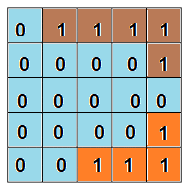
In the above figure, there are two islands coloured in brown and orange respectively.
Tony wants to build a bridge between these two islands. With the help of Friday Tony can build the bridge by changing 1 or more 0’s to 1’s. Size of the bridge is the number of 0’s changed to 1’s. Tony wants to minimize the size of the bridge as it minimizes time to reach Thanos.
For example
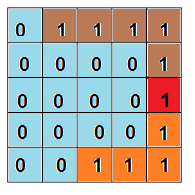
Here Bridge is marked in red colour and 1 is the minimum size of bridge possible.
Tony is busy assembling all the avengers, so he called you to solve this problem.
Problem approach
First, we did a dry run of the code. Then, they provided me with the test cases, and I wrote the code to cover all the edge cases. It took around 30 minutes to fully pass the solution, covering all the edge cases, as I hadn’t seen this question before. The interviewer was quite happy with the solution and then switched to fundamental topics like DBMS and related subjects.


Here's your problem of the day 
Solving this problem will increase your chance to get selected in this company
Skill covered: Programming
How do you remove whitespace from the start of a string?
Choose another skill to practice
Similar interview experiences
Associate Software Engineer
3 rounds | 4 problems
Interviewed by Tekion Corp
Selected 
1343 views

0 comments

0 upvotes
Associate Software Engineer
4 rounds | 11 problems
Interviewed by Tekion Corp
 Selected
 1136 views
1 comments
0 upvotes
Associate Software Engineer
4 rounds | 8 problems
Interviewed by Tekion Corp
Selected 964 views
0 comments
0 upvotes
Associate Software Engineer
2 rounds | 9 problems
Interviewed by Tekion Corp

Rejected
847 views
0 comments
0 upvotes
Companies with similar interview experiences

Associate Software Engineer
3 rounds | 10 problems
Interviewed by Amdocs
Selected 2410 views
0 comments
0 upvotes
Associate Software Engineer
3 rounds | 4 problems
Interviewed by Amdocs
 Selected
 1985 views
0 comments
0 upvotes

Associate Software Engineer
3 rounds | 5 problems
Interviewed by Optum
Selected 2176 views
0 comments
0 upvotes