





Tekion Corp interview experience Real time questions & tips from candidates to crack your interview
Associate Software Engineer
Tekion Corp


4 rounds | 7 Coding
problems
 Selected
 Interview preparation journey

Journey
So, when i came to college i was new to coding.I got to know about competitive programming and DSA from my seniors. So without wasting much more time i started learning about C++ and all related stuff. Initially i was facing a lot of problem in finding the logic of the DSA problems but slowly and gradually with a lot of practise i saw quite good improvement in my logic and problem solving skills. After that i decided to practise daily i started giving contests daily and solving at least one problem daily on Leetcode. When our campus placements started i was confident and i cracked Tekion Corp very early during our placement season.
So according to me consistency and dedication are two main keys to success.
Application story
It was on-campus so we applied directly on the college portal. The whole process was online except the HR round which was in-person with the company official who visited our campus.
Why selected/rejected for the role?
As i had done a lot of practise on different platforms so i was confident enough that i will solve any DSA question that interviewer gonna ask, so answering confidently and explaining each and every step of code i was writing helps a lot during my interview.
Preparation
Duration: 12 Months
Topics: Arrays, Strings, Graphs, DP, Trees, OOps, OS

Tip 1 : Solve atleast one problem on leetcode and practise more and more. Number of questions matters but quality matters more.
Tip 2 : try to give leetcode contests so that you got to know how real OAs happens and do upsolve them.
Tip 3 : At least 2 Projects should be there in your resume
Application process
Where: Campus
Eligibility: Above 7 CGPA was required.
Tip 1 : Atleast two projects should be there on your resume.
Tip 2 : try to mention all your achievements on your resume.

Interview rounds
01
Round
Medium
Online Coding Interview
Duration90 Minutes
Interview date24 Aug 2022
Coding problem2
So, this round is basically a coding + MCQ round which is conducted on the Hackerearth platform and consists of 2 coding questions and 8 MCQs the time allocated for this round was 90 mins.
Coding Questions: The questions asked were of medium/ hard level of difficulty.
1. Split Array
Moderate

0/80
Asked in companies



You are given an array ‘ARR’ of size ‘N’ and an integer ‘M’. You have to split the array into ‘M’ non-overlapping, non-empty subarrays such that the maximum of all the subarray’s sum is the minimum possible. Your task is to return the minimum of the maximum of all the subarray’s sum.
For example:
You are given ‘ARR’ = [7, 2, 6, 10, 8] and ‘M’ = 2. We split the array as [ 7, 2, 6] and [10, 8], the maximum of 7 + 2 + 6 and 10 + 8 is 18, which is the minimum possible.
2. Minimum Jumps
Moderate
25m average time
75% success
0/80
Asked in companies


Bob lives with his wife in a city named Berland. Bob is a good husband, so he goes out with his wife every Friday to ‘Arcade’ mall.
‘Arcade’ is a very famous mall in Berland. It has a very unique transportation method between shops. Since the shops in the mall are laying in a straight line, you can jump on a very advanced trampoline from the shop i, and land in any shop between (i) to (i + Arr[i]), where Arr[i] is a constant given for each shop.
There are N shops in the mall, numbered from 0 to N-1. Bob's wife starts her shopping journey from shop 0 and ends it in shop N-1. As the mall is very crowded on Fridays, unfortunately, Bob gets lost from his wife. So he wants to know, what is the minimum number of trampoline jumps from shop 0 he has to make in order to reach shop N-1 and see his wife again. If it is impossible to reach the last shop, return -1.
02
Round
Easy
Video Call
Duration60 Minutes
Interview date25 Aug 2022
Coding problem3
So this round was online and I have shared a zoom link I was supposed to join the meeting at the given time.
The interviewer was very calm and chill and started with a brief introduction of him and told me to introduce myself. After the introduction, he shared with me a doc link and directly jump to the first coding question.
So, after half an hour I got a mail for round – 2.
1. Populating Next Right Pointers In Each Node
Moderate
25m average time
75% success
0/80
Asked in companies



You have been given a complete binary tree of ‘N’ nodes. The nodes are numbered 1 to ‘N’.
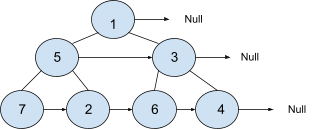
You need to find the ‘next’ node that is immediately right in the level order form for each node in the given tree.
Note :
1. A complete binary tree is a binary tree in which nodes at all levels except the last level have two children and nodes at the last level have 0 children.
2. Node ‘U’ is said to be the next node of ‘V’ if and only if  ‘U’ is just next to ‘V’ in tree representation.
3. Particularly root node and rightmost nodes have ‘next’ node equal to ‘Null’
4. Each node of the binary tree has three-pointers, ‘left’, ‘right’, and ‘next’. Here ‘left’ and ‘right’ are the children of node and ‘next’ is one extra pointer that we need to update.
For Example :
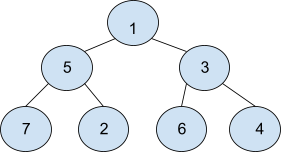
The‘next’ node for ‘1’ is ‘Null’, ‘2’ has ‘next’ node ‘6’, ‘5’ has ‘next’ node ‘3’, For the rest of the nodes check below.
Problem approach
It's important to see that the given tree is a perfect binary tree. This means that each node will always have both children and only the last level of nodes will have no children.
Now, we need to populate next pointers of each node with nodes that occur to its immediate right on the same level. This can easily be done with BFS. Since for each node, we require the right node on the same level, we will perform a right-to-left BFS instead of the standard left-to-right BFS.
Before starting the traversal of each level, we would initialize a rightNode variable set to NULL. Then, since we are performing right-to-left BFS, we would be starting at rightmost node of each level. We set the next node of cur as rightNode and update rightNode = cur. This would ensure that each node would be assigned its rightNode properly while traversing from right to left.
Also, if cur has a child, we would first push its right child and only then its left child (since we are doing right-to-left BFS). Once BFS is completed (after queue becomes empty), all next node would be populated and we can finally return root.
2. Task Scheduler
Moderate
35m average time
65% success
0/80
Asked in companies



A ninja needs to complete ‘n’ tasks. Each task is represented by an uppercase letter of the English alphabet. Different letters are assigned to different tasks. A ninja can complete tasks in any order. He takes one unit of time to complete one task. For each unit of time, he could complete either one task or just be idle.
Ninja easily gets bored by doing the same task again. So he decided to keep at least ‘t’ units of time between any two same tasks.
You are given a string ‘tasks’ consisting of ‘n’ uppercase letters of the English alphabet, representing the tasks ninja need to complete, and an integer ‘t’ representing the least units of time between any two same tasks. Find out the minimum total units of time ninja will take to complete all ‘n’ tasks.
Problem approach
The last task of type a is completed on day last[a].
Currently it takes us res day.
For the task a,
we can do it on res + 1 day,
and it need to be bigger than last[a] + space.
So this task is completed on max(res, last[a] + space) + 1.
We keep doing this for all tasks, and finally return result res
3. Course Schedule
Easy
15m average time
85% success
0/40
Asked in companies


You are a student of Netaji Subhas Institute of Technology. You have to take ‘N’ number of courses labelled from 1 to N to complete your B.Tech Degree.
Some courses may have prerequisites, for example, to take course 1 you have to first take course 2, which is expressed as a pair: [1, 2]. Now, your task is to find is it possible for you to finish all courses.
Note: There are no duplicate pairs in the prerequisites array.
For example-
If N = 2 and prerequisite = [[1, 2]]. Then, there are a total of 2 courses you need to take. To take course 1 you need to finish course 2. So, it is possible to complete all courses.
Problem approach
This problem is equivalent to detecting a cycle in the directed graph represented by prerequisites. Both BFS and DFS can be used to solve it using the idea of topological sort. Since pair is inconvenient for implementing graph algorithms, we first transform it to the adjacency-list representation. If course u is a prerequisite of course v, then the adjacency list of u will contain v.
BFS
BFS uses the indegrees of each node. We will first try to find a node with 0 indegree. If we fail to do so, there must be a cycle in the graph and we return false. Otherwise we set its indegree to be -1 to prevent from visiting it again and reduce the indegrees of its neighbors by 1. This process will be repeated for n (number of nodes) times.
03
Round
Easy
Video Call
Duration90 Minutes
Interview date25 Aug 2022
Coding problem1
So, this round was again online with a senior person working at tekion.
Initially, the interviewer told me the pattern that what he is going to ask in the whole interview.
After the introduction part, he started asking me about the projects that I mentioned in my resume and asked me everything related to them. I was not able to answer every question he asked but I answered most of them.
Then he asked me to design a database for a Hotel Management system.
I was actually not comfortable with the designing part so after 5 mins I told him that I am not comfortable with this so he said don’t worry let us move on.
He then asked me what is your strong point except for DSA.
So I told him that I Know OOPs, OS, and DBMS after that, he started asking me questions like what is synchronization,
What are process scheduling algorithms and to explain every algorithm,
How to handle deadlock, etc?
1. Subarrays With Zero Sum
Easy
0/40
Asked in companies

You are given ‘N’ integers in the form of an array ‘ARR’. Count the number of subarrays having their sum as 0.
For example :
Let ‘ARR’ be: [1, 4, -5]
The subarray [1, 4, -5] has a sum equal to 0. So the count is 1.
04
Round
Easy
HR Round
Duration10 minutes
Interview date25 Aug 2022
Coding problem1
This round was offline and was actually a general discussion round with the company official who visited our campus.
He just asked me about the 3 rounds like .
I also asked him about the fun activities happens in the company and he happily answer that.
So this round last for about 15 mins.
1. Basic HR Questions
how was your experience or how were the round goes
He also told me to give brief about the project which i had mentioned in my resume.


Here's your problem of the day 
Solving this problem will increase your chance to get selected in this company
Skill covered: Programming
How do you remove whitespace from the start of a string?
Choose another skill to practice
Similar interview experiences
Associate Software Engineer
3 rounds | 4 problems
Interviewed by Tekion Corp
Selected 
1343 views

0 comments

0 upvotes
Associate Software Engineer
4 rounds | 11 problems
Interviewed by Tekion Corp
 Selected
 1136 views
1 comments
0 upvotes
Associate Software Engineer
4 rounds | 8 problems
Interviewed by Tekion Corp
 Selected
 964 views
0 comments
0 upvotes
Associate Software Engineer
2 rounds | 9 problems
Interviewed by Tekion Corp

Rejected
847 views
0 comments
0 upvotes
Companies with similar interview experiences

Associate Software Engineer
3 rounds | 10 problems
Interviewed by Amdocs
Selected 2410 views
0 comments
0 upvotes
Associate Software Engineer
3 rounds | 4 problems
Interviewed by Amdocs
 Selected
 1985 views
0 comments
0 upvotes

Associate Software Engineer
3 rounds | 5 problems
Interviewed by Optum
Selected 2176 views
0 comments
0 upvotes