





Tekion Corp interview experience Real time questions & tips from candidates to crack your interview
Associate Software Engineer
Tekion Corp


4 rounds | 8 Coding
problems

 Selected
 Interview preparation journey

Preparation
Duration: 12 months
Topics: Every topics of DSA , OOPS, DBMS, Operating System, Computer Networks, Projects(MERN)

Tip 1 : Practice all the standard interview problems of every topic which will count upto approx 400 questions.
Tip 2 : Do atleast two good projects and also prepare them so that you can answer all the cross questions asked related to it.
Tip 3 : Study CS Fundamentals and OOPS, don't take it lightly.
Application process
Where: Campus
Eligibility: Students above 7 CGPA and of branch CSE,ECE,EE,EIE were only allowed.
Tip 1 : Make one page resume and add atleast two projects and your coding profiles skills and achievements.
Tip 2 : Do no fake out your resume it will fire back at the time of interview.

Interview rounds
01
Round
Medium
Online Coding Interview
Duration90 minutes
Interview date29 Jul 2022
Coding problem2
There were 10 MCQ questions based on CS fundamentals and OOPS and 2 coding questions based on data structures and algorithms. It was on HackerEarth platform and the timing of the test was from 4 pm to 6.30 pm there was no slot. The camera and tab change proctoring were there.
1. Split the given array into K sub-arrays
Hard
15m average time
85% success

0/120
Asked in companies


You’re given an array 'arr' of size 'n' and an integer 'k'.
Your task is to split 'arr' into 'k' sub-arrays such that the maximum sum achieved from the 'k' subarrays formed must be the minimum possible.
A subarray is a contiguous part of the array.
Return the minimum possible value of the maximum sum obtained after splitting the array into 'k' partitions.
Example:
Input: ‘arr’ = [1, 1, 2] and ‘k’ = 2

Output: 2

Explanation: If we want to make two subarrays, there are two possibilities: [[1], [1, 2]] and [[1, 1], [2]]. We can see that the maximum sum of any subarray is minimized in the second case. Hence, the answer is 2, which is the maximum sum of any subarray in [[1, 1], [2]].
2. Minimum Robot Moves
Easy
0/40
Asked in companies

A robot can move along the x-axis, it starts from the origin and wants to reach the ‘X’ coordinate. Find the number of moves it requires to complete the task.
In each move, it has to exactly move some units to the left/right of its current position. The number of units it moves in a move is equal to the move number. That is: it moves exactly one unit in move - 1, exactly two units in move - 2 and exactly ten units in move - 10. Find the minimum number of moves required to reach the ‘X’ coordinate. Print ‘-1’ if it is not possible to reach the location.
For Example :
If X = 6

If all three moves are taken to the right then the robot will end up at 1 + 2 + 3 = 6, so a minimum of three moves are needed.
02
Round
Medium
Video Call
Duration60 minutes
Interview date3 Aug 2022
Coding problem3
The round was scheduled around 10 AM in the morning and the interviewer was quite friendly and cooperative in nature and also gave hints of the coding problem asked by him, the interview was taken on google meet and coding question was explained on google docs. The interview lasted for 60 minutes.
1. Construct BST from Preorder Traversal
Moderate
13m average time
0/80
Asked in companies


You are given a preorder traversal of a binary search tree. Your task is to find the postorder from the preorder.
Return the root of the BST constructed from the given preorder. The driver code will then use this root to print the post-order traversal.
For example:
You are given preOrder = [10, 5, 1, 7, 40, 50], the binary search tree from the given preorder traversal is
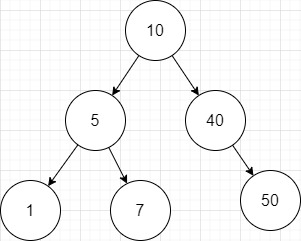
Hence the answer is [1, 7, 5, 50, 40, 10].
Problem approach
Intution
Since it is preorder traversal of bst the first element will be root node and all the smaller than root node will be in the left subtree and all the larger once will be in the right subtree.So we will use the above logic and construct the tree recursively and the time complexity will be O(N).
We follow the following steps
1> we create the node
2> we traverse the array for values that are less than the current node these values will become our left subtree. we stop whenever we get a value larger than the current root of the subtree.
3> we take the rest of the array (values that are greater than the value of the current root)-these are the values that will make out the right subtree!
so recursively we make a root!
make the left subtree(recursively)
then make right subtree(recursively)
2. OS Questions
Difference between process and thread.
Scheduling Algorithms.
Deadlocks.
Semaphore and Mutex.
Static and Dynamic Binding
Page fault and Demand Paging.
Problem approach
Tip 1 : Prepare well for OS from an article or youtube video.
Tip 2 : Go through the most asked OS questions articles available on the internet.
Tip 3 : since this is a theoretical subject revise thoroughly.
3. DBMS Questions
Normalization and its types.
Transactions.
ACID properties of DBMS.
Problem approach
Tip 1 : Prepare well for DBMS from an article or youtube video.
Tip 2 : Go through the most asked DBMS questions articles available on the internet.
Tip 3 : since this is a theoretical subject revise thoroughly.
03
Round
Medium
Video Call
Duration40 minutes
Interview date3 Aug 2022
Coding problem2
The round was scheduled around 12 PM in the afternoon and the interviewer was quite friendly and cooperative in nature and also gave hints of the coding problem asked by him, the interview was taken on google meet and coding question was explained on google docs. The interview lasted for 60 minutes.
1. Maximum Subarray Sum
Moderate
25m average time
75% success
0/80
Asked in companies



Given an array of numbers, find the maximum sum of any contiguous subarray of the array.
For example, given the array [34, -50, 42, 14, -5, 86], the maximum sum would be 137, since we would take elements 42, 14, -5, and 86.
Given the array [-5, -1, -8, -9], the maximum sum would be -1.
Follow up: Do this in O(N) time.
Problem approach
step 1 – I first gave him a brute force approach like checking for all subarray and taking the maximum sum, it was a O(N^2) approach.
step 2 -- then I moved to optimized approach and told him the pretty standard kadane algorithm which is a O(N) time complexity and also I was able to code it quickly.
2. Find K-th smallest Element in BST
Easy
15m average time
85% success
0/40
Asked in companies



Given a binary search tree and an integer ‘K’. Your task is to find the ‘K-th’ smallest element in the given BST( binary search tree).
BST ( binary search tree) -
If all the smallest nodes on the left side and all the greater nodes on the right side of the node current node.
Example -

Order of elements in increasing order in the given BST is - { 2, 3, 4, 5, 6, 7, 8, 10 }
Suppose given ‘K = 3’ then 3rd smallest element is ‘4’.
Suppose given ‘K = 8’ then 8th smallest element is ‘10’.
Note:
1. You are not required to print the output explicitly, it has already been taken care of. Just implement the function and return the ‘K-th’ smallest element of BST.
2. You don’t need to return ‘K-th’ smallest node, return just value of that node.
3. If ‘K-th’ smallest element is not present in BST then return -1.
Problem approach
Step 1 -- since it is a bst and preorder traversel of bst is in sorted order so by using an extra space we can easily store the preorder traversal of the bst and return the kth element .
Now he told me to do it without using extra space. So for this optimization
Step 2 -- the simplest logic is to do reverse inorder traversal and while doing reverse inorder traversal simply keep a count of the number of Nodes visited. When the count becomes equal to k, we stop the traversal and print the data. It uses the fact that reverse inorder traversal will give us a list sorted in descending order.
04
Round
Easy
HR Round
Duration30 minutes
Interview date3 Aug 2022
Coding problem1
the timing of the round was approx 3 PM and it was conducted on google meet it was just more like a discussion round and some standard hr questions.the interviewer seemed very polite and humble.
1. Basic HR Questions
The interviewer greeted me and asked me how was my day.
It was more like a discussion rather than an Interview.
she started with the standard question, Tell me about yourself.
I had already prepared answers for 2-3 types of HR round introduction and Behavioral questions. So I was able to give him a short, precise, and to-the-point Introduction of mine.
She also asked me how much I am aware of the company like what the company does etc.
Then she moved on to the Projects that I had mentioned on my resume,
I told about 1-2 Projects which I did until now and briefly explained all of them.
Then she asked me if I had any questions for him.
I asked a few questions, and she was happy to answer.
Problem approach
Tip 1 : Prepare some standard HR questions available on various websites.
Tip 2 : revise your projects mentioned in the resume.
Tip 3 : Do proper communication and be confident throughout the discussion and be honest about every answer.


Here's your problem of the day 
Solving this problem will increase your chance to get selected in this company
Skill covered: Programming
Providing input/output examples in your prompt is a technique called:
Choose another skill to practice
Similar interview experiences
Associate Software Engineer
2 rounds | 5 problems
Interviewed by Tekion Corp
Selected 
3626 views

0 comments

0 upvotes
Associate Software Engineer
3 rounds | 4 problems
Interviewed by Tekion Corp
Selected 1403 views
0 comments
0 upvotes
Associate Software Engineer
4 rounds | 11 problems
Interviewed by Tekion Corp
 Selected
 1178 views
1 comments
0 upvotes
Associate Software Engineer
2 rounds | 9 problems
Interviewed by Tekion Corp

Rejected
913 views
0 comments
0 upvotes
Companies with similar interview experiences

Associate Software Engineer
3 rounds | 10 problems
Interviewed by Amdocs
Selected 2493 views
0 comments
0 upvotes
Associate Software Engineer
3 rounds | 4 problems
Interviewed by Amdocs
 Selected
 2070 views
0 comments
0 upvotes

Associate Software Engineer
3 rounds | 5 problems
Interviewed by Optum
Selected 2277 views
0 comments
0 upvotes