





Teradata interview experience Real time questions & tips from candidates to crack your interview
SDE - 1
Teradata


1 rounds | 3 Coding
problems

Rejected
Interview preparation journey

Journey
I applied for the role through the on-campus placement portal at IIT Guwahati. My journey began in August, with a strong focus on DSA and core computer science subjects. The process started with a rigorous Online Assessment (OA), which included sections on coding, math/aptitude, and CS fundamentals.
Application story
I applied through an on-campus opportunity. The OA was conducted at night. I prepared for DSA, graph, and tree questions from coding platfroms
Why selected/rejected for the role?
I was rejected at the interview, as the questions were of a higher difficulty level, so I couldn’t qualify for the further rounds.
Preparation
Duration: 3 - 4 months
Topics: Data Structures, pointers, OOPs, system design, algorithms, dynamic programming

Tip 1: Practice at least 250 questions.
Tip 2: Do at least 2 projects.
Tip 3: Practice company's past OA questions, if available.
Application process
Where: Campus
Eligibility: No criteria, (Salary Package - 18 LPA)
Tip 1: Have some projects on your resume.
Tip 2: Do not include false information on your resume.

Interview rounds
01
Round
Hard
Online Coding Test
Duration105 minutes
Interview date7 Oct 2025
Coding problem3
1. Distribute N candies among K people
Easy
15m average time
85% success

0/40
Asked in companies



Sanyam has ‘N’ candies, he wants to distribute that into ‘K’ of his friends. He made his ‘K’ friends stand in line, in increasing order of his likeness. Not being so smart he gives 1 candy to the first friend, 2 to the second person, and so on till the kth person. In the next turn, the first person gets ‘K + 1’ candies, the second person gets ‘K + 2’ candies, and so on.
While distributing the candies, if at a turn, the number of candies to be given to a friend is less than the required candies, then that friend gets all the remaining candies and Sanyam stops the distribution.
Your task is to find the total number of candies every person has at the end.
Problem approach
Binary Search for Full Rounds: The total number of candies k can be very large (1014). Instead of simulating, use binary search to find the maximum number of full rounds R you can complete. A round is "full" if you can give 1 candy to every animal that still needs one.
Calculate Remaining Candies: After R full rounds, some animals are "finished" (if ai≤R). Subtract the candies eaten in these R rounds from k.
Final Simulation: With the remaining k′ candies (where k′< number of active animals), iterate through the animals one last time. If an animal still needs candies, give it one and decrement k′. Once k′ reaches zero, the current animal is finished; output the indices of all other animals that still need more than R candies (or R+1 if they were already passed in this last partial round).
2. Check If Binary Representation of a Number is Palindrome
Easy
15m average time
80% success
0/40
Asked in companies


Ninja is given an integer ‘N’. Ninja wants to find whether the binary representation of integer ‘N’ is palindrome or not.
A palindrome is a sequence of characters that reads the same backward as forward.
Ninja is busy with his training. Help Ninja in finding out whether the binary representation of ‘N’ is palindrome or not.
Problem approach
Generate Candidate Palindromes: A binary palindrome of length L is determined by its first ⌈L/2⌉ bits. Since N can be up to 1018 (approx 60 bits), generate palindromes of length len(N)−1, len(N), and len(N)+1.
Constructing from Prefix: For a fixed length L, take the first half of N's binary representation. Create three palindromes by:
Using the prefix as is.
Subtracting 1 from the prefix.
Adding 1 to the prefix.
(This covers the closest values numerically).
Find Minimum Difference: Convert these binary candidates back to decimals. Calculate the absolute difference with N and pick the one with the smallest difference.
3. Count elements in all subtrees
Easy
10m average time
90% success
0/40
Asked in companies



You are given an arbitrary tree consisting of 'N' nodes numbered from 0 to 'N' - 1. You need to find the total number of elements in all the subtrees of the given tree. In other words, given a generic tree, find the count of elements in the subtrees rooted at each node.
A subtree of a tree T is a tree S consisting of a node in T and all of its descendants in T. The subtree corresponding to the root node is the entire tree. For better understanding, refer to the image below:-
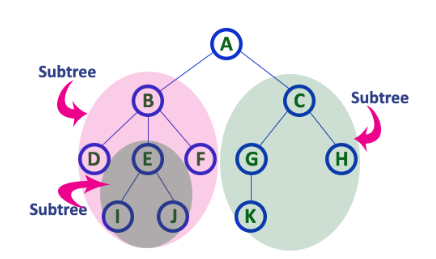
Note:
1. The tree will always be rooted at 0.
2. You can return the count of nodes in any order.
3. The root of any subtree is also counted in the subtree thus the count of nodes in a subtree rooted at a leaf node is
4. You can return the numbers in any order.
Problem approach
Identify Heavy/Light Children: For each node, find the "heavy" child (the child with the largest subtree size). All other children are "light."
The "DSU on Tree" Logic:
Recursively solve for all light children but clear their data (e.g., map or frequency array) after solving.
Recursively solve for the heavy child and keep its data.
Iterate through all light children again, adding their subtree values into the heavy child's existing data.
Answer the Query: Now the data structure contains all the info for node u's subtree. Store the answer for node u. By keeping the heavy child's data, you ensure each node is added to a data structure at most O(logN) times.


Here's your problem of the day 
Solving this problem will increase your chance to get selected in this company
Skill covered: Programming
How do you remove whitespace from the start of a string?
Choose another skill to practice
Similar interview experiences
SDE - 1
4 rounds | 6 problems
Interviewed by Teradata

 Selected
0 views

0 comments

0 upvotes

SDE - 1
3 rounds | 7 problems
Interviewed by OYO
Selected 6182 views
0 comments
0 upvotes

SDE - 1
3 rounds | 9 problems
Interviewed by Salesforce
Selected 4552 views
0 comments
0 upvotes
SDE - 1
2 rounds | 3 problems
Interviewed by Teradata
Rejected
145 views
0 comments
0 upvotes
Companies with similar interview experiences

SDE - 1
5 rounds | 12 problems
Interviewed by Amazon
 Selected
 117552 views
24 comments
0 upvotes

SDE - 1
4 rounds | 5 problems
Interviewed by Microsoft
Selected 60143 views
5 comments
0 upvotes
SDE - 1
3 rounds | 7 problems
Interviewed by Amazon
 Selected
 36138 views
7 comments
0 upvotes