





Texas Instruments interview experience Real time questions & tips from candidates to crack your interview
SDE - Intern
Texas Instruments


3 rounds | 7 Coding
problems

 Selected
 Interview preparation journey

Preparation
Duration: 3 Months
Topics: Dynamic Programming, Greedy Techniques, Data Structures, OOPs, DBMS, Graph Theory

Tip 1 : Prepare OS,DBMS,OOPs too
Tip 2 : Mention atleast one project or past work experience in your resume
Tip 3 : Try maintaining 8+ CGPA as sometimes shortlist is done based on CGPA
Tip 4 : Try past interview questions from Coding Ninjas Site.
Application process
Where: Campus
Eligibility: Above 7.5 CGPA
Tip 1 : Try to Keep Resume 1 Pager
Tip 2 : Have atleast one project or past work experience mentioned
Tip 3 : Don't put false things on Resume as questions are asked in detail from Resume

Interview rounds
01
Round
Medium
Online Coding Test
Duration45 minutes
Interview date21 Apr 2021
Coding problem2
The first Round was held on Hackerrank and the questions were of medium difficulty based on Data Structures and Algorithms.
The time of test was 1:00 PM and it was of 45 minutes with 2 coding questions to be solved.
1. Josephus
Moderate
30m average time
70% success

0/80
Asked in companies



‘N’ people are standing in a circle numbered from ‘1’ to ‘N’ in clockwise order. First, the person numbered 1 will proceed in a clockwise direction and will skip K-1 persons including itself and will kill a Kth person. Now (K+1)th person from 1 will start and will kill the Kth person from itself.
You have to find the position of the last person surviving with respect to initial numbering.
Note:
A person can also kill himself.
2. Meetings II
Moderate
10m average time
90% success
0/80
Asked in companies



Stark Industry is planning to organize Stark Expo, for which various departments have to organize meetings to check their preparations. Since Stark Tower has limited rooms available for the meeting, Tony decided to allot a room to each meeting so that all the meetings are organized in the least possible conference rooms, and a the moment, only one meeting will happen in one room. So, he asked JARVIS to allot each meeting a room and tell the minimum number of conference rooms to be reserved. But, since JARVIS was busy rendering another Iron Man suit model, he asked you to help.
You are given an array of integers ARR of size N x 2, representing the start and end time for N meetings. Your task is to find the minimum number of rooms required to organize all the meetings.
Note:
1. You can assume that all the meetings will happen on the same day.
2. Also, as soon as a meeting gets over if some other meeting is scheduled to start at that moment, they can then be allocated that room.
Note:
Try to solve the problem in linear time complexity.
For Example:
Consider there are three meetings scheduled with timings:
1pm - 4pm
3pm - 5pm
4pm - 6pm

At the start of time, meeting 1 will be allotted room 1, which will be occupied till 4 pm hence for meeting 2 we’ll have to provide another room. At 4 pm, meeting 3 can be organized in room 1 because by that time, meeting 1 would have ended. Hence we’ll require two rooms for holding all three meetings.
02
Round
Medium
Coding Test - Pen and paper
Duration75 minutes
Interview date26 Apr 2021
Coding problem2
A google Doc was shared with us and we were supposed to write code there.
Use of IDEs was not allowed so we had to write correct code on Google Docs which was later checked by them through online IDEs.
The Interviewer were friendly and observative and helped us through code if we made some silly error.
1. Snake and Ladder
Moderate
30m average time
60% success
0/80
Asked in companies


You have been given a Snake and Ladder Board with 'N' rows and 'N' columns with the numbers written from 1 to (N*N) starting from the bottom left of the board, and alternating direction each row.
For example
For a (6 x 6) board, the numbers are written as follows:
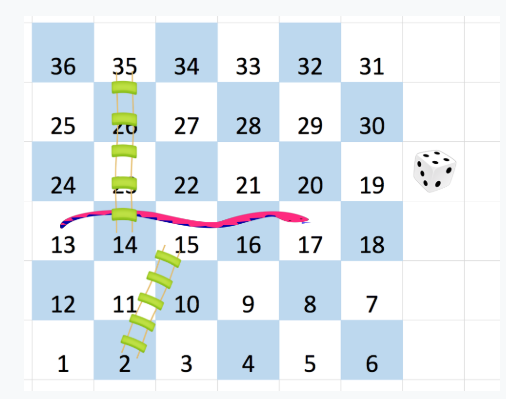
You start from square 1 of the board (which is always in the last row and first column). On each square say 'X', you can throw a dice which can have six outcomes and you have total control over the outcome of dice throw and you want to find out the minimum number of throws required to reach the last cell.
Some of the squares contain Snakes and Ladders, and these are possibilities of a throw at square 'X':
You choose a destination square 'S' with number 'X+1', 'X+2', 'X+3', 'X+4', 'X+5', or 'X+6', provided this number is <= N*N.
If 'S' has a snake or ladder, you move to the destination of that snake or ladder.  Otherwise, you move to S.
A board square on row 'i' and column 'j' has a "Snake or Ladder" if board[i][j] != -1. The destination of that snake or ladder is board[i][j].
Note :
You can only take a snake or ladder at most once per move: if the destination to a snake or ladder is the start of another snake or ladder, you do not continue moving - you have to ignore the snake or ladder present on that square.

For example, if the board is:
-1 1 -1
-1 -1 9
-1 4 -1
Let's say on the first move your destination square is 2  [at row 2, column 1], then you finish your first move at 4 [at row 1, column 2] because you do not continue moving to 9 [at row 0, column 0] by taking the ladder from 4.

A square can also have a Snake or Ladder which will end at the same cell.
For example, if the board is:
-1 3 -1
-1 5 -1
-1 -1 9
Here we can see Snake/Ladder on square 5 [at row 1, column 1] will end on the same square 5.
2. Largest rectangle in a histogram
Hard
25m average time
75% success
0/120
Asked in companies


You have been given an array/list 'HEIGHTS' of length ‘N. 'HEIGHTS' represents the histogram and each element of 'HEIGHTS' represents the height of the histogram bar. Consider that the width of each histogram is 1.
You are supposed to return the area of the largest rectangle possible in the given histogram.
For example :
In the below histogram where array/list elements are {2, 1, 5, 6, 2, 3}.
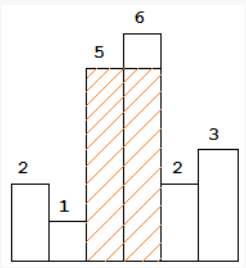
The area of largest rectangle possible in the given histogram is 10.
03
Round
Easy
Face to Face
Duration60 minutes
Interview date29 Apr 2021
Coding problem3
The face to face round was held on Google Meet where initially Interviewer asked a DS/Algo problem and then Later Manager Joined and asked about our resume projects in detail.
The time was 10:00 AM
1. Maximum sum rectangle
Hard
25m average time
70% success
0/120
Asked in companies

You are given an M X N matrix of integers ARR. Your task is to find the maximum sum rectangle.
Maximum sum rectangle is a rectangle with the maximum value for the sum of integers present within its boundary, considering all the rectangles that can be formed from the elements of that matrix.
A rectangle is a 2-D polygon with opposite sides parallel and equal to each other.
For example:
Consider following matrix:

 1  2 -1 -4 -20
-8 -3  4  2   1
 3  8  10 1   3
-4 -1  1  7  -6

The rectangle (1,1) to (3,3) is the rectangle with the maximum sum, i.e. 29.

 1   2 -1 -4  -20
-8 |-3  4  2 |  1
 3 | 8  10 1 |  3
-4 |-1  1  7 | -6
2. XOR Query
Moderate
10m average time
90% success
0/80
Asked in companies

Assume you initially have an empty array say ‘ARR’.
You need to return the updated array provided that some ‘Q’ number of queries were performed on this array.
The queries are of two types:
1. 1 ‘VAL’, for this type of query, you need to insert the integer 'VAL' to the end of the array.
2. 2 ‘VAL’, for this type of query, you need to take the bitwise XOR of all the elements of the array with 'VAL' i.e each element of the array ‘ARR’ will be updated as ‘ARR[i]’ = ‘ARR[i]’ ^ ‘VAL’ ( ^ denotes the bitwise XOR operation).
Note:
1) Bitwise XOR operation takes two numbers and performs XOR operation on every bit of those two numbers. For example, consider two numbers 2 and 3 their bitwise XOR will be 1. Because the binary representation of 2 is '10' and the binary representation of 3 is '11'. And XOR of '10' and '11' will be '01'(because XOR evaluates to 0 if the corresponding bits are the same in both the operands, otherwise it evaluates to 1), which is equal to 1.

2) The first query will always be a type 1 query.

3) Note that the ith query should be performed on the array obtained after performing (i-1)th query on the array and so on i.e the changes of each query are updated on the original array itself.
3. Basic HR Questions
Tell one incident when you were not able to cooperate with your team member and how did you work together.
Why Texas Instrument , which is a Semiconductor Company ?


Here's your problem of the day 
Solving this problem will increase your chance to get selected in this company
Skill covered: Programming
How do you remove whitespace from the start of a string?
Choose another skill to practice
Similar interview experiences
Analog technology Development
3 rounds | 3 problems
Interviewed by Texas Instruments
Selected 
1697 views

0 comments

0 upvotes

SDE - 1
3 rounds | 7 problems
Interviewed by OYO
Selected 6182 views
0 comments
0 upvotes

SDE - 1
2 rounds | 5 problems
Interviewed by Meesho
Rejected
7246 views
0 comments
0 upvotes

SDE - 1
3 rounds | 9 problems
Interviewed by Salesforce
 Selected
 4552 views
0 comments
0 upvotes
Companies with similar interview experiences
SDE - Intern
3 rounds | 6 problems
Interviewed by Amazon

Rejected
16213 views
4 comments
0 upvotes

SDE - Intern
4 rounds | 7 problems
Interviewed by Microsoft
 Selected
 16224 views
1 comments
0 upvotes
SDE - Intern
2 rounds | 4 problems
Interviewed by Amazon
Selected 10541 views
2 comments
0 upvotes