





Truminds Software Systems interview experience Real time questions & tips from candidates to crack your interview
SDE - 1
Truminds Software Systems


3 rounds | 6 Coding
problems

 Selected
 Interview preparation journey

Preparation
Duration: 3 Months
Topics: Data Structures, OOPS,Algorithms, DBMS,Computer Networks, Operating Systems

Tip 1 : Practice at least 300 questions.
Tip 2 : Do at least 2 projects to discuss during the interview.
Tip 3 : Have a good grasp of what is written on the resume.
Application process
Where: Campus
Eligibility: 7 CGPA
Tip 1 : Have some good projects on your resume (Minimum 2) and you should know each and every single detail about the project.
Tip 2 : Don't fake on resume and be true.

Interview rounds
01
Round
Easy
Online Coding Interview
Duration90 Minutes
Interview date10 Jan 2022
Coding problem1
This round is online OA Round contains 20 MCQ's and 2 Medium-Hard Coding Question.
1. Sliding Maximum
Moderate
25m average time
85% success

0/80
Asked in companies



You are given an array 'ARR' of integers of length 'N' and a positive integer 'K'. You need to find the maximum elements for each and every contiguous subarray of size K of the array.
For example
'ARR' =  [3, 4, -1, 1, 5] and 'K' = 3
Output =  [4, 4, 5]

Since the maximum element of the first subarray of length three ([3, 4, -1]) is 4, the maximum element of the second subarray of length three ([4, -1, 1]) is also 4 and the maximum element of the last subarray of length three ([-1, 1, 5]) is 5, so you need to return [4, 4, 5].
Problem approach
So this problem can be solved using Heap.
I have created max Heap of pair in C++. The first pair will be the element and the second will be the index of that element in the given array.
Then I used the sliding window technique.Firstly I have inserted the elements in the heap till their size is < k. As soon as its size becomes >= k then I am taking out its top.first element (Max element in case of the max heap) and insert it to output vector and then pop out the elements which are of no use that is not there in the current slide.
This way I did this problem.
02
Round
Easy
Video Call
Duration60 Minutes
Interview date13 Jul 2022
Coding problem2
It is a 1-hour interview and in the beginning, asked to introduce then there is a discussion about the projects there in the resume and then 2 easy-level DSA questions were asked.
1. Cycle Detection in a Singly Linked List
Moderate
15m average time
80% success
0/80
Asked in companies



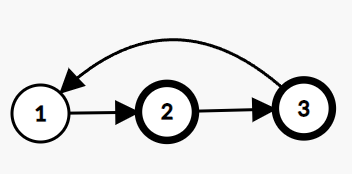
You are given a Singly Linked List of integers. Return true if it has a cycle, else return false.
A cycle occurs when a node's next points back to a previous node in the list.
Example:
In the given linked list, there is a cycle, hence we return true.
Problem approach
Here I have used a slow and fast pointer approach.
The idea is to have 2 pointers: slow and fast. Slow pointer takes a single jump and corresponding to every jump slow pointer takes, fast pointer takes 2 jumps. If there exists a cycle, both slow and fast pointers will reach the exact same node. If there is no cycle in the given linked list, then fast pointer will reach the end of the linked list well before the slow pointer reaches the end or null.
Initialize slow and fast at the beginning.
Start moving slow to every next node and moving fast 2 jumps, while making sure that fast and its next is not null.
If after adjusting slow and fast, if they are referring to the same node, there is a cycle otherwise repeat the process
If fast reaches the end or null then the execution stops and we can conclude that no cycle exists.
2. Find Number Of Islands
Moderate
34m average time
60% success
0/80
Asked in companies



You are given a 2-dimensional array/list having N rows and M columns, which is filled with ones(1) and zeroes(0). 1 signifies land, and 0 signifies water.
A cell is said to be connected to another cell, if one cell lies immediately next to the other cell, in any of the eight directions (two vertical, two horizontal, and four diagonals).
A group of connected cells having value 1 is called an island. Your task is to find the number of such islands present in the matrix.
Problem approach
In this question, we have to find the number of islands. So I just simply applied the DFS from any 1 in the 2D matrix and mark visited in the visited matrix and keep the counter on each DFS call.
03
Round
Easy
Video Call
Duration45 minutes
Interview date15 Jun 2022
Coding problem3
It was again an interview with the manager and He first ask me to introduce myself and then asked about the projects there in my resume. This interview was a general discussion with the manager.He asked me some OS, DBMS,Computer Networks questions, and 2 easy DS questions.
1. Operating System Based Questions
What is IPC? What is the different IPC mechanisms?
Problem approach
Tip 1 : Read Galvin for OS thoroughly
2. DBMS Questions
Mention the issues with traditional file-based systems that make DBMS a better choice?
3. DBMS Question
What is meant by ACID properties in DBMS?


Here's your problem of the day 
Solving this problem will increase your chance to get selected in this company
Skill covered: Programming
How do you remove whitespace from the start of a string?
Choose another skill to practice
Similar interview experiences

SDE - 1
3 rounds | 7 problems
Interviewed by OYO
Selected 
6182 views

0 comments

0 upvotes
Software Developer
3 rounds | 5 problems
Interviewed by Truminds Software Systems
 Selected
 589 views
0 comments
0 upvotes

SDE - 1
2 rounds | 5 problems
Interviewed by Meesho
Rejected
7245 views
0 comments
0 upvotes

SDE - 1
3 rounds | 9 problems
Interviewed by Salesforce
 Selected
 4552 views
0 comments
0 upvotes
Companies with similar interview experiences

SDE - 1
2 rounds | 3 problems
Interviewed by BNY Mellon
 Selected
 6786 views
3 comments
0 upvotes
SDE - 1
3 rounds | 6 problems
Interviewed by BNY Mellon
Selected 0 views
0 comments
0 upvotes

SDE - 1
3 rounds | 5 problems
Interviewed by CIS - Cyber Infrastructure
Selected 2418 views
0 comments
0 upvotes