





Twilio interview experience Real time questions & tips from candidates to crack your interview

SDE - 1
Twilio


2 rounds | 6 Coding
problems

Rejected
Interview preparation journey

Journey
I was admitted to DTU college in the computer science stream. I was advised by my seniors to practice DSA from the very start of B.Tech, and I did not take that seriously. Honestly speaking, I regretted not taking their advice and in the third year I started coding, and I had to increase practice hours because I started late.
Application story
I applied for the post through the campus drive. After applying I practiced hard for it and the hardwork paid off at the last.
Why selected/rejected for the role?
I think I was on point with my coding solutions to the questions asked in the interviews. I did not able to provide the optimal solutions and I was giving correct explanations to some theory questions asked.
Preparation
Duration: 4 months
Topics: Data Structures, Pointers, OOPS, System Design, Algorithms, Dynamic Programming

Tip 1 : Even if you are stuck in the problem, just give a try. The interviewer will help you definitely for sure.
Tip 2 : Prepare Data Structures and Algorithms well. They mostly check our Problem Solving ability to find the solutions for the real world problems.
Tip 3 : Be enough confident, don't be nervous. Maintain atleast 2 projects in your resume
Application process
Where: Campus
Eligibility: Above 7 CGPA
Tip 1 : Mention atleast 2 projects.
Tip 2 : Mention your skills in which you are perfect.
Tip 3 : It should not be too long or too short

Interview rounds
01
Round
Easy
Video Call
Duration90 minutes
Interview date14 Oct 2022
Coding problem3
1. Rotate matrix by 90 degrees
Easy
15m average time
85% success

0/40
Asked in companies



You are given a square matrix of non-negative integers 'MATRIX'. Your task is to rotate that array by 90 degrees in an anti-clockwise direction using constant extra space.
For example:
For given 2D array :

    [    [ 1,  2,  3 ],
         [ 4,  5,  6 ],
         [ 7,  8,  9 ]  ]

After 90 degree rotation in anti clockwise direction, it will become:

    [   [ 3,  6,  9 ],
        [ 2,  5,  8 ],
        [ 1,  4,  7 ]   ]
Problem approach
You are given a square matrix of non-negative integers 'MATRIX'. Your task is to rotate that array by 90 degrees in an anti-clockwise direction using constant extra space.
2. Operating System Questions
What are semaphores?
What is memory management unit?
Problem approach
The Memory Management Unit (MMU) is responsible for the translation of virtual addresses used by software to physical addresses used in the memory system.
3. Game of Stones
Easy
15m average time
85% success
0/40
Asked in companies



Given the count of total stones in a game. Two-player ‘Ale’ and ‘Bob’ are playing the game. Your task is to find who will win the game if both the players are playing optimally.
Rules of the game.
1. In a single turn, a player can choose a single stone or ‘even’ number of stones.
2. They will play alternatively, which means in the first chance ‘Ale’ will collect the stones, in second-chance ‘Bob’ will collect the stones. And always ‘Ale’ will start the game.
3. If any player is not able to take any stones then another player will win the game.
Problem approach
Given the count of total stones in a game. Two-player ‘Ale’ and ‘Bob’ are playing the game. Your task is to find who will win the game if both the players are playing optimally.
Rules of the game.
1. In a single turn, a player can choose a single stone or ‘even’ number of stones.
2. They will play alternatively, which means in the first chance ‘Ale’ will collect the stones, in second-chance ‘Bob’ will collect the stones. And always ‘Ale’ will start the game.
3. If any player is not able to take any stones then another player will win the game.
02
Round
Medium
Video Call
Duration90 minutes
Interview date14 Oct 2022
Coding problem3
1. Sum Of Squares Of First N Natural Numbers
Easy
15m average time
85% success
0/40
Asked in companies


You are given an integer 'N'. You need to find the sum of squares of the first 'N' natural numbers.
For example:
If 'N' = 4. You need to return 1^2 + 2^2 + 3^2 + 4^2 = 30.
Problem approach
You are given an integer 'N'. You need to find the sum of squares of the first 'N' natural numbers.
2. Largest Number in Binary Tree
Moderate
36m average time
60% success
0/80
Asked in companies

You have been given a Binary Tree of 'N' nodes where the nodes have integer values.
Your task is to find the largest number that could be formed by concatenating all its nodes values.
For example:
For the given binary tree:
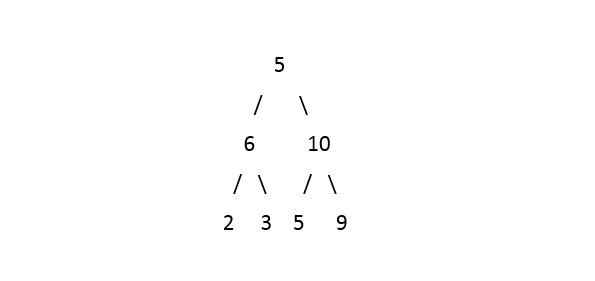
Output: 96553210

Explanation: After concatenating all the numbers in the above binary tree this is the largest number that can be formed.
Problem approach
You have been given a Binary Tree of 'N' nodes where the nodes have integer values.
Your task is to find the largest number that could be formed by concatenating all its nodes values.
3. Bridges In A Graph
Moderate
25m average time
65% success
0/80
Asked in companies



Given an undirected graph of V vertices and E edges. Your task is to find all the bridges in the given undirected graph. A bridge in any graph is defined as an edge which, when removed, makes the graph disconnected (or more precisely, increases the number of connected components in the graph).
For Example :
If the given graph is :
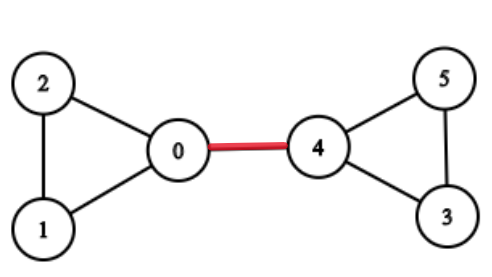
Then the edge between 0 and 4 is the bridge because if the edge between 0 and 4 is removed, then there will be no path left to reach from 0 to 4.and makes the graph disconnected, and increases the number of connected components.
Note :
There are no self-loops(an edge connecting the vertex to itself) in the given graph.

There are no parallel edges i.e no two vertices are directly connected by more than 1 edge.
Problem approach
Given an undirected graph of V vertices and E edges. Your task is to find all the bridges in the given undirected graph. A bridge in any graph is defined as an edge which, when removed, makes the graph disconnected (or more precisely, increases the number of connected components in the graph).


Here's your problem of the day 
Solving this problem will increase your chance to get selected in this company
Skill covered: Programming
How do you remove whitespace from the start of a string?
Choose another skill to practice
Similar interview experiences
SDE - 1
2 rounds | 5 problems
Interviewed by Twilio
Rejected

923 views

0 comments

0 upvotes
SDE - 1
2 rounds | 5 problems
Interviewed by Twilio
Rejected
961 views
0 comments
0 upvotes
SDE - 1
2 rounds | 5 problems
Interviewed by Twilio

Rejected
773 views
0 comments
0 upvotes
SDE - 1
3 rounds | 6 problems
Interviewed by Twilio
Rejected
612 views
0 comments
0 upvotes
Companies with similar interview experiences

SDE - 1
5 rounds | 12 problems
Interviewed by Amazon

 Selected
 117552 views
24 comments
0 upvotes
SDE - 1
4 rounds | 5 problems
Interviewed by Microsoft
Selected 60143 views
5 comments
0 upvotes
SDE - 1
3 rounds | 7 problems
Interviewed by Amazon
 Selected
 36138 views
7 comments
0 upvotes