





UiPath interview experience Real time questions & tips from candidates to crack your interview
Software Engineer Intern
UiPath


3 rounds | 6 Coding
problems

Rejected
Interview preparation journey

Journey
I started coding after getting into college. Until then, I had no idea about programming at all. It's helpful to reach out to your seniors for advice on what matters most after entering college, as they have already gone through the same experience. Of course, each senior will have different opinions, but you need to be smart enough to make decisions about what’s right for you!
Application story
It was an on-campus opportunity, so, similar to other companies, if you are eligible, you are free to apply for the role. Once you apply, you will have to go through the hiring process.
Why selected/rejected for the role?
I was rejected in the hiring manager round. I don't know the exact reason for not being selected, but I think the objective of this round may not have been to solve or not solve the problem. I believe they were checking communication skills and the way I explained things.
Preparation
Duration: 6 Months
Topics: OOP, DBMS, Networks, Operating Systems, DSA, HLD

Tip 1: Practice makes a man perfect, so keep practicing rather than dreaming or imagining.
Tip 2: Theoretical topics should be picked just before the interviews, i.e., at the end of your preparation journey.
Tip 3: Keep participating in contests on competitive programming platforms. Never cheat yourself while preparing.
Application process
Where: Campus
Eligibility: Eligible Branches: Open to all pre-final year BTech students. CPI Cut-off: Greater than 7. (Salary: 16.5 LPA)
Tip 1: Don’t fake anything, because most interviewers will open your CV in front of you and iterate over all the topics.
Tip 2: Don’t make any blunders, such as spelling or grammar mistakes. There are many tools available, so it’s expected that you don’t make mistakes here.
Tip 3: Keep it to a single page.
Tip 4: Never create your CV in one go; keep iterating and fine-tuning it until it's final.

Interview rounds
01
Round
Medium
Online Coding Interview
Duration60 minutes
Interview date5 Aug 2022
Coding problem3
This round didn’t have any MCQs; there were only 3 CP questions.
1. Find all occurrences
Moderate
35m average time
60% success

0/80
Asked in companies



You are given a 'M' x 'N' matrix of characters, 'CHARACTER_MATRIX' and a string 'WORD'. Your task is to find and print all occurrences of the string in the given character matrix. You are allowed to search the string in all eight possible directions, i.e. North, South, East, West, North-East, North-West, South-East, South-West.
Note: There should not be any cycle in the output path. The entire string must lie inside the matrix boundary. You should not jump across boundaries, i.e. from row 'N' - 1 to 0 or column 'N' - 1 to 0 or vice versa.
Example:
Consider below matrix of characters,
[ 'D', 'E', 'X', 'X', 'X' ]
[ 'X', 'O', 'E', 'X', 'E' ]
[ 'D', 'D', 'C', 'O', 'D' ]
[ 'E', 'X', 'E', 'D', 'X' ]
[ 'C', 'X', 'X', 'E', 'X' ]

If the given string is "CODE", below are all its occurrences in the matrix:

'C'(2, 2) 'O'(1, 1) 'D'(0, 0) 'E'(0, 1)
'C'(2, 2) 'O'(1, 1) 'D'(2, 0) 'E'(3, 0)
'C'(2, 2) 'O'(1, 1) 'D'(2, 1) 'E'(1, 2)
'C'(2, 2) 'O'(1, 1) 'D'(2, 1) 'E'(3, 0)
'C'(2, 2) 'O'(1, 1) 'D'(2, 1) 'E'(3, 2)
'C'(2, 2) 'O'(2, 3) 'D'(2, 4) 'E'(1, 4)
'C'(2, 2) 'O'(2, 3) 'D'(3, 3) 'E'(3, 2)
'C'(2, 2) 'O'(2, 3) 'D'(3, 3) 'E'(4, 3)
Problem approach
Solve using the KMP algorithm.
2. Longest Palindromic Substring
Moderate
35m average time
78% success
0/80
Asked in companies


You are given a string ‘S’ of length ‘N’.
You must return the longest palindromic substring in ‘S’.
Note: Return any of them in case of multiple substrings with the same length.
Example:
Input: ‘S’ =’badam’

Output: ‘ada’

‘ada’ is the longest palindromic substring, and it can be proved that it is the longest possible palindromic substring.
Problem approach
Solve using dynamic programming.
3. Dijkstra's shortest path
Moderate
25m average time
65% success
0/80
Asked in companies


You have been given an undirected graph of ‘V’ vertices (labeled 0,1,..., V-1) and ‘E’ edges. Each edge connecting two nodes (‘X’,’Y’) will have a weight denoting the distance between node ‘X’ and node ‘Y’.
Your task is to find the shortest path distance from the source node, which is the node labeled as 0, to all vertices given in the graph.
Example:
Input:
4 5
0 1 5
0 2 8
1 2 9
1 3 2
2 3 6
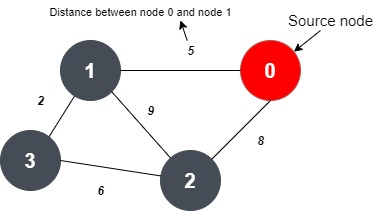
In the given input, the number of vertices is 4, and the number of edges is 5.

In the input, following the number of vertices and edges, three numbers are given. The first number denotes node ‘X’, the second number denotes node ‘Y’ and the third number denotes the distance between node ‘X’ and ‘Y’.

As per the input, there is an edge between node 0 and node 1 and the distance between them is 5.

The vertices 0 and 2 have an edge between them and the distance between them is 8.
The vertices 1 and 2 have an edge between them and the distance between them is 9.
The vertices 1 and 3 have an edge between them and the distance between them is 2.
The vertices 2 and 3 have an edge between them and the distance between them is 6.
Note:
1. There are no self-loops(an edge connecting the vertex to itself) in the given graph.

2. There can be parallel edges i.e. two vertices can be directly connected by more than 1 edge.
02
Round
Medium
Face to Face
Duration45 minutes
Interview date7 Aug 2022
Coding problem2
This was a typical DSA round.
1. Search In Rotated Sorted Array
Easy
12m average time
85% success
0/40
Asked in companies



You have been given a sorted array/list 'arr' consisting of ‘n’ elements. You are also given an integer ‘k’.
Now the array is rotated at some pivot point unknown to you.
For example, if 'arr' = [ 1, 3, 5, 7, 8], then after rotating 'arr' at index 3, the array will be 'arr' = [7, 8, 1, 3, 5].
Now, your task is to find the index at which ‘k’ is present in 'arr'.
Note :
1. If ‘k’ is not present in 'arr', then print -1.
2. There are no duplicate elements present in 'arr'.
3. 'arr' can be rotated only in the right direction.
Example:
Input: 'arr' = [12, 15, 18, 2, 4] , 'k' = 2

Output: 3

Explanation:
If 'arr' = [12, 15, 18, 2, 4] and 'k' = 2, then the position at which 'k' is present in the array is 3 (0-indexed).
Problem approach
Solve using binary search.
2. Insert Into A Binary Search Tree
Easy
20m average time
80% success
0/40
Asked in companies



You have been given a root node of the binary search tree and a positive integer value. You need to perform an insertion operation i.e. inserting a new node with the given value in the given binary search tree such that the resultant tree is also a binary search tree.
If there can be more than one possible tree, then you can return any.
Note :
A binary search tree is a binary tree data structure, with the following properties :

    a. The left subtree of any node contains nodes with a value less than the node’s value.

    b. The right subtree of any node contains nodes with a value equal to or greater than the node’s value.

    c. Right, and left subtrees are also binary search trees.
It is guaranteed that,

    d. All nodes in the given tree are distinct positive integers.

    e. The given BST does not contain any node with a given integer value.
Example, below the tree, is a binary search tree.
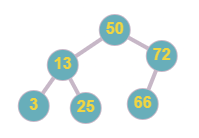
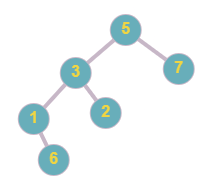
Below the tree is not a BST as node ‘2’ is less than node ‘3’ but ‘2’ is the right child of ‘3’, and node ‘6’ is greater than node ‘5’ but it is in the left subtree of node ‘5’.
Problem approach
First of all, you should be aware of the binary search tree. The elements in the left subtree will always be less than the value of the root node, while the right subtree will have elements greater than the value at the root node. So, while inserting or deleting, you will have to maintain this structure. Given that the tree maintains this specific structure, searching becomes easy.
03
Round
Medium
Face to Face
Duration30 minutes
Interview date7 Aug 2022
Coding problem1
Single question was asked by hiring manager.
1. Snake and Ladder
Moderate
30m average time
60% success
0/80
Asked in companies



You have been given a Snake and Ladder Board with 'N' rows and 'N' columns with the numbers written from 1 to (N*N) starting from the bottom left of the board, and alternating direction each row.
For example
For a (6 x 6) board, the numbers are written as follows:
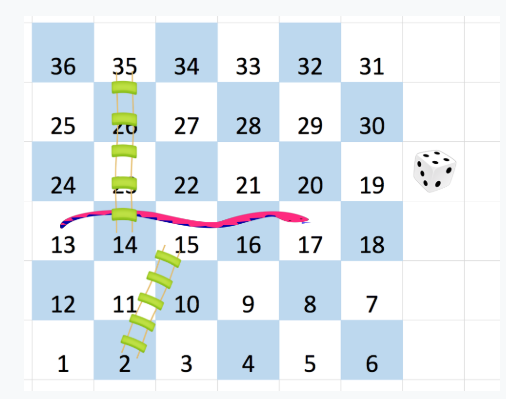
You start from square 1 of the board (which is always in the last row and first column). On each square say 'X', you can throw a dice which can have six outcomes and you have total control over the outcome of dice throw and you want to find out the minimum number of throws required to reach the last cell.
Some of the squares contain Snakes and Ladders, and these are possibilities of a throw at square 'X':
You choose a destination square 'S' with number 'X+1', 'X+2', 'X+3', 'X+4', 'X+5', or 'X+6', provided this number is <= N*N.
If 'S' has a snake or ladder, you move to the destination of that snake or ladder.  Otherwise, you move to S.
A board square on row 'i' and column 'j' has a "Snake or Ladder" if board[i][j] != -1. The destination of that snake or ladder is board[i][j].
Note :
You can only take a snake or ladder at most once per move: if the destination to a snake or ladder is the start of another snake or ladder, you do not continue moving - you have to ignore the snake or ladder present on that square.

For example, if the board is:
-1 1 -1
-1 -1 9
-1 4 -1
Let's say on the first move your destination square is 2  [at row 2, column 1], then you finish your first move at 4 [at row 1, column 2] because you do not continue moving to 9 [at row 0, column 0] by taking the ladder from 4.

A square can also have a Snake or Ladder which will end at the same cell.
For example, if the board is:
-1 3 -1
-1 5 -1
-1 -1 9
Here we can see Snake/Ladder on square 5 [at row 1, column 1] will end on the same square 5.
Problem approach
Since the dice has values from 1 to 6, in one step you can jump only up to 6. So, basically, imagine it as a graph where, from the current value, there are forward edges to the subsequent 6 elements. The snake's positions can be considered as backward edges, and ladders can be considered as forward edges. So, now the problem boils down to finding the shortest path from start to end, given the graph. Solve it using breadth-first search.


Here's your problem of the day 
Solving this problem will increase your chance to get selected in this company
Skill covered: Programming
How do you remove whitespace from the start of a string?
Choose another skill to practice
Similar interview experiences
SDE - 1
3 rounds | 7 problems
Interviewed by OYO
 Selected
6182 views

0 comments

0 upvotes
SDE - Intern
2 rounds | 3 problems
Interviewed by Amazon
Rejected
1565 views
0 comments
0 upvotes

SDE - 1
2 rounds | 5 problems
Interviewed by Meesho
Rejected
7245 views
0 comments
0 upvotes
SDE - 1
3 rounds | 9 problems
Interviewed by Salesforce
 Selected
 4552 views
0 comments
0 upvotes
Companies with similar interview experiences
Software Engineer Intern
4 rounds | 4 problems
Interviewed by Microsoft
 Selected
 1496 views
0 comments
0 upvotes