





Unthinkable Solutions interview experience Real time questions & tips from candidates to crack your interview

SDE - Intern
Unthinkable Solutions


4 rounds | 9 Coding
problems
 Selected
 Interview preparation journey

Preparation
Duration: 2 months
Topics: Data Structures, Operating System, Object Oriented Programming, Computer Networks.

Tip 1 : Be Confident and try to catch the hints during interview.
Tip 2 : Make sure to go through with your theory section once before your interview
Tip 3 : Prepare for easy-medium problems that would be enough mainly on arrays and strings.
Application process
Where: Campus
Eligibility: 6 CGPA
Tip 1 : Don't have much spaces in your resume make sure that your resume is concise and on point
Tip 2 : Highlight the techie keywords in your resume since your interviewer don't have much time to go through with the whole resume.

Interview rounds
01
Round
Medium
Online Coding Interview
Duration90 minutes
Interview date4 Oct 2019
Coding problem2
We have been assigned 2 coding problems 1 easy and one medium-level question.
As I submitted all three questions I was selected for direct technical interview round but some of my friends got second round test they needed to clear that second round to get an interview call so try to submit all the questions.
1. Min Jumps
Easy
15m average time
85% success

0/40
Asked in companies



You live in a Ninja town which is in the form of a N * M grid. In this town, people travel from one place to another by jumping over the buildings which are present in each cell of the grid. It is Christmas eve, and Santa wants to give gifts and chocolates to the kids who live in the building which is present at the cell (N - 1, M - 1). Initially, Santa is present on cell (0, 0). Since Santa is in a hurry, help him find a path from starting point to the endpoint with the least amount of time.
The Santa may go only from one building to any of its adjacent buildings which is present either to the right or to the bottom or bottom right cell i.e. if the current position is (x, y), he may go to (x + 1, y + 1) or (x + 1, y) or (x, y + 1) given that the new coordinates are in the grid. The time taken to reach from one building to another is equal to the absolute difference between the heights of buildings.
Note:
1. The heights of the buildings are positive.
2. Santa starts from the cell (0, 0) and he has to reach the building (N - 1, M - 1).
3. Santa cannot leave the grid at any point of time.
Problem approach
Since each element of our input array (N) represents the maximum jump length and not the definite jump length, that means we can visit any index between the current index (i) and i + N[i]. Stretching that to its logical conclusion, we can safely iterate through N while keeping track of the furthest index reachable (next) at any given moment (next = max(next, i + N[i])). We'll know we've found our solution once next reaches or passes the last index (next >= N.length - 1).
The difficulty then lies in keeping track of how many jumps it takes to reach that point. We can't simply count the number of times we update next, as we may see that happen more than once while still in the current jump's range. In fact, we can't be sure of the best next jump until we reach the end of the current jump's range.
So in addition to next, we'll also need to keep track of the current jump's endpoint (curr) as well as the number of jumps taken so far (ans).
Since we'll want to return ans at the earliest possibility, we should base it on next, as noted earlier. With careful initial definitions for curr and next, we can start our iteration at i = 0 and ans = 0 without the need for edge case return expressions.
2. Replace Each Element Of Array With Its Corresponding Rank
Easy
10m average time
90% success
0/40
Asked in companies


Given an array of integers 'ARR’ of size ‘N’. Replace each element of this array with its corresponding rank and return the array.
The rank of an element is an integer between 1 to ‘N’ inclusive that represents how large the element is in comparison to other elements of the array. The following rules can also define the rank of an element:
1. It is an integer starting from 1.

2. The larger the element, the larger the rank. If two elements are equal, their rank must be the same.

3. It should be as small as possible.
For Example:
'ARR' = [4, 7, 2, 90]

Here, 2 is the smallest element, followed by 4, 7, and 90.

Hence rank of element 2 is 1, element 4 is 2, element 7 is 3, and element 90 is 4.

Hence we return [2, 3, 1, 4].
Problem approach
A Simple Solution is to create an auxiliary array, copy contents of given array to auxiliary array. Finally traverse the auxiliary array and update given array using copied values. Time complexity of this solution is O(n), but it requires O(n) extra space.
An efficient solution can solve the problem in O(n) time and O(1) space. The idea is to keep track of previous element in loop.
02
Round
Easy
Online Coding Test
Duration50 minutes
Interview date3 Oct 2021
Coding problem3
He asked me to tell me about yourself and then started talking about my project which technologies you used what challenges you faced while working on this project, what was role in this project and all then he asked me about how good you are with OOPs concept I said I’m pretty much familiar with oops so he started asking about oops like what is oops how it could be useful while writing the code, what is encapsulation and interface, how you can obtain multi-Inheritance in OOPs.
1. Pattern: Triangle of numbers
Moderate
0/80
Asked in companies


Print the following pattern for the given number of rows.
Pattern for N = 4

The dots represent spaces.
Problem approach
Well this can be done easily done if you observe the pattern there all you need to take a count of stars and space variable to keep track of what is used in previous step now keep increasing your star and decrease you space while printing for each row from bottom to top.
problem will be solved using two for loop and 2 variables.
2. Is SubSequence
Easy
10m average time
90% success
0/40
Asked in companies


You have been given two strings ‘STR1’ and ‘STR2’.
Your task is to find if ‘STR1’ is a subsequence of ‘STR2’.
A subsequence of a string is a new string that can be derived from the original string by deleting some characters (can be none) without changing the relative ordering of other characters.
Example:
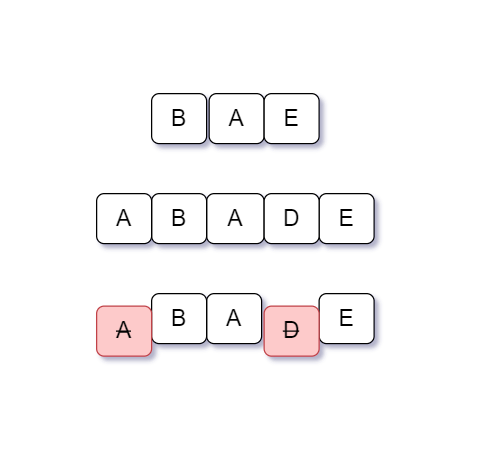
‘ACE’ is a subsequence of ‘ABCDE’ because ‘ACE’ can be formed by deleting ‘B’ and ‘D’ without changing the relative order of characters. ‘ADB’ is not a subsequence of ‘ABCDE’ because we can get ‘ABD’ from ‘ABCDE’ but not ‘ADB’ and in ‘ADB’ relative order of ‘B’ and ‘D’ are different from original strings.
Note:
1.Strings ‘STR1’ and ‘STR2’ consists only of English uppercases.

2.Length of string ‘STR2’ will always be greater than or equal to the length of string ‘STR1’.
Example:
For example, the given ‘STR1’ is ‘BAE’ and ‘STR2’ is ‘ABADE’.
String ‘STR1’ is a subsequence of string ‘STR2’ because ‘BAE’ can be formed by deleting ‘A’ and ‘D’ from ‘ABADE’ and the relative ordering of the characters of the string ‘ABADE’ persists.
Problem approach
All you need to find is LCS of both the string if LCS == target.size() return true else false
By LCS I mean longest common substring.
3. Number Pattern
Easy
15m average time
85% success
0/40
Asked in companies


Ninja wants to build a number pattern.
Example For ‘N’ = 4

Pattern:

4444
3444
2344
1234
Your task is to make a program that prints a similar pattern for a given 'N'.
Problem approach
The idea is that we can use a stack to keep track of previous min-max intervals.
Here is the principle to maintain the stack:
For each number num in the array
If stack is empty:
push a new Pair of num into stack
If stack is not empty:
if num < stack.peek().min, push a new Pair of num into stack
if num >= stack.peek().min, we first pop() out the peek element, denoted as last
if num < last.max, we are done, return true;
if num >= last.max, we merge num into last, which means last.max = num.
Once we update last, if stack is empty, we just push back last.
However, the crucial part is:
If stack is not empty, the updated last might:
Entirely covered stack.peek(), i.e. last.min < stack.peek().min (which is always true) && last.max >= stack.peek().max, in which case we keep popping out stack.peek().
Form a 1-3-2 pattern, we are done ,return true
So at any time in the stack, non-overlapping Pairs are formed in descending order by their min value, which means the min value of peek element in the stack is always the min value globally.
03
Round
Medium
Coding Test - Pen and paper
Duration40 minutes
Interview date2 Oct 2021
Coding problem3
After this, under 5-10 minutes I got call for the second technical interview and it’s occurred just after 5 minutes the first interview now in this interview he gave me 3 medium level DSA problems.
1. Spiral Matrix
Easy
0/40
Asked in companies


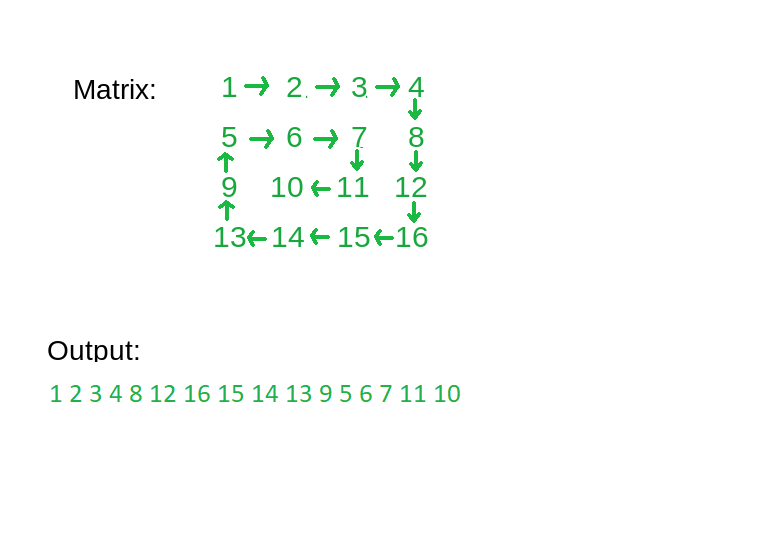
You are given a N x M matrix of integers, return the spiral path of the matrix
Example Of Spiral Path
Problem approach
Traverse the matrix in the spiral order by keeping four variables: u for the uppermost row, d for the downmost row, l for the leftmost column and r for the rightmost column.
2. Longest Common Subsequence
Moderate
39m average time
0/80
Asked in companies



Given two strings, 'S' and 'T' with lengths 'M' and 'N', find the length of the 'Longest Common Subsequence'.
For a string 'str'(per se) of length K, the subsequences are the strings containing characters in the same relative order as they are present in 'str,' but not necessarily contiguous. Subsequences contain all the strings of length varying from 0 to K.
Example :
Subsequences of string "abc" are: ""(empty string), a, b, c, ab, bc, ac, abc.
Problem approach
Bottom-up DP
For every i in text1, j in text2, we will choose one of the following two options:
If two characters match, length of the common subsequence would be 1 plus the length of the common subsequence till the i-1 andj-1 indexes
If two characters doesn't match, we will take the longer by either skipping i or j indexes
3. Count characters
Easy
0/40
Asked in companies


Write a program to count and print the total number of characters (lowercase english alphabets only), digits (0 to 9) and white spaces (single space, tab i.e. '\t' and newline i.e. '\n') entered till '$'.
That is, input will be a stream of characters and you need to consider all the characters which are entered till '$'.
Print count of characters, count of digits and count of white spaces respectively (separated by space).
Problem approach
Well Interviewer asked me to solve this question without using hashmap, so I've used a constant size array to store the frequency of each character in my string then I've easily counted the frequency of each character.
04
Round
Easy
HR Round
Duration20 minutes
Interview date2 Oct 2021
Coding problem1
After this, I got a call for my HR interview which was smoothest one out of all the rounds she discussed the salary structure and job hours how to reach the office, and all that’s it and she said take your time to accept this offer and finally got the congratulation mail from the HR department of unthinkable solution whole interview process was smooth.
1. Basic HR Questions
- Tell me about yourself
- What are your hobbies?
- Where do you see yourself in 5 years?
- Why you're leaving your current company?
- What do you want to achieve after joining this organisation?
- What is your expected salary package?
Problem approach
Tip 1 : Be confident
Tip 2 : Answer to the point
Tip 3 : Be precise


Here's your problem of the day 
Solving this problem will increase your chance to get selected in this company
Skill covered: Programming
How do you remove whitespace from the start of a string?
Choose another skill to practice
Similar interview experiences
SDE - Intern
4 rounds | 4 problems
Interviewed by Unthinkable Solutions
 Selected
3694 views

0 comments

0 upvotes
Associate Developer
5 rounds | 8 problems
Interviewed by Unthinkable Solutions
Selected 853 views
0 comments
0 upvotes
SDE - Intern
2 rounds | 3 problems
Interviewed by Unthinkable Solutions
Rejected
1080 views
0 comments
0 upvotes
Associate Technology
2 rounds | 3 problems
Interviewed by Unthinkable Solutions
Rejected
643 views
0 comments
0 upvotes
Companies with similar interview experiences

SDE - Intern
2 rounds | 4 problems
Interviewed by Arcesium
 Selected
 3739 views
0 comments
0 upvotes
SDE - Intern
3 rounds | 5 problems
Interviewed by Arcesium
Selected 2683 views
0 comments
0 upvotes

SDE - Intern
3 rounds | 5 problems
Interviewed by BNY Mellon
 Selected
 2348 views
0 comments
0 upvotes