





Upstox interview experience Real time questions & tips from candidates to crack your interview

SDE - 1
Upstox


3 rounds | 6 Coding
problems

 Selected
 Interview preparation journey

Journey
I took admission in DTU college in the Computer Science stream. My seniors advised me to practice DSA from the very start of B.Tech, but I did not take that seriously. Honestly speaking, I regretted not following their advice, and in the third year, I started coding. I had to increase my practice hours because I started late. After the fourth year, I was able to join a startup in Noida, but I was not satisfied with it. So, I regularly looked for opportunities in recognized organizations, and after working for one year at that startup, I got the opportunity to work at Upstox.
Application story
I saw a post on LinkedIn about Upstox being interested in hiring experienced candidates for the SDE-1 position, and I considered it a great opportunity for myself. I emailed the HR expressing my interest in being part of the selection process and attached my resume. Two days later, I received an email stating that my resume had been selected and that I would be having my interview rounds from then on.
Why selected/rejected for the role?
I think my skills and knowledge were up to the mark, which made them consider me a valuable candidate. Moreover, my communication skills contributed to my success.
Preparation
Duration: 2 months
Topics: System Design, Arrays, Hashing, Graphs, BFS, DFS

Tip 1: Keep practicing the questions on a daily basis. Once you get into the flow, you will be able to solve any question. Try to maintain a daily streak.
Tip 2: Prepare for the machine coding and system design rounds by reading at least one article a day.
Application process
Where: Linkedin
Eligibility: 7 and above
Tip 1: Mention only those skills in which you are confident.
Tip 2: You should have at least one good project in which you have in-depth knowledge.

Interview rounds
01
Round
Medium
Video Call
Duration60 mins
Interview date7 Apr 2022
Coding problem2
I had my round at midday. The interview was scheduled with Interview-Vector, which is a third-party platform used to conduct interviews. The interviewer was friendly and very helpful. I was asked 2 coding questions in 60 minutes, which I solved. Initially, he asked me to give a basic introduction of myself.
1. Spiral Matrix
Easy
15m average time
80% success

0/40
Asked in companies



You are given a 2-D array 'MATRIX' of dimensions N x M, of integers. You need to return the spiral path of the matrix.
Example Of Spiral Path:
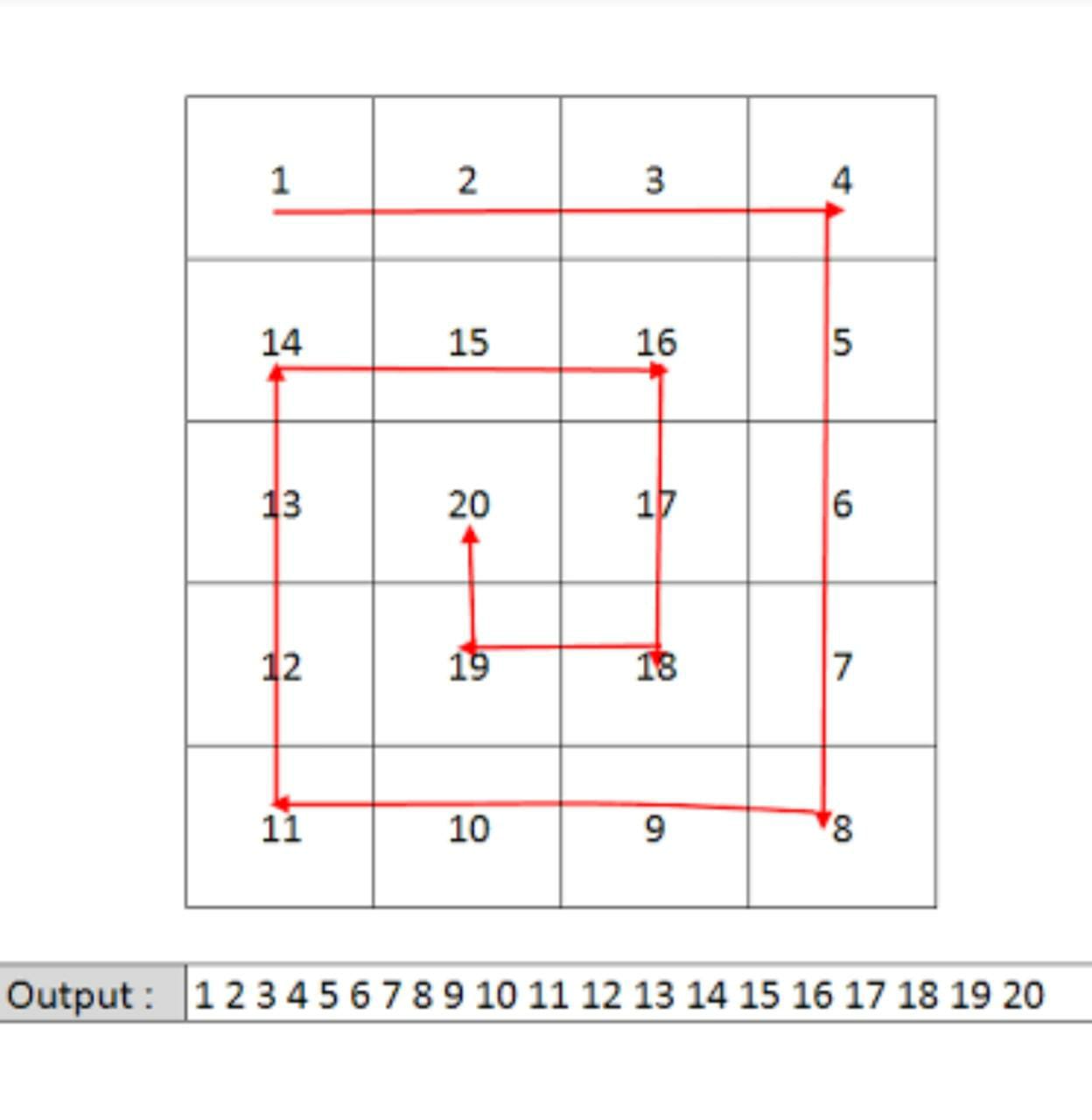
Problem approach
I have practiced this problem so many times that I solved it easily using the BFS approach.
2. Distance Of Nearest Cell Having 1 In A Binary Matrix
Moderate
35m average time
65% success
0/80
Asked in companies



You have been given a binary matrix 'MAT' containing only 0’s and 1’s of size N x M. You need to find the distance of the nearest cell having 1 in the matrix for each cell.
The distance is calculated as |i1 – i2| + |j1 – j2|, where i1, j1 are the coordinates of the current cell and i2, j2 are the coordinates of the nearest cell having value 1.
Note :
You can only move in four directions which are : Up, Down, Left and Right.
For example :
If N = 3, M = 4

and mat[ ][ ] = { 0, 0, 0, 1,
                  0, 0, 1, 1,
                  0, 1, 1, 0 }

then the output matrix will be

3  2  1  0
2  1  0  0
1  0  0  1
Problem approach
I first tried thinking about which algorithm would be used to solve this question. After that, it was easier to solve.
02
Round
Easy
Video Call
Duration60 mins
Interview date7 Apr 2022
Coding problem2
I was first asked to introduce myself and my past experience. The interviewer was helpful and assisted me in reaching the final solution.
1. Arithmetic Subarrays
Easy
20m average time
80% success
0/40
Asked in companies


You are given an array ‘A’ of length ‘N’, you have to tell the number of arithmetic subarrays that exist in the array ‘A’.
An Arithmetic subarray is a subarray that has 3 or more elements and the difference between consecutive elements is the same. Eg: [1, 3, 5, 7] has a length of 4, and diff between any two consecutive elements is 2.
Note:
A subarray is a slice from a contiguous array (i.e., occupy consecutive positions) and inherently maintains the order of elements.
Problem approach
This was a hard problem, but with the help of the interviewer and by identifying the correct data structure to solve it, I was able to solve it.
2. Merge Two Sorted Linked Lists
Moderate
15m average time
80% success
0/80
Asked in companies


You are given two sorted linked lists. You have to merge them to produce a combined sorted linked list. You need to return the head of the final linked list.
Note:
The given linked lists may or may not be null.
For example:
If the first list is: 1 -> 4 -> 5 -> NULL and the second list is: 2 -> 3 -> 5 -> NULL

The final list would be: 1 -> 2 -> 3 -> 4 -> 5 -> 5 -> NULL
Problem approach
Take an empty list first and then start comparing each linked list using the divide and conquer algorithm.
03
Round
Easy
Video Call
Duration40 mins
Interview date7 Apr 2022
Coding problem2
1. Palindrome Partitioning
Moderate
25m average time
75% success
0/80
Asked in companies

You are given a string 'S'. Your task is to partition 'S' such that every substring of the partition is a palindrome. You need to return all possible palindrome partitioning of 'S'.
Note: A substring is a contiguous segment of a string.
For Example:
For a given string “BaaB”
3 possible palindrome partitioning of the given string are:
{“B”, “a”, “a”, “B”}
{“B”, “aa”, “B”}
{“BaaB”}
Every substring of all the above partitions of “BaaB” is a palindrome.
Problem approach
Kadane's algorithm helped me solve this problem.
2. DBMS Questions
Problem approach
Tip 1: Be clear with the basics and fundamentals of the BTech syllabus.
Tip 2: Calmness and confidence must be there.


Here's your problem of the day 
Solving this problem will increase your chance to get selected in this company
Skill covered: Programming
How do you remove whitespace from the start of a string?
Choose another skill to practice
Similar interview experiences
SDE - 1
3 rounds | 7 problems
Interviewed by OYO
 Selected
6182 views

0 comments

0 upvotes
SDE - Intern
2 rounds | 3 problems
Interviewed by Amazon
Rejected
1565 views
0 comments
0 upvotes

SDE - 1
2 rounds | 5 problems
Interviewed by Meesho
Rejected
7245 views
0 comments
0 upvotes

SDE - 1
3 rounds | 9 problems
Interviewed by Salesforce
 Selected
 4551 views
0 comments
0 upvotes
Companies with similar interview experiences
SDE - 1
5 rounds | 12 problems
Interviewed by Amazon
 Selected
 117551 views
24 comments
0 upvotes

SDE - 1
4 rounds | 5 problems
Interviewed by Microsoft
Selected 60142 views
5 comments
0 upvotes
SDE - 1
3 rounds | 7 problems
Interviewed by Amazon
 Selected
 36137 views
7 comments
0 upvotes