





Virtusa interview experience Real time questions & tips from candidates to crack your interview
SDE - 1
Virtusa


2 rounds | 4 Coding
problems

Rejected
Interview preparation journey

Preparation
Duration: 3 months
Topics: Data Structures, Pointers, OOPS, System Design, Algorithms, Dynamic Programming

Tip 1 : Graph should be on your tips.
Tip 2 : while explaining the solution to interviewer, dont just hop onto the most optimal solution. Start with the brute force one, give the cons of brute force solution, and then go step by step till you reach the optimal solution.
Tip 3 : Improve on your communication skills as well.
Application process
Where: Other
Eligibility: Above 7 CGPA
Tip 1 : Mention only what is required for your profile, for e.g. do not stress too much on your co curricular stuff. Rather, try explaining more of your technical stuff that is relevant for your job.
Tip 2 : keep it limited to 1 page. And make sure its a pdf and not an image.

Interview rounds
01
Round
Easy
Video Call
Duration45 mins
Interview date3 Aug 2022
Coding problem2
1. Preorder traversal of a BST
Moderate
15m average time
85% success

0/80
Asked in companies



You have been given an array/list 'PREORDER' representing the preorder traversal of a BST with 'N' nodes. All the elements in the given array have distinct values.
Your task is to construct a binary search tree that matches the given preorder traversal.
A binary search tree (BST) is a binary tree data structure that has the following properties:
• The left subtree of a node contains only nodes with data less than the node’s data.
• The right subtree of a node contains only nodes with data greater than the node’s data.
• Both the left and right subtrees must also be binary search trees.
Note:
It is guaranteed that a BST can be always constructed from the given preorder traversal. Hence, the answer will always exist.
Example:
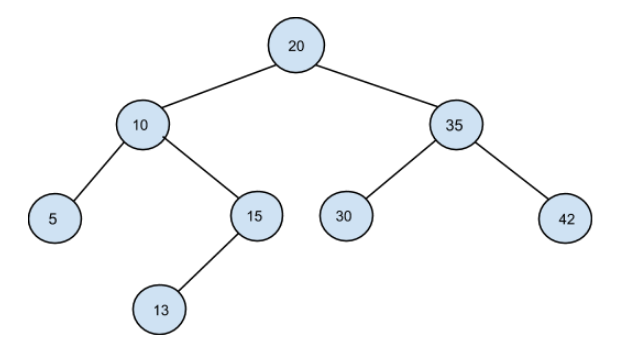
From PREORDER = [20, 10, 5, 15, 13, 35, 30, 42] , the following BST can be constructed:
Problem approach
You have been given an array/list 'PREORDER' representing the preorder traversal of a BST with 'N' nodes. All the elements in the given array have distinct values.
Your task is to construct a binary search tree that matches the given preorder traversal.
A binary search tree (BST) is a binary tree data structure that has the following properties:
• The left subtree of a node contains only nodes with data less than the node’s data.
• The right subtree of a node contains only nodes with data greater than the node’s data.
• Both the left and right subtrees must also be binary search trees.
2. Check if number is Binary
Easy
10m average time
90% success
0/40
Asked in companies


Given a string of integers ‘bin’. Return 'true' if the string represents a valid binary number, else return 'false'. A binary number is a number that has only 0 or 1 in it.
Problem approach
Step 1 : First I converted the number into string and checked if each character is 0 or 1
Step 2 : The interviewer asked me if there is any other approach to solve this problem
Step 3 : I picked the approach of picking up the digit of integer from last and then checking whether that it is 0 or 1
Step 4 : If we get a digit other than 0/1 we will break the loop. The interviewer was happy with this approach.
02
Round
Easy
Video Call
Duration45 mins
Interview date3 Aug 2022
Coding problem2
1. Rearrange The Array
Easy
0/40
Asked in companies


You are given an array/list NUM of integers. You are supposed to rearrange the elements of NUM such that no two adjacent elements will be the same or find out if it not possible.
For example:
Input: arr[] = {1,1,1,2,2,2}
Output: {1,2,1,2,1,2}

Note: {2,1,2,1,2,1} is also valid because there are no two adjacent elements which are the same.
Problem approach
You are given an array/list 'NUM' of integers. You are supposed to rearrange the elements of the given 'NUM' so that after rearranging the given array/list there are no two adjacent elements present in the rearranged 'NUM' which will be the same.
For Example:
Input: NUM[] = {1,1,1,2,2,2}
Output: {1,2,1,2,1,2}
Note: {2,1,2,1,2,1} is also valid because there are no two adjacent which are the same.
2. Technical questions
How to find the pre order traversal of a tree?
State complexity of merge sort
Questions based on radix sort
Problem approach
Tip 1 : Practice preorder, postorder and inorder traversal questions of a tree
Tip 2 : Understand merge sort
Tip 3 : Have complete understanding of Radix sort


Here's your problem of the day 
Solving this problem will increase your chance to get selected in this company
Skill covered: Programming
How do you remove whitespace from the start of a string?
Choose another skill to practice
Similar interview experiences
SDE - 1
3 rounds | 5 problems
Interviewed by Virtusa
 Selected
1908 views

0 comments

0 upvotes
SDE - 1
1 rounds | 3 problems
Interviewed by Virtusa
Rejected
1841 views
0 comments
0 upvotes
SDE - 1
2 rounds | 4 problems
Interviewed by Virtusa
Selected 1063 views
0 comments
0 upvotes
SDE - 1
2 rounds | 5 problems
Interviewed by Virtusa
Rejected
0 views
0 comments
0 upvotes
Companies with similar interview experiences
SDE - 1
5 rounds | 12 problems
Interviewed by Amazon
 Selected
 117552 views
24 comments
0 upvotes

SDE - 1
4 rounds | 5 problems
Interviewed by Microsoft
Selected 60143 views
5 comments
0 upvotes
SDE - 1
3 rounds | 7 problems
Interviewed by Amazon
 Selected
 36138 views
7 comments
0 upvotes