





VMware Inc interview experience Real time questions & tips from candidates to crack your interview

SDE - 1
VMware Inc


2 rounds | 7 Coding
problems

Rejected
Interview preparation journey

Preparation
Duration: 5 months
Topics: Data Structures, Algorithms, System Design, Aptitude, OOPS

Tip 1 : Must do Previously asked Interview as well as Online Test Questions.
Tip 2 : Go through all the previous interview experiences from Codestudio and Leetcode.
Tip 3 : Do at-least 2 good projects and you must know every bit of them.
Application process
Where: Referral
Eligibility: Above 7 CGPA
Tip 1 : Have at-least 2 good projects explained in short with all important points covered.
Tip 2 : Every skill must be mentioned.
Tip 3 : Focus on skills, projects and experiences more.

Interview rounds
01
Round
Easy
Telephonic
Duration60 minutes
Interview date9 Mar 2015
Coding problem2
Need to write working code on a shared document so that the interviewer can see if you can put your ideas into code. In this round, they are not bothered about time complexity of your algorithm. They just wanted to know if you can code whatever you think. So if you do not find best solution also it is OK but write the code for average case at-least.
1. Search In Rotated Sorted Array
Moderate
30m average time
65% success

0/80
Asked in companies



Aahad and Harshit always have fun by solving problems. Harshit took a sorted array consisting of distinct integers and rotated it clockwise by an unknown amount. For example, he took a sorted array = [1, 2, 3, 4, 5] and if he rotates it by 2, then the array becomes: [4, 5, 1, 2, 3].
After rotating a sorted array, Aahad needs to answer Q queries asked by Harshit, each of them is described by one integer Q[i]. which Harshit wanted him to search in the array. For each query, if he found it, he had to shout the index of the number, otherwise, he had to shout -1.
For each query, you have to complete the given method where 'key' denotes Q[i]. If the key exists in the array, return the index of the 'key', otherwise, return -1.
Note:
Can you solve each query in O(logN) ?
Problem approach
This was a pretty standard Binary Search Question and I had solved this question before on platforms like LeetCode and CodeStudio . I was asked this question to test my implementation skills and how well do I handle Edge Cases .
Approach :
1) The idea is to find the pivot point, divide the array in two sub-arrays and perform binary search.
2) The main idea for finding pivot is – for a sorted (in increasing order) and pivoted array, pivot element is the only element for which next element to it is smaller than it.
3) Using the above statement and binary search pivot can be found.
4) After the pivot is found out divide the array in two sub-arrays.
5) Now the individual sub – arrays are sorted so the element can be searched using Binary Search.
TC : O(Log(N))
SC : O(1)
2. Pair Sum in BST.
Easy
15m average time
85% success
0/40
Asked in companies



You are given a Binary Search Tree (BST) and a target value ‘K’. Your task is to return true if there exist two nodes in the given BST such that the sum of their values is equal to the given target ‘K’, else return false.
A binary search tree (BST) is a binary tree data structure which has the following properties.
• The left subtree of a node contains only nodes with data less than the node’s data.

• The right subtree of a node contains only nodes with data greater than the node’s data.

• Both the left and right subtrees must also be binary search trees.
Note:
1. All the elements of the Binary Search Tree are unique.

2. You can’t use the same node value/element of BST twice.
For example:
tree: 8 5 10 2 6 -1 -1 -1 -1 -1 7 -1 -1
'K' = 13,
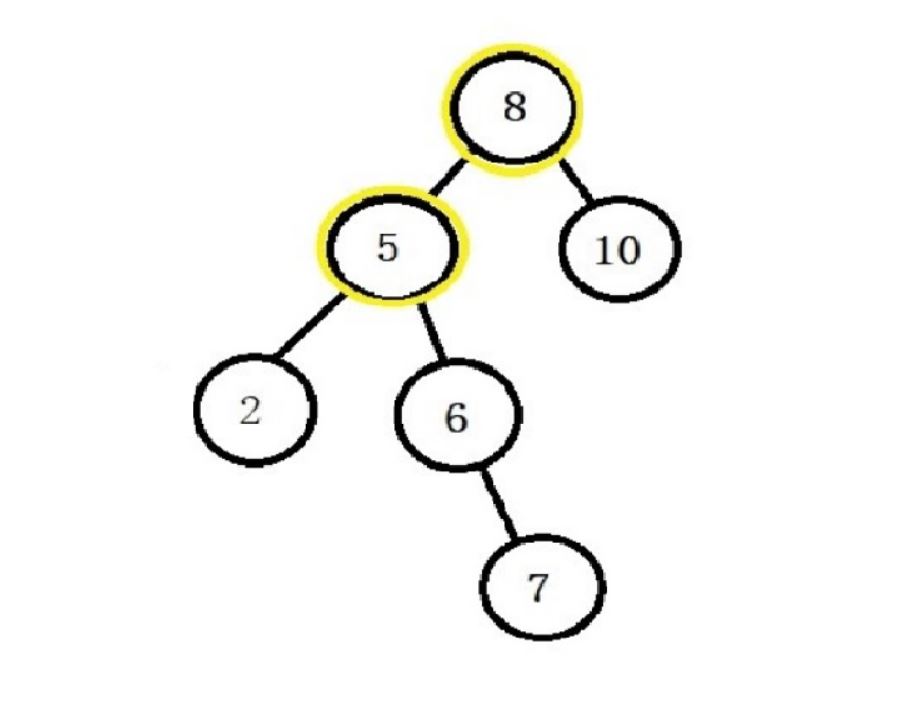
The nodes with values 8 and 5 as shown in the above figure gives sum equal to the given target 13.

Therefore, the output will be “true” i.e it is possible to find a pair in the given BST having sum equal to ‘K’.
Problem approach
This problem can be solved using hashing. The idea is to traverse the tree in an inorder fashion and insert every node’s value into a set. Also check if, for any node, the difference between the given sum and node’s value is found in the set, then the pair with the given sum exists in the tree.
Time Complexity :O(n).
02
Round
Medium
Face to Face
Duration60 minutes
Interview date9 Mar 2015
Coding problem5
I was interviewed for vcloud team so they asked me questions on Cloud, DSA etc.
1. Reverse List In K Groups
Hard
15m average time
85% success
0/120
Asked in companies



You are given a linked list of 'n' nodes and an integer 'k', where 'k' is less than or equal to 'n'.
Your task is to reverse the order of each group of 'k' consecutive nodes, if 'n' is not divisible by 'k', then the last group of nodes should remain unchanged.
For example, if the linked list is 1->2->3->4->5, and 'k' is 3, we have to reverse the first three elements, and leave the last two elements unchanged. Thus, the final linked list being 3->2->1->4->5.
Implement a function that performs this reversal, and returns the head of the modified linked list.
Example:
Input: 'list' = [1, 2, 3, 4], 'k' = 2

Output: 2 1 4 3

Explanation:
We have to reverse the given list 'k' at a time, which is 2 in this case. So we reverse the first 2 elements then the next 2 elements, giving us 2->1->4->3.
Note:
All the node values will be distinct.
Problem approach
Recursion can be used to solve this problem. We reverse every group of k linked list nodes and attach it to the previous group.
Steps :
1) The first step is to check whether the Head is NULL or Not, if its NULL then we can directly return NULL,
2) If the Head is not NULL, then we need to check the length of Linked List starting from current Head.
3) If the length is less than k , then there is no need to reverse it and hence we can directly return head,
4) Else if its a multiple of K, then we have to reverse the K elements starting from current Head. While reversing keep track of the next node and previous node.
5) We will follow the same steps for the rest of the elements Recursively and link the two sub-lists.
Time Complexity : O(n)
Auxiliary Space : O(n/k)
2. Reverse Stack Using Recursion
Easy
21m average time
80% success
0/40
Asked in companies


Reverse a given stack of 'N' integers using recursion. You are required to make changes in the input parameter itself.
Note: You are not allowed to use any extra space other than the internal stack space used due to recursion.
Example:
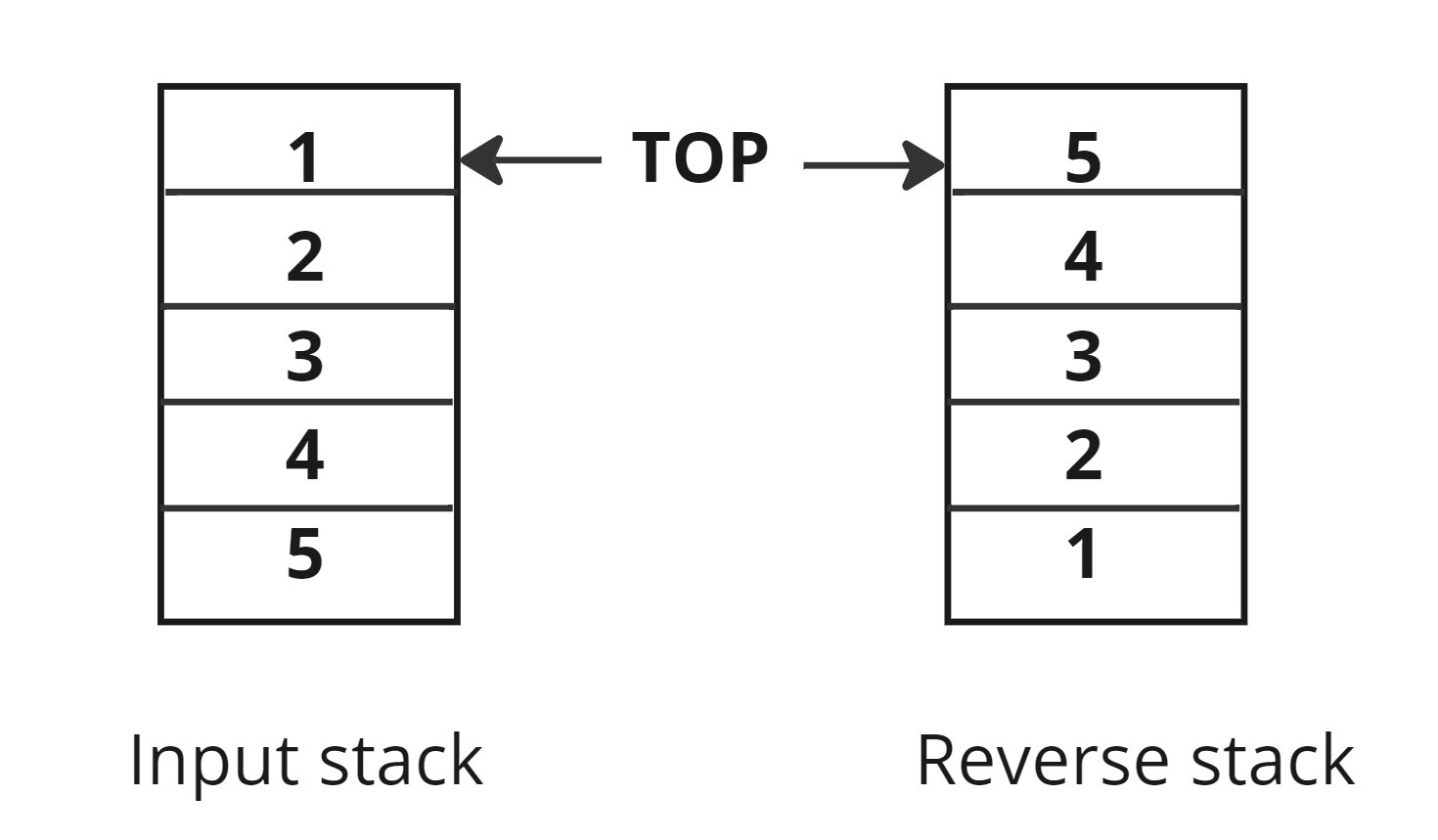
Input: [1,2,3,4,5]
Output: [5,4,3,2,1]
Problem approach
Recursion can be used to reverse a stack. In this approach, we pop the top element from the given stack and recursively call another instance of the same function. When this child function returns to the parent function, append the popped element to the bottom of the stack. For this, two recursive functions can be used: reverseStack() and insertAtBottom().
reverseStack():
It checks if the stack is empty or not. The top element is popped out and stored in the element variable if the stack is not empty. We then call reverseStack() function again on the updated stack. When this child function returns, we call the helper function insertAtBottom().
insertAtBottom():
It recursively inserts an element at the bottom of a stack. If the stack is empty, it simply pushes the element else; the top element is popped out and stored in the topElement variable. Then insertAtBottom() is called again on the updated stack. When this child function returns, it pushes the topElement back in the stack.
Time Complexity: O(N²) : Two recursive functions are there in which the first function is calling itself recursively and the second function in each call. Also, the second function is recursively called.
Space Complexity: O(N) : The recursive program uses a memory of O(N) to store the function call stack.
3. Technical Question
What is Cloud?
Problem approach
"The cloud" refers to servers that are accessed over the Internet, and the software and databases that run on those servers. Cloud servers are located in data centers all over the world. By using cloud computing, users and companies do not have to manage physical servers themselves or run software applications on their own machines.
The cloud enables users to access the same files and applications from almost any device, because the computing and storage takes place on servers in a data center, instead of locally on the user device.
4. Technical Question
Benefits of Cloud?
Problem approach
1) Back-up and restore data
Once the data is stored in the cloud, it is easier to get back-up and restore that data using the cloud.
2) Improved collaboration
Cloud applications improve collaboration by allowing groups of people to quickly and easily share information in the cloud via shared storage.
3) Excellent accessibility
Cloud allows us to quickly and easily access store information anywhere, anytime in the whole world, using an internet connection. An internet cloud infrastructure increases organization productivity and efficiency by ensuring that our data is always accessible.
4) Low maintenance cost
Cloud computing reduces both hardware and software maintenance costs for organizations.
5) Mobility
Cloud computing allows us to easily access all cloud data via mobile.
6) Data security
Data security is one of the biggest advantages of cloud computing. Cloud offers many advanced features related to security and ensures that data is securely stored and handled.
5. Technical Question
Challenges of Cloud Computing?
Problem approach
Security and Privacy
Security and Privacy of information is the biggest challenge to cloud computing. Security and privacy issues can be overcome by employing encryption, security hardware and security applications.
Portability
This is another challenge to cloud computing that applications should easily be migrated from one cloud provider to another. There must not be vendor lock-in. However, it is not yet made possible because each of the cloud provider uses different standard languages for their platforms.
Interoperability
It means the application on one platform should be able to incorporate services from the other platforms. It is made possible via web services, but developing such web services is very complex.
Computing Performance
Data intensive applications on cloud requires high network bandwidth, which results in high cost. Low bandwidth does not meet the desired computing performance of cloud application.


Here's your problem of the day 
Solving this problem will increase your chance to get selected in this company
Skill covered: Programming
How do you remove whitespace from the start of a string?
Choose another skill to practice
Similar interview experiences
SDE - 1
2 rounds | 5 problems
Interviewed by VMware Inc

Rejected

840 views

0 comments

0 upvotes
SDE - 1
3 rounds | 6 problems
Interviewed by VMware Inc
Rejected
1139 views
0 comments
0 upvotes
SDE - 1
3 rounds | 5 problems
Interviewed by VMware Inc
Rejected
345 views
0 comments
0 upvotes
SDE - 1
3 rounds | 5 problems
Interviewed by VMware Inc
Rejected
353 views
0 comments
0 upvotes
Companies with similar interview experiences

SDE - 1
5 rounds | 12 problems
Interviewed by Amazon

 Selected
 115097 views
24 comments
0 upvotes
SDE - 1
4 rounds | 5 problems
Interviewed by Microsoft
Selected 58238 views
5 comments
0 upvotes
SDE - 1
3 rounds | 7 problems
Interviewed by Amazon
 Selected
 35147 views
7 comments
0 upvotes