





VMware Inc interview experience Real time questions & tips from candidates to crack your interview

SDE - 1
VMware Inc


3 rounds | 6 Coding
problems

 Selected
 Interview preparation journey

Preparation
Duration: 6 months
Topics: DSA, Competitive Coding, OOPS Concepts, OS, DBMS, CN.

Tip 1 : Practice the DSA sheet of 180 commonly asked questions by striver.
Tip 2 : Do Competitive coding regularly, try to be consistent in short contests.
Tip 3 : Revise the core subjects basics regularly.
Application process
Where: Campus
Eligibility: Above 6 CGPA
Tip 1 : Resume must be concise and to the point.
Tip 2 : Never add any fake skill in your resume, because they can ask anything from your skills.

Interview rounds
01
Round
Easy
Video Call
Duration45 minutes
Interview date3 May 2022
Coding problem2
1. Next smaller Palindrome
Easy
10m average time
85% success

0/40
Asked in companies



You are given a number 'N' in the form of a string 'S', which is a palindrome. You need to find the greatest number strictly less than 'N' which is also a palindrome.
Note:
1. A palindrome is a word, number, phrase, or another sequence of characters that reads the same backward as forward, such as madam, racecar, 1234321, etc.
2. The numerical value of the given string S will be greater than 0.
3. A single-digit number is also considered a palindrome.
4. The answer number should not contain any leading zeros, except for the case when the answer is 0.
5. Note that the length of the string is nothing but the number of digits in N.
Problem approach
You are given a number 'N' in the form of a string 'S', your task is to find the smallest number strictly greater than the given number 'N' which is a palindrome.
2. Check Permutation
Easy
15m average time
85% success
0/40
Asked in companies


You have been given two strings 'STR1' and 'STR2'. You have to check whether the two strings are anagram to each other or not.
Note:
Two strings are said to be anagram if they contain the same characters, irrespective of the order of the characters.
Example :
If 'STR1' = “listen” and 'STR2' = “silent” then the output will be 1.

Both the strings contain the same set of characters.
Problem approach
You have been given two strings 'STR1' and 'STR2'. You have to check whether the two strings are anagram to each other or not.
02
Round
Easy
Video Call
Duration45 minutes
Interview date12 May 2022
Coding problem2
1. Level order traversal
Easy
15m average time
85% success
0/40
Asked in companies



You have been given a Binary Tree of integers. You are supposed to return the level order traversal of the given tree.
For example:
For the given binary tree
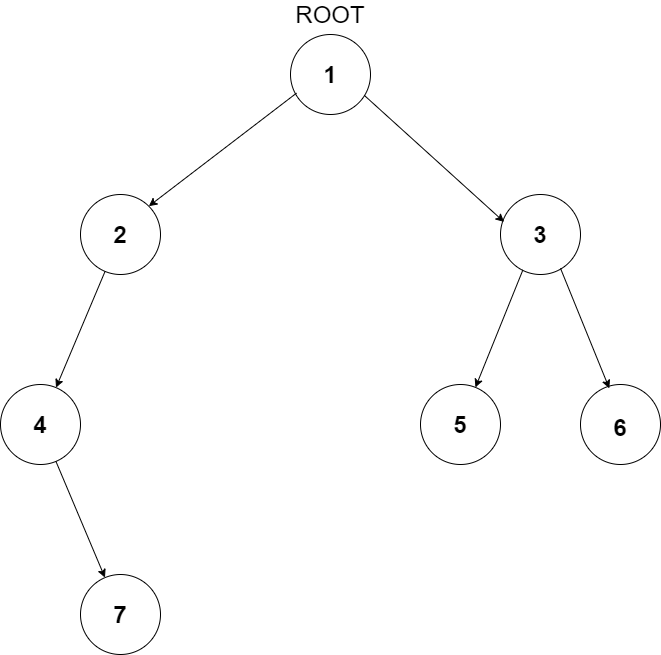
The level order traversal will be {1,2,3,4,5,6,7}.
Problem approach
You have been given a Binary Tree of integers. You are supposed to return the level order traversal of the given tree.
2. Kth ancestor of a node in binary tree
Hard
50m average time
35% success
0/120
Asked in companies

You are given an arbitrary binary tree consisting of N nodes numbered from 1 to N, an integer 'K', and a node 'TARGET_NODE_VAL' from the tree. You need to find the Kth ancestor of the node 'TARGET_NODE_VAL'. If there is no such ancestor, then print -1.
The Kth ancestor of a node in a binary tree is the Kth node in the path going up from the given node to the root of the tree. Refer to sample test cases for further explanation.
Note:
1. The given node 'TARGET_NODE_VAL' is always present in the tree.
2. The value of each node in the tree is unique.
3. Notice that the Kth ancestor node if present will always be unique.
Problem approach
You are given an arbitrary binary tree consisting of N nodes numbered from 1 to N, an integer 'K', and a node 'TARGET_NODE_VAL' from the tree. You need to find the Kth ancestor of the node 'TARGET_NODE_VAL'. If there is no such ancestor, then print -1.
The Kth ancestor of a node in a binary tree is the Kth node in the path going up from the given node to the root of the tree. Refer to sample test cases for further explanation.
03
Round
Easy
Video Call
Duration45 minutes
Interview date14 May 2022
Coding problem2
1. Equilibrium indices of a sequence
Moderate
15m average time
85% success
0/80
Asked in companies


You have been given an array/list 'SEQUENCE' denoting the sequence of 'N' integers. Your task is to find the equilibrium indices of the sequence in 'SEQUENCE'.
The equilibrium index of a sequence of integers is defined as the index such that the sum of all the elements at lower indices is equal to the sum of elements at higher indices.
Note:
1. 'SEQUENCE' may contain more than one equilibrium indices.

2. If there are no equilibrium indices, return an empty sequence.

3. Consider the sum of elements lower than the first index and higher than the last index to be 0 (zero).
Problem approach
You have been given an array/list 'SEQUENCE' denoting the sequence of 'N' integers. Your task is to find the equilibrium indices of the sequence in 'SEQUENCE'.
The equilibrium index of a sequence of integers is defined as the index such that the sum of all the elements at lower indices is equal to the sum of elements at higher indices.
2. Convert Bst To The Greater Sum Tree
Moderate
30m average time
70% success
0/80
Asked in companies


You have been given a Binary Search Tree of integers. You are supposed to convert it to a greater sum tree such that the value of every node in the given BST is replaced with the sum of the values of all the nodes which are greater than the value of the current node in the tree.
A Binary Search Tree is a tree, whose internal nodes each store a value greater than all the values in the node's left subtree and less than those in its right subtree.
Note :
You need to modify the given tree only. You are not allowed to create a new tree.
For example:
For the given binary search tree
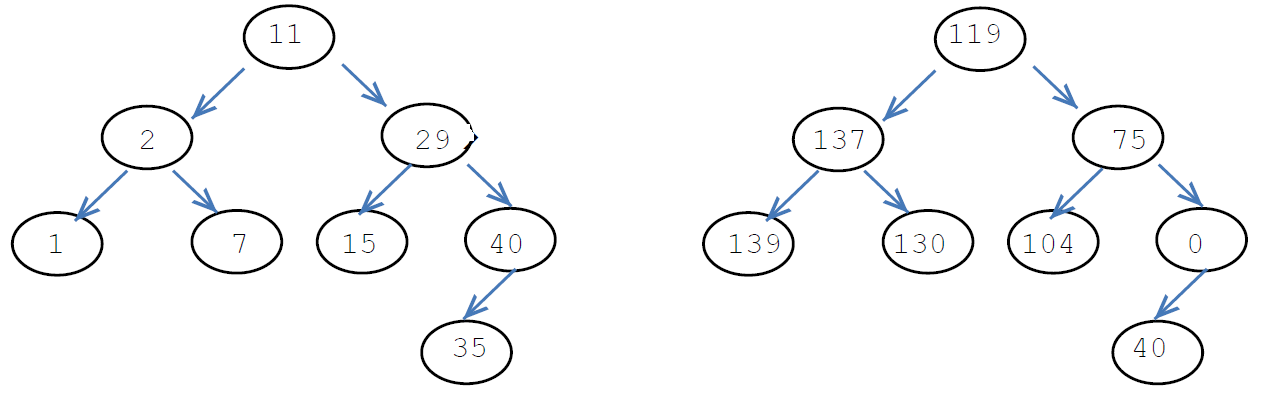
11 will be replaced by {15 + 29 + 35 + 40}, i.e. 119.
2 will be replaced by {7 + 11 + 15 + 29 + 35 + 40}, i.e. 137.
29 will be replaced by {35 + 40}, i.e. 75.
1 will be replaced by {2 + 7 + 11 + 15 + 29 + 35 + 40}, i.e. 139.
7 will be replaced by {11 + 15 + 29 + 35 + 40}, i.e. 130.
15 will be replaced by {15 + 29 + 35 + 40}, i.e. 104.
40 will be replaced by 0 {as there is no node with a value greater than 40}.
35 will be replaced by {40}, i.e. 40.
Problem approach
Given a binary tree with 'N' number of nodes, convert it to a Greater Tree such that data of every node of the original BST is changed to the original node’s data plus the sum of all node’s data greater than or equal to the original data of the node in the BST.


Here's your problem of the day 
Solving this problem will increase your chance to get selected in this company
Skill covered: Programming
How do you remove whitespace from the start of a string?
Choose another skill to practice
Similar interview experiences
SDE - 1
2 rounds | 5 problems
Interviewed by VMware Inc
Rejected

957 views

0 comments

0 upvotes
SDE - 1
3 rounds | 6 problems
Interviewed by VMware Inc
Rejected
1312 views
0 comments
0 upvotes
SDE - 1
3 rounds | 5 problems
Interviewed by VMware Inc
Rejected
445 views
0 comments
0 upvotes
SDE - 1
3 rounds | 5 problems
Interviewed by VMware Inc
Rejected
449 views
0 comments
0 upvotes
Companies with similar interview experiences
SDE - 1
5 rounds | 12 problems
Interviewed by Amazon
 Selected
 117552 views
24 comments
0 upvotes

SDE - 1
4 rounds | 5 problems
Interviewed by Microsoft
Selected 60143 views
5 comments
0 upvotes
SDE - 1
3 rounds | 7 problems
Interviewed by Amazon
 Selected
 36138 views
7 comments
0 upvotes