





VMware Inc interview experience Real time questions & tips from candidates to crack your interview

SDE - 1
VMware Inc


3 rounds | 5 Coding
problems

Rejected
Interview preparation journey

Journey
First, I was selected for a Tier 1 college, and that’s where my journey in coding began. I did most of my coding in my final years, but I regret not starting earlier.
Application story
I applied for a software developer position when the company visited my campus for placements. After submitting my resume through the campus portal, I completed pre-interview assessments. These assessments focused on showcasing my technical skills.
Why selected/rejected for the role?
I was rejected for this offer because I was not clear on the question they asked me during the interview.
Preparation
Duration: 8 months
Topics: Data Structures, Pointers, OOPS, System Design, Algorithms, Dynamic Programming

Tip 1: Practice topic-wise CodeStudio questions from the basics.
Tip 2: Watch many system design mock interviews.
Tip 3: Do mock interviews with friends for DSA and system design rounds.
Application process
Where: Campus
Eligibility: Above 7.5 CGPA
Tip 1: Include some projects on your resume.
Tip 2: Do not include false information on your resume.

Interview rounds
01
Round
Easy
Video Call
Duration45 minutes
Interview date3 Oct 2022
Coding problem2
1. Maximum Sum Rectangle
Easy
15m average time
85% success

0/40
Asked in companies



You are given a matrix ‘ARR’ with ‘N’ rows and ‘M’ columns. Your task is to find the maximum sum rectangle in the matrix.
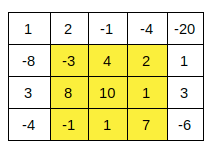
Maximum sum rectangle is a rectangle with the maximum value for the sum of integers present within its boundary, considering all the rectangles that can be formed from the elements of that matrix.
For Example
Consider following matrix:
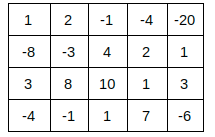
The rectangle (1,1) to (3,3) is the rectangle with the maximum sum, i.e. 29.
Problem approach
Use the Kadanes algorithm to solve this problem
1) The idea is to fix the left and right columns one by one and find the maximum sum of contiguous rows for every left and right column pair.
2) I find top and bottom row numbers (which have maximum sum) for every fixed left and right column pair.
3) To find the top and bottom row numbers, calculate the sum of elements in every row from left to right and store these sums in an array say temp[]. So temp[i] indicates the sum of elements from left to right in row i. If I apply Kadane’s 1D algorithm on temp[], and get the maximum sum subarray of temp, this maximum sum would be the maximum possible sum with left and right as boundary columns.
4) To get the overall maximum sum, we compare this sum with the maximum sum so far
2. Minimum number of swaps required to sort an array
Easy
10m average time
90% success
0/40
Asked in companies



You have been given an array 'ARR' of 'N' distinct elements.
Your task is to find the minimum no. of swaps required to sort the array.
For example:
For the given input array [4, 3, 2, 1], the minimum no. of swaps required to sort the array is 2, i.e. swap index 0 with 3 and 1 with 2 to form the sorted array [1, 2, 3, 4].
Problem approach
While iterating over the array, check the current element, and if not in the correct place, replace that element with the index of the element that should have come to this place greedily which will give the optimal answer
Follow the below steps to solve the problem:
1) Create a new array and copy the elements of the input array
2) Sort the new array and declare a variable ans equal to 0
3) Run a for loop to traverse the elements
4) If the current element in the sorted array is not equal to the one in the input array then increase the ans by 1
And swap the current element, with the required element at this index
Return ans
02
Round
Easy
Video Call
Duration60 minutes
Interview date4 Oct 2022
Coding problem2
1. Maximum meetings
Easy
10m average time
90% success
0/40
Asked in companies


You are given the schedule of 'N' meetings with their start time 'Start[i]' and end time 'End[i]'.
You have only 1 meeting room. So, you need to return the maximum number of meetings you can organize.
Note:
The start time of one chosen meeting can’t be equal to the end time of the other chosen meeting.
For example:
'N' = 3, Start = [1, 3, 6], End = [4, 8, 7].

You can organize a maximum of 2 meetings. Meeting number 1 from 1 to 4, Meeting number 3 from 6 to 7.
Problem approach
Assuming that time T starts with 0. The task is to find the maximum number of lectures that are ongoing at a particular instance of time. This will give the minimum number of halls required to schedule all the lectures.
To find the number of lectures ongoing at any instance of time. Maintain a prefix_sum[] which will store the number of lectures ongoing at any instance of time t. For any lecture with timings between [s, t], do prefix_sum[s]++ and prefix_sum[t + 1]–.
Afterwards, the cumulative sum of this prefix array will give the count of lectures going on at any instance of time.
The maximum value for any time instant t in the array is the minimum number of halls required.
2. Find Duplicates In Array
Easy
15m average time
90% success
0/40
Asked in companies


You are given an array/list 'ARR' consisting of N integers, which contains elements only in the range 0 to N - 1. Some of the elements may be repeated in 'ARR'. Your task is to find all such duplicate elements.
Note:
1. All the elements are in the range 0 to N - 1.
2. The elements may not be in sorted order.
3. You can return the duplicate elements in any order.
4. If there are no duplicates present then return an empty array.
Problem approach
Follow the steps to implement the approach:
Iterate Through the Array
Calculate an index based on the absolute value of each element.
If the index is equal to ‘n,‘ count it as the largest element.
If the element at the calculated index is negative, add (index – 1) to the result vector and modify the element at that index.
If there are more than one largest element, add ‘n – 1’ to the result vector.
If the result vector is empty, add ‘-1‘ to it.
Otherwise, sort the result vector.
Return the Result Vector
03
Round
Easy
Video Call
Duration45 minutes
Interview date4 Oct 2022
Coding problem1
1. Balanced parentheses
Moderate
10m average time
90% success
0/80
Asked in companies

Given an integer ‘N’ representing the number of pairs of parentheses, Find all the possible combinations of balanced parentheses with the given number of pairs of parentheses.
Note :
Conditions for valid parentheses:
1. All open brackets must be closed by the closing brackets.

2. Open brackets must be closed in the correct order.
For Example :
()()()() is a valid parentheses.
)()()( is not a valid parentheses.
Problem approach
The idea is to put all the opening brackets in the stack. Whenever you hit a closing bracket, search if the top of the stack is the opening bracket of the same nature. If this holds then pop the stack and continue the iteration. In the end, if the stack is empty, it means all brackets are balanced or well-formed. Otherwise, they are not balanced.


Here's your problem of the day 
Solving this problem will increase your chance to get selected in this company
Skill covered: Programming
How do you remove whitespace from the start of a string?
Choose another skill to practice
Similar interview experiences
SDE - 1
2 rounds | 4 problems
Interviewed by VMware Inc
Rejected

853 views

0 comments

0 upvotes
SDE - 1
2 rounds | 5 problems
Interviewed by VMware Inc
Rejected
840 views
0 comments
0 upvotes
SDE - 1
3 rounds | 6 problems
Interviewed by VMware Inc
Rejected
1139 views
0 comments
0 upvotes
SDE - 1
3 rounds | 5 problems
Interviewed by VMware Inc
Rejected
345 views
0 comments
0 upvotes
Companies with similar interview experiences
SDE - 1
5 rounds | 12 problems
Interviewed by Amazon

 Selected
 115097 views
24 comments
0 upvotes
SDE - 1
4 rounds | 5 problems
Interviewed by Microsoft
Selected 58238 views
5 comments
0 upvotes
SDE - 1
3 rounds | 7 problems
Interviewed by Amazon
 Selected
 35147 views
7 comments
0 upvotes