





Wells Fargo interview experience Real time questions & tips from candidates to crack your interview

SDE - Intern
Wells Fargo


4 rounds | 6 Coding
problems

 Selected
 Interview preparation journey

Journey
I am a final year student at Motilal Nehru National Institute of Technology, Allahabad. I started my coding in the second year of my college, initially, I started with a machine Learning course and subsequently started with Data Structures and Algorithms. I began with HackerEarth and hacker rank and solved some basic problems there to get a knack for programming. Then I started with code forces at first with basic competitive programming problems, I started participating in contests once I got comfortable in programming. 3-4 months before the placement session I started solving problems on leetcode and interview bit. Personally, Interviewbit helped me a lot to excel my DSA skills, I also did a webD project in Django. Wells Fargo came to our college to hire summer interns and I was one of the selected interns.
Application story
As a computer science student, I was excited to participate in the on-campus internship drive. I prepared for the online test, making sure I had a solid understanding of Data Structures and Algorithms, as well as the basics of OS, DBMS, and Web development using Django. The online test was challenging, but I felt confident in my abilities. Next came the interview rounds, where I had to showcase my skills and experience. The interviewers asked me in-depth questions about my knowledge, and I responded with my best answers. The recruitment application journey was intense, but it paid off when I received an offer letter from my dream company.
Why selected/rejected for the role?
During the interview, the interviewer asked tough questions, but I had good problem-solving skill and was able to confidently answer each one. In the end, I got the internship.
Preparation
Duration: 6 months
Topics: Data Structures, Algorithms, Object Oriented Programming, Web Development, Django, ReactJs, NodeJs, Operating Systems, Networking, DBMS

Tip 1 : Do interviewbit twice
Tip 2 : Do atleast 700-800 questions combined on all platforms over different topics
Tip 3 : Do atleast 2 projects
Application process
Where: Campus
Eligibility: 6 cpi and above
Tip 1: Make a 1-page resume only
Tip 2: don't put false information, it might go against you.

Interview rounds
01
Round
Medium
Online Coding Interview
Duration80 mins
Interview date20 Aug 2021
Coding problem1
there were 3 sections:
aptitude
English and,
coding
1. Sort 0s, 1s, 2s
Easy

0/40
Asked in companies

You are given an array ‘arr’ consisting only of 0s , 1s, and 2s.
Sort the given array.
For Example:
For ‘arr’ = {1, 0, 0, 2, 1}.
‘Answer’ = {0, 0, 1, 1, 2}.
‘Answer’ should contain all 0s first, then all 1s and all 2s in the end.
02
Round
Medium
Face to Face
Duration60 mins
Interview date21 Aug 2021
Coding problem2
It was a 1 hour round The interviewer asked me some questions on DSA and some on project
1. Delete middle element from stack
Easy
15m average time
85% success
0/40
Asked in companies

You are having a stack "ARR" of size 'N+1', your task is to delete the middlemost element so that the size of resulting stack is 'N'.
A stack is a linear data structure where both insertion and deletion of elements take place at the top. It follows FILO (First In Last Out) or LIFO (Last In First Out) approaches. Books piled on top of each other is an example of a stack, where you can only remove a single book at a time, which is at the top of the stack. Likewise, you can only add a single book at a time, on the top of the stack only.
Example :-
INPUT : ARR [ ] = [ 1 , 2 , 3 , 4 , 5 ] , N = 4
OUTPUT: ARR [ ] = [ 1 , 2 , 4,  5 ]

The above example contains an odd number of elements, hence the middle element is clearly the (N+1) / 2th element, which is removed from the stack in the output.

INPUT : ARR [ ] = [ 5, 6, 7, 8 ] , N = 3
OUTPUT: ARR [ ] = [ 5, 7, 8 ]

The above example contains an even number of elements, so out of the two middle elements, we consider the one which occurs first. Hence, the middle element would be ((N+1) / 2 - 1) element, which is 6 and is removed from the stack in the output.
Problem approach
I initially did it using extra space by taking two stacks, but later I gave him a backtracking-based solution, and he wasn't very satisfied because it used an internal stack.
2. OOPs Question
Three Pillars of OOPS
03
Round
Easy
Face to Face
Duration45 mins
Interview date21 Feb 2023
Coding problem2
Technical interview
1. Cycle Detection in a Singly Linked List
Moderate
15m average time
80% success
0/80
Asked in companies



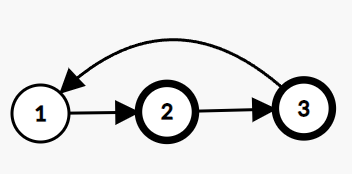
You are given a Singly Linked List of integers. Return true if it has a cycle, else return false.
A cycle occurs when a node's next points back to a previous node in the list.
Example:
In the given linked list, there is a cycle, hence we return true.
Problem approach
tortoise and hare approach
2. Technical Questions
Different maps and how they are implemented in memory
04
Round
Easy
HR Round
Duration10 mins
Interview date21 Feb 2023
Coding problem1
Telephonic HR interview
1. Basic HR Questions
He asked me to introduce myself and asked about my family background we had a good 10 min chat
Problem approach
Tip 1: Stay confident and speak good english


Here's your problem of the day 
Solving this problem will increase your chance to get selected in this company
Skill covered: Programming
How do you remove whitespace from the start of a string?
Choose another skill to practice
Similar interview experiences
SDE - Intern
4 rounds | 12 problems
Interviewed by Wells Fargo
Selected 
3132 views

0 comments

0 upvotes
SDE - Intern
2 rounds | 4 problems
Interviewed by Wells Fargo
Selected 1730 views
0 comments
0 upvotes
SDE - Intern
3 rounds | 4 problems
Interviewed by Wells Fargo
 Selected
 1263 views
0 comments
0 upvotes
SDE - Intern
3 rounds | 7 problems
Interviewed by Wells Fargo
Selected 1667 views
0 comments
0 upvotes
Companies with similar interview experiences

SDE - Intern
2 rounds | 4 problems
Interviewed by Arcesium
 Selected
 3915 views
0 comments
0 upvotes
SDE - Intern
3 rounds | 5 problems
Interviewed by Arcesium
Selected 2888 views
0 comments
0 upvotes

SDE - Intern
3 rounds | 5 problems
Interviewed by BNY Mellon
 Selected
 2484 views
0 comments
0 upvotes