





Wells Fargo interview experience Real time questions & tips from candidates to crack your interview

SDE - Intern
Wells Fargo


2 rounds | 4 Coding
problems

 Selected
 Interview preparation journey

Preparation
Duration: 6 months
Topics: Data Structures, Pointers, OOPS, System Design, Algorithms, Dynamic Programming.

Tip 1 : Keep it concise and to the point.
Tip 2 : Do not exaggerate or pretend to be a certain way.
Tip 3 : Use correct and non-ambiguous language.
Tip 4 : Don't mention everything on there but the best and relevant stuff of all
Application process
Where: Campus
Eligibility: Above 7 CGPA
Tip 1 : Keep it concise and to the point.
Tip 2 : Do not exaggerate or pretend to be a certain way.
Tip 3 : Use correct and non-ambiguous language.
Tip 4 : Don't mention everything on there but the best and relevant stuff of all

Interview rounds
01
Round
Easy
Online Coding Interview
Duration90 minutes
Interview date16 Sep 2021
Coding problem2
The test was conducted on the AMCAT platform, with webcam and tab-switch monitoring. All questions were mandatory to answer. Coding questions were 2, one being difficult and another's the one given below.
1. Number of Mismatching Bits
Easy
10m average time
90% success

0/40
Asked in companies

Given two integers "first" and "second". Find the number of bits that do not match in the binary representation of the given numbers.
For example, let "first" be 11 and "second" be 15. Writing both the given numbers in binary we get first = 1011(binary representation of 11) and second = 1111(binary representation of 15) we can see all the bits are the same except the second bit.
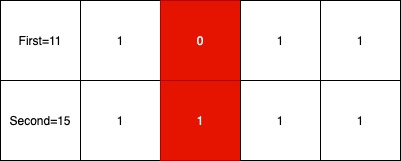
Therefore only 1 bit differs hence we return 1 as shown in the diagram.
Note:
1. Do not print anything, just implement the provided function and return the number of mismatching bits for the given numbers.
Problem approach
For example, let "first" be 11 and "second" be 15. Writing both the given numbers in binary we get first = 1011(binary representation of 11) and second = 1111(binary representation of 15) we can see all the bits are the same except the second bit
2. BST Delete
Easy
15m average time
80% success
0/40
Asked in companies


You are given a binary search tree (BST) and a key value 'K'. You need to delete the node with value 'K'. It is guaranteed that a node has the value 'K'.
A binary search tree (BST), also called an ordered or sorted binary tree, is a rooted binary tree whose internal nodes each store a key greater than all the keys in the node's left subtree and less than those in its right subtree.
Note:
All the elements of the binary search tree are unique.
Problem approach
A binary search tree (BST), also called an ordered or sorted binary tree, is a rooted binary tree whose internal nodes each store a key greater than all the keys in the node's left subtree and less than those in its right subtree.
02
Round
Easy
Telephonic
Duration90 minutes
Interview date18 Sep 2021
Coding problem2
This technical interview was scheduled at 9 AM for me.
1. Minimum count of balls in a bag
Moderate
15m average time
85% success
0/80
Asked in companies


You are given an integer array ‘ARR’ of size ‘N’, where ‘ARR[i]’ denotes the number of balls in the ‘i-th’ bag. You are also given an integer ‘M’, denoting the maximum number of operations you can perform on ‘ARR’ (the given collection of bags).
In each operation, you can do the following:
- Choose a bag from the collection and divide it into two new bags such that each bag contains a positive (non-zero) number of balls. Remove the chosen bag from the collection and add the new bags into the collection.
After performing the operations, let ‘X’ be the maximum number of balls in a bag. The task is to find the minimum possible value of ‘X’ and return it.
Example:
ARR = [5, 7], N = 2, M = 2

Perform the following two operations on ‘ARR’:
1. Divide the bag with 7 balls into 3 and 4. New ARR = [3, 4, 5].
2. Divide the bag with 5 balls into 1 and 4. New ARR = [1, 3, 4, 4].

The bag with the maximum number of balls has 4 balls. Hence, the minimum possible value of ‘X’ is 4. Return 4 as the answer.
Note:
1. You can perform any number of operations between [0, M], both included.
2. Avoid using the 'Modulo' operator as it can cause Time Limit Exceeded.
Problem approach
You are given an integer array ‘ARR’ of size ‘N’, where ‘ARR[i]’ denotes the number of balls in the ‘i-th’ bag. You are also given an integer ‘M’, denoting the maximum number of operations you can perform on ‘ARR’ (the given collection of bags).
In each operation, you can do the following:
Choose a bag from the collection and divide it into two new bags such that each bag contains a positive (non-zero) number of balls. Remove the chosen bag from the collection and add the new bags into the collection.
After performing the operations, let ‘X’ be the maximum number of balls in a bag. The task is to find the minimum possible value of ‘X’ and return it.
2. System Design Question
I was asked to design a Food Delivery App (Swiggy). This round revolved around designing database schemas. I was given around 20 minutes to identify the various entities involved in the system, establish the relationships between these entities and also identify the primary key - foreign key constraints. After 20 minutes, we had a good discussion on my findings and corrections with respect to certain attributes I may have missed out in my design.
A few complex SQL queries were also asked related to the above schemas.


Here's your problem of the day 
Solving this problem will increase your chance to get selected in this company
Skill covered: Programming
How do you remove whitespace from the start of a string?
Choose another skill to practice
Similar interview experiences
SDE - Intern
4 rounds | 12 problems
Interviewed by Wells Fargo
Selected 
3131 views

0 comments

0 upvotes
SDE - Intern
3 rounds | 4 problems
Interviewed by Wells Fargo
 Selected
 1262 views
0 comments
0 upvotes
SDE - Intern
3 rounds | 7 problems
Interviewed by Wells Fargo
Selected 1666 views
0 comments
0 upvotes
SDE - Intern
4 rounds | 6 problems
Interviewed by Wells Fargo
Selected 1033 views
0 comments
0 upvotes
Companies with similar interview experiences

SDE - Intern
2 rounds | 4 problems
Interviewed by Arcesium
 Selected
 3915 views
0 comments
0 upvotes
SDE - Intern
3 rounds | 5 problems
Interviewed by Arcesium
Selected 2888 views
0 comments
0 upvotes

SDE - Intern
3 rounds | 5 problems
Interviewed by BNY Mellon
 Selected
 2484 views
0 comments
0 upvotes