





WheelsEye interview experience Real time questions & tips from candidates to crack your interview
SDE - 1
WheelsEye


2 rounds | 4 Coding
problems
Rejected
Interview preparation journey

Journey
I began my preparation by building a strong foundation in programming and core computer science subjects, focusing on understanding concepts rather than just memorizing solutions. I consistently practiced coding problems to improve my logical thinking and worked on strengthening my basics in data structures and algorithms. Along the way, I faced rejections and challenging interviews, but I treated each experience as a learning opportunity to identify my weak areas and improve.
Application story
I applied through a referral. I learned about this opportunity from one of my friends and asked him to refer me. After that, HR contacted me, collected some basic details, and scheduled the first round of the interview.
Why selected/rejected for the role?
I was stuck in a coding question during second round and was not successfully able to solve that question.
Preparation
Duration: 3 months
Topics: Data Structures, Pointers, OOPS, System Design, Algorithms, Dynamic Programming

Tip 1: Strengthen your fundamentals in Data Structures, Algorithms, and core subjects before attempting advanced problems.
Tip 2: Practice explaining your approach clearly while solving coding problems, as communication plays a key role in technical interviews.
Tip 3: After every mock test or interview, analyse your mistakes carefully and work specifically on your weak areas.
Application process
Where: Campus
Eligibility: 8 CGPA, (Salary package: 10 LPA)
Tip 1: Highlight strong technical skills and relevant coding projects that demonstrate your practical understanding of data structures and problem-solving.
Tip 2: Keep your resume clean and structured, and ensure you can confidently explain every project, tool, or technology mentioned during technical discussions.

Interview rounds
01
Round
Easy
Face to Face
Duration60 minutes
Interview date6 Jun 2025
Coding problem2
1. Zig-Zag String
Easy
15m average time
85% success

0/40
Asked in companies



You are given a string ‘STR’ of size ‘N’ and an integer ‘M’ (the number of rows in the zig-zag pattern of ‘STR’). Your task is to return the string formed by concatenating all ‘M’ rows when string ‘STR’ is written in a row-wise zig-zag pattern.
Example:
N = 12, M = 3 and STR = ‘CODINGNINJAS’
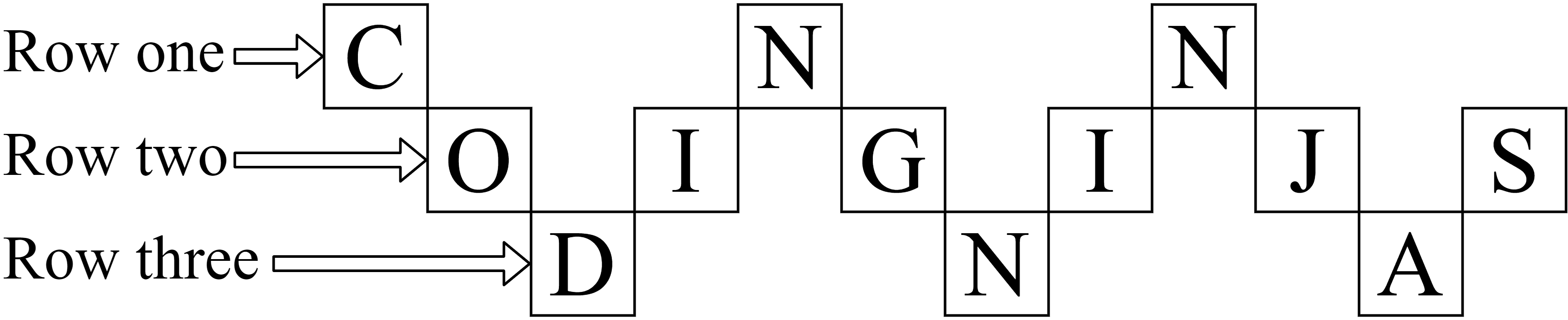
There are three rows (‘M = 3’) in the zig-zag pattern. Row one contains ‘CNN’, row two contains ‘OIGIJS’, and row three contains ‘DNA’. After concatenating the three rows, we get the string ‘CNNOIGIJSDNA’. So, the answer is ‘CNNOIGIJSDNA’.
Note:
1. The string ‘STR’ consists of capital letters only (i.e., characters from ‘A-Z’).
Problem approach
The zigzag movement follows two phases repeatedly:
Vertical Downward Phase
Move from row 0 to numRows - 1.
Diagonal Upward Phase
Move from row numRows - 2 back to row 1.
Then repeat.
This creates one complete zigzag cycle.
2. Valid Parentheses
Easy
10m average time
80% success
0/40
Asked in companies



You're given a string 'S' consisting of "{", "}", "(", ")", "[" and "]" .
Return true if the given string 'S' is balanced, else return false.
For example:
'S' = "{}()".

There is always an opening brace before a closing brace i.e. '{' before '}', '(' before ').
So the 'S' is Balanced.
Problem approach
Step 1: Read the string from left to right.
Step 2: Whenever you encounter an opening bracket:
Mentally “remember” that it needs to be closed later.
Step 3: Whenever you encounter a closing bracket:
Check two things:
Was something opened before?
If nothing was opened → invalid.
Does this closing bracket match the most recently opened one?
If not → invalid.
Step 4: After checking the entire string:
If everything that was opened is properly closed → valid.
If something remains unclosed → invalid.
02
Round
Easy
Face to Face
Duration60 minutes
Interview date9 Jun 2025
Coding problem2
1. Median of two sorted arrays
Hard
25m average time
65% success
0/120
Asked in companies



Given two sorted arrays 'a' and 'b' of size 'n' and 'm' respectively.
Find the median of the two sorted arrays.
Median is defined as the middle value of a sorted list of numbers. In case the length of list is even, median is the average of the two middle elements.
The expected time complexity is O(min(logn, logm)), where 'n' and 'm' are the sizes of arrays 'a' and 'b', respectively, and the expected space complexity is O(1).
Example:
Input: 'a' = [2, 4, 6] and 'b' = [1, 3, 5]

Output: 3.5

Explanation: The array after merging 'a' and 'b' will be { 1, 2, 3, 4, 5, 6 }. Here two medians are 3 and 4. So the median will be the average of 3 and 4, which is 3.5.
Problem approach
If total elements = N
If N is odd → median = middle element
If N is even → median = average of two middle elements
Instead of merging both arrays (which takes O(n + m)),
we use a binary search partition technique.
The key idea:
Divide both arrays into left and right halves such that:
Left half contains exactly half of total elements
Every element in left half ≤ every element in right half
When this condition is satisfied → we can compute the median directly.
2. System Design
Design Parking Lot system. (Learn)


Here's your problem of the day 
Solving this problem will increase your chance to get selected in this company
Skill covered: Programming
How do you remove whitespace from the start of a string?
Choose another skill to practice
Similar interview experiences
SDE - 1
2 rounds | 3 problems
Interviewed by WheelsEye
 Selected
0 views

0 comments

0 upvotes
SDE - 1
2 rounds | 3 problems
Interviewed by WheelsEye
 Selected
 0 views
0 comments
0 upvotes
SDE - 1
2 rounds | 3 problems
Interviewed by WheelsEye
Selected 0 views
0 comments
0 upvotes
SDE - Intern
1 rounds | 3 problems
Interviewed by Amazon
 Selected
 4456 views
0 comments
0 upvotes
Companies with similar interview experiences
SDE - 1
5 rounds | 12 problems
Interviewed by Amazon
 Selected
 117552 views
24 comments
0 upvotes
SDE - 1
4 rounds | 5 problems
Interviewed by Microsoft
Selected 60142 views
5 comments
0 upvotes
SDE - 1
3 rounds | 7 problems
Interviewed by Amazon
 Selected
 36138 views
7 comments
0 upvotes