





WinZO interview experience Real time questions & tips from candidates to crack your interview
SDE - 1
WinZO


3 rounds | 6 Coding
problems

Rejected
Interview preparation journey

Journey
I immersed myself in programming languages, data structures, and algorithms. As I progressed, I explored advanced topics like machine learning and AI. I dedicated countless hours to personal projects and online courses, learning through trial and error. The support of coding communities and mentors was invaluable. Through dedication, practice, and continuous learning, I made significant progress.
Application story
It's on-campus placement season, and companies are coming for on-campus recruitment. The criteria for applying to this company are that the candidate should have 80% or above in both the 10th class and 12th class, and a CGPA greater than 8.5.
Why selected/rejected for the role?
I am trying to understand why I was rejected. They didn't call me for the HR round after taking two technical rounds. Everything was looking fine this time. They just visited our college and have not selected anyone for a full-time offer.
Preparation
Duration: 3 months
Topics: Data Structures, Algorithms, Machine Learning Concepts, Problem-solving Strategies, System Design Principles

Tip 1: Consistent Practice is Key - Dedicate time daily to practicing coding problems, working on projects, and reviewing concepts. Consistency helps solidify your understanding and improve problem-solving skills.
Tip 2: Learn from Mistakes - Don't be discouraged by mistakes or failures. Instead, embrace them as learning opportunities. Analyze what went wrong, understand the gaps in your knowledge, and strive to improve with each setback.
Application process
Where: Campus
Eligibility: 8.5 CGPA
Tip 1: Highlight Relevant Projects - Showcase your practical skills by including projects that demonstrate your abilities and align with the job you're applying for. Describe the project's scope, your role, the technologies used, and the problems you solved.
Tip 2: Tailor Your Resume - Customize your resume for each job application by focusing on the skills and experiences most relevant to the position. This shows your genuine interest and makes your resume stand out.

Interview rounds
01
Round
Hard
Online Coding Interview
Duration60 minutes
Interview date5 Aug 2023
Coding problem2
1. The Maze
Moderate
35m average time
65% success

0/80
Asked in companies



Ninja went to an amusement park and visited a maze. Now, he is stuck in the maze. He can go in any direction(Up, Down, Left, or Right) from this point, but he cannot change his direction of motion until he comes across a wall in its path. Once he stops, he can choose his new direction.
Now, you are given Ninja’s starting point, the destination he wants to reach, and the maze in the form of a 2D matrix. You need to find out if Ninja can reach the destination from the starting point or not.
The maze is represented by a 2D array. ‘1’ means Ninja came across a wall and he needs to stop. ‘0’ means that it is an empty space and he can keep moving.
The coordinates of starting point and destination are represented by row and column numbers.
For Example
Given maze: {[0, 0, 1], [1, 0, 0], [1, 0, 0]}
Starting point: [2, 2]
Destination: [0, 0]

For the above example maze will look like this:
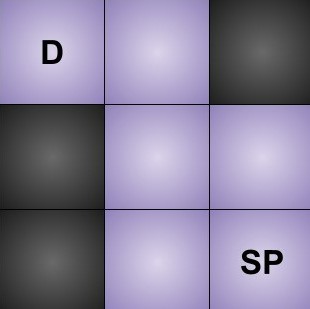
So, we can see there are 2 ways for Ninja to reach destination(D), from the starting point(SP). They are: [left -> up -> left] and [up -> left -> up -> left].
So, you need to print true.
2. K Centers
Moderate
25m average time
75% success
0/80
Asked in companies



In Ninja Land there are ‘N’ cities numbered from 0 to ‘N’-1. The distance between each pair of cities is given by N * N matrix ‘DIST’ where ‘DIST[i][j]’ denotes the distance between city ‘i’ and ‘j’.
Ninja wants to select ‘K’ (‘K’ <= ‘N’) cities and install Coding Ninjas Server in these cities. He wants to select ‘K’ cities in such a way that the maximum distance of a city from the Coding Ninjas Server is minimized.
Can you help Ninja in finding this maximum distance if he selects ‘K’ cities optimally? You should return this distance.
Note :
1. DIST[i][j] = DIST[j][i].
2. DIST[i][i] = 0.
Example :
Consider that there are 4 cities i.e. ‘N’ = 4, and the distance between each pair of cities is given by the following matrix ‘DIST’:
             [0, 10, 7, 6]
             [10, 0, 8, 5]
             [7, 8, 0, 12]
             [6, 5, 12, 0]

Graphically, cities can be represented as -:
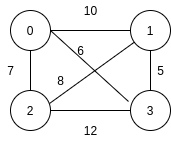
Assume Ninjas wants to install a server in 2 cities i.e ‘K’ = 2.  Then one optimal choice is to select cities 2 and 3.
After that, the minimum distance of city 0 from the server is  6  (i.e from city 2).
The minimum distance of city 1 from the server is 5  (i.e from city 3).
The minimum distance of cities 2 and 3 from the server is 0, as the server is installed in these cities.
Thus the maximum distance of the city from the server is max (6, 5, 0, 0) = 6.
So, we should return 6.
No selection of two cities can give a maximum distance which is less than 6.
Problem approach
long long solve(){
int ha,hb,hc,ab,bc,ac;
cin>>ha>>hb>>hc>>ac>>ab>>bc;
unordered_map map;
map[1]=ha;
map[2]=hb;
map[3]=hc;
map[12]=ab;
map[21]=ab;
map[13]=ac;
map[31]=ac;
map[23]=bc;
map[32]=bc;
long long ans = LONG_MAX;
for (long long i = 1; i <= 3; i++) {
for (long long j = 1; j <= 3; j++) {
if (i != j) {
long long one = map[i] + map[j] + map[i * 10 + j];
long long two = 2 * (map[i] + map[i * 10 + j]);
long long three = 2 * (map[j] + map[i * 10 + j]);
long long four = 2 * (map[j] + map[j]);
ans = min(ans, min(one, min(two, min(three, four))));
}
}
}
return ans;
} 02
Round
Easy
Face to Face
Duration60 minutes
Interview date8 Aug 2023
Coding problem2
1. Regular Expression Matching
Hard
25m average time
80% success
0/120
Asked in companies



Given an input string 'S' and a pattern 'P', implement a regular expression matching with the support of two special characters ‘.’ (dot) and ‘*’(asterisk) where
1. ‘.’ matches to any single character.
2. ‘*’ matches to zero or more of the preceding element.
If the input string 'S' matches the pattern 'P', then return true else, return false.
Note:
1. You have to match the entire string with the pattern given.

2. Both the strings, 'S' and 'P' contain only lower-case alphabets.

3. Only the pattern will contain additional characters ‘*’ and ‘.’ along with alphabets.
Problem approach
#include
#include

using namespace std;

class Solution {
public:
bool isMatch(string s, string p) {
int m = s.length();
int n = p.length();

// Create a 2D table to store the matching results
vector> dp(m + 1, vector(n + 1, false));

// Base case: an empty string and an empty pattern match
dp[0][0] = true;

// Fill the first row of the table
// If the pattern contains '*' and the previous character in the pattern matches the current character in the string,
// then the current position in the table matches.
for (int j = 1; j <= n; j++) {
if (p[j - 1] == '*') {
dp[0][j] = dp[0][j - 2];
}
}

// Fill the remaining positions of the table
for (int i = 1; i <= m; i++) {
for (int j = 1; j <= n; j++) {
// If the current characters match or the pattern contains '.',
// then the current position in the table matches the previous position.
if (s[i - 1] == p[j - 1] || p[j - 1] == '.') {
dp[i][j] = dp[i - 1][j - 1];
}
// If the pattern contains '*', we have two cases:
// 1. The '*' matches zero preceding element, then check if the pattern without '*' matches the current string.
// 2. The '*' matches one or more preceding elements, then check if the current character in the string matches the preceding character in the pattern,
// and the current position in the table matches the previous position or the current position matches the position before the preceding character in the pattern.
else if (p[j - 1] == '*') {
dp[i][j] = dp[i][j - 2]; // case 1

if (p[j - 2] == '.' || p[j - 2] == s[i - 1]) {
dp[i][j] = dp[i][j] || dp[i - 1][j]; // case 2
}
}
}
}

return dp[m][n];
}
};2. Valid Parentheses
Easy
10m average time
80% success
0/40
Asked in companies


You're given a string 'S' consisting of "{", "}", "(", ")", "[" and "]" .
Return true if the given string 'S' is balanced, else return false.
For example:
'S' = "{}()".

There is always an opening brace before a closing brace i.e. '{' before '}', '(' before ').
So the 'S' is Balanced.
03
Round
Easy
Face to Face
Duration60 minutes
Interview date11 Aug 2023
Coding problem2
1. Jump Game
Moderate
25m average time
75% success
0/80
Asked in companies


There is an array 'JUMP' of size 'N' which is 1-indexed and you are currently at index 1. Your goal is to reach index 'N' (end).
When you are at index 'i', you can jump a maximum length of 'JUMP[i]' which means you can make a jump of size 1 to JUMP[i]. Return true if you can reach the end otherwise false.
Example:-
N = 5
JUMP = [1,2,3,4,5]

ANSWER:- The answer should be YES as you can jump from 1st index to 2nd index, from 2nd index to 4th index, and from 4th index to 5th index.
2. Find Number Of Islands
Moderate
34m average time
60% success
0/80
Asked in companies


You are given a 2-dimensional array/list having N rows and M columns, which is filled with ones(1) and zeroes(0). 1 signifies land, and 0 signifies water.
A cell is said to be connected to another cell, if one cell lies immediately next to the other cell, in any of the eight directions (two vertical, two horizontal, and four diagonals).
A group of connected cells having value 1 is called an island. Your task is to find the number of such islands present in the matrix.


Here's your problem of the day 
Solving this problem will increase your chance to get selected in this company
Skill covered: Programming
How do you remove whitespace from the start of a string?
Choose another skill to practice
Similar interview experiences

SDE - 1
3 rounds | 7 problems
Interviewed by OYO
 Selected
6182 views

0 comments

0 upvotes

SDE - 1
2 rounds | 5 problems
Interviewed by Meesho
Rejected
7246 views
0 comments
0 upvotes

SDE - 1
3 rounds | 9 problems
Interviewed by Salesforce
 Selected
 4552 views
0 comments
0 upvotes
SDE - Intern
3 rounds | 3 problems
Interviewed by WinZO

Rejected
539 views
0 comments
0 upvotes
Companies with similar interview experiences
SDE - 1
5 rounds | 12 problems
Interviewed by Amazon
 Selected
 117552 views
24 comments
0 upvotes

SDE - 1
4 rounds | 5 problems
Interviewed by Microsoft
Selected 60143 views
5 comments
0 upvotes
SDE - 1
3 rounds | 7 problems
Interviewed by Amazon
 Selected
 36138 views
7 comments
0 upvotes