





Wipro pvt interview experience Real time questions & tips from candidates to crack your interview
Project Engineer
Wipro pvt


3 rounds | 5 Coding
problems

 Selected
 Interview preparation journey

Preparation
Duration: 3 months
Topics: Data Structures, Pointers, OOPS, System Design, Algorithms, Dynamic Programming

Tip 1 : Practice at least 250 Questions of basic data structures
Tip 2 : Practice on daily basis don't take long breaks
Tip 3 : Take time to study DSA
Application process
Where: Campus
Eligibility: No backlogs
Tip 1 : Have some projects on resume.
Tip 2 : Do not put false things on resume
Tip 3 : Highlight your achievements in your resume

Interview rounds
01
Round
Easy
Online Coding Interview
Duration120 minutes
Interview date9 Nov 2021
Coding problem2
The questions which came in online test was quite easy. There were 30 MCQs and 2 coding problem which we have to solve
1. Balanced parentheses
Moderate
10m average time
90% success

0/80
Asked in companies



Given an integer ‘N’ representing the number of pairs of parentheses, Find all the possible combinations of balanced parentheses with the given number of pairs of parentheses.
Note :
Conditions for valid parentheses:
1. All open brackets must be closed by the closing brackets.

2. Open brackets must be closed in the correct order.
For Example :
()()()() is a valid parentheses.
)()()( is not a valid parentheses.
Problem approach
Algorithm:
Declare a character stack S.
Now traverse the expression string exp.
If the current character is a starting bracket (‘(‘ or ‘{‘ or ‘[‘) then push it to stack.
If the current character is a closing bracket (‘)’ or ‘}’ or ‘]’) then pop from stack and if the popped character is the matching starting bracket then fine else brackets are not balanced.
After complete traversal, if there is some starting bracket left in stack then “not balanced”
2. Reverse A LL
Moderate
30m average time
65% success
0/80
Asked in companies


Ninjas is practicing problems on the linked list. He came across a problem in which he has given a linked list of ‘N’ nodes and two integers, ‘LOW’ and ‘HIGH’. He has to return the linked list ‘HEAD’ after reversing the nodes between ‘LOW’ and ‘HIGH’, including the nodes at positions ‘LOW’ and ‘HIGH’.
Problem approach
Initialize three pointers prev as NULL, curr as head and next as NULL.
Iterate through the linked list. In loop, do following.
// Before changing next of current,
// store next node
next = curr->next
// Now change next of current
// This is where actual reversing happens
curr->next = prev
// Move prev and curr one step forward
prev = curr
curr = next
02
Round
Easy
Online Coding Interview
Duration60 minutes
Interview date27 Jun 2022
Coding problem2
It was a coding round. 2 coding questions each from Array and string were asked.
1. Search In Infinite Sorted 0-1 Array
Easy
10m average time
90% success
0/40
Asked in companies



You are given an infinite array consisting of only ones and zeroes, in sorted order. You have to find the index of the first occurrence of 1.
Example:
If the array is 0 0 0 0 1 1 1 1… then, the first occurrence of 1 will be at index 4 therefore the answer here is 4.
Note:
As the array size is infinite, the actual array won’t be given to you. Instead, you will be able to access the array elements by calling a method named ‘get’.

get(i) : returns the value present at index I.

Indexing is 0-based.

Instead of representing an infinite array in the input, we give the index of the first occurrence of 1 in the input itself. However, this input will be completely hidden from the user.

It is guaranteed that the answer will fit in a 64-bit integer.
2. Binary Tree Pruning
Moderate
20m average time
80% success
0/80
Asked in companies



You have been given a Binary Tree where the value of each node is either 0 or 1. Your task is to return the same Binary Tree but all of its subtrees that don't contain a 1 have been removed.
Note :
A subtree of a node X is X, plus every node that is a descendant of X.
For Example :
Look at the below example to see a Binary Tree pruning.
Input: [1, 1, 1, 0, 1, 0, 1, 0, 0, -1, -1, -1, -1, -1, -1, -1, -1, -1, -1]
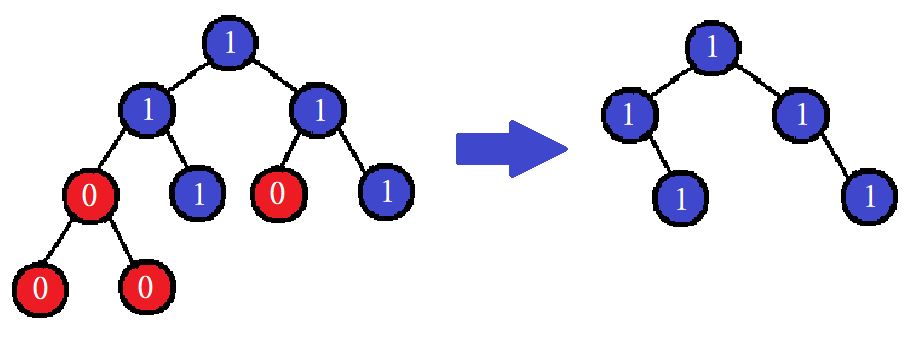
Output: [1, 1, 1, -1, 1, -1, 1, -1, -1, -1, -1]

For example, the input for the tree depicted in the below image would be :
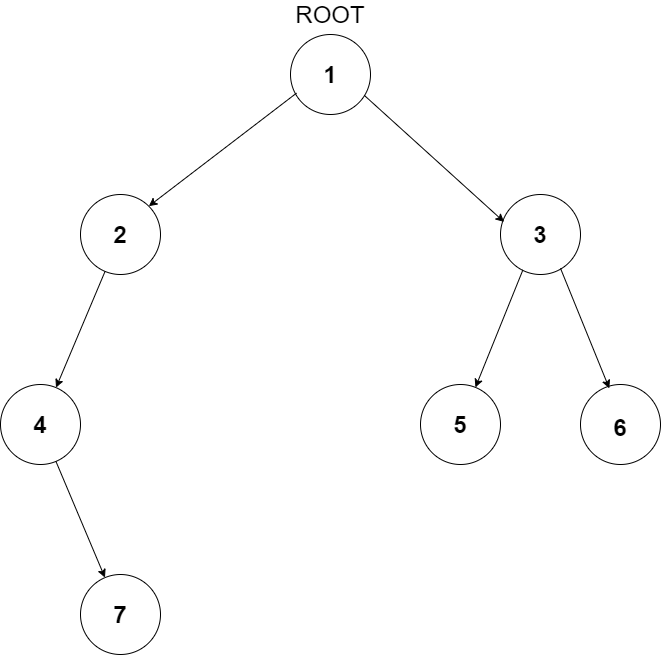
1
2 3
4 -1 5 6
-1 7 -1 -1 -1 -1
-1 -1
Explanation :
Level 1 :
The root node of the tree is 1

Level 2 :
Left child of 1 = 2
Right child of 1 = 3

Level 3 :
Left child of 2 = 4
Right child of 2 = null (-1)
Left child of 3 = 5
Right child of 3 = 6

Level 4 :
Left child of 4 = null (-1)
Right child of 4 = 7
Left child of 5 = null (-1)
Right child of 5 = null (-1)
Left child of 6 = null (-1)
Right child of 6 = null (-1)

Level 5 :
Left child of 7 = null (-1)
Right child of 7 = null (-1)

The first not-null node (of the previous level) is treated as the parent of the first two nodes of the current level. The second not-null node (of the previous level) is treated as the parent node for the next two nodes of the current level and so on.
The input ends when all nodes at the last level are null (-1).
Note :
The above format was just to provide clarity on how the input is formed for a given tree.

The sequence will be put together in a single line separated by a single space. Hence, for the above-depicted tree, the input will be given as:
1 2 3 4 -1 5 6 -1 7 -1 -1 -1 -1 -1 -1
03
Round
Easy
HR Round
Duration20 minutes
Interview date13 Nov 2021
Coding problem1
It was a HR Round. The interviewer was a senior post holder from WIPRO. He was very friendly in nature. So, this round more looked like a general discussion
1. Basic HR Questions
- Introduce yourself
- What are your strength?
- What are your tech expertise?
- What are your strength and weakness?
- Why do you want to join RTDS?
- Explain the working of your project
Problem approach
Tip 1 : Good projects
Tip 2 : Knowledge about basic questions


Here's your problem of the day 
Solving this problem will increase your chance to get selected in this company
Skill covered: Programming
How do you remove whitespace from the start of a string?
Choose another skill to practice
Similar interview experiences
Project Engineer
2 rounds | 6 problems
Interviewed by Wipro pvt
Selected 
989 views

0 comments

0 upvotes
Project Engineer
3 rounds | 4 problems
Interviewed by Wipro pvt
Selected 1138 views
0 comments
0 upvotes
Project Engineer
3 rounds | 4 problems
Interviewed by Wipro pvt
Selected 1382 views
0 comments
0 upvotes
Project Engineer
3 rounds | 4 problems
Interviewed by Wipro pvt
 Selected
 1201 views
1 comments
0 upvotes
Companies with similar interview experiences

Project Engineer
2 rounds | 4 problems
Interviewed by Amdocs
 Selected
 1255 views
0 comments
0 upvotes