





Zomato interview experience Real time questions & tips from candidates to crack your interview
SDE - 1
Zomato


2 rounds | 5 Coding
problems

 Selected
 Interview preparation journey

Preparation
Duration: 3 months
Topics: DSA, DBMS, Puzzles, OS, System Design, DP

Tip 1 : Never never try to cheat in online interview the interviewer will definitely get to know.
Tip 2 : Psuedo code presentation matters a lot so name Your variable properly and with proper indentation.
Tip 3 : Keep on trying even if You feel that's not the right answer so at least put that idea forward.
Tip 4 : Do Leetcode medium questions as much as possible As they are mostly asked in Interviews.
Application process
Where: Referral
Eligibility: girl candidate
Tip 1 : Avoid unnecesary details on Resume
Tip 2 : Make It look clean and also keep it of one page

Interview rounds
01
Round
Easy
Video Call
Duration60 mins
Interview date4 Mar 2022
Coding problem4
This is an online assessment round consisting of 4 DSA problems of medium-hard range. The duration of the round is 60 minutes.
1. Allocate Books
Moderate

0/80
A number ‘X’ is interesting if the binary representation of ‘X’ (without leading zeroes) has exactly two zeroes.
You are given two positive integers, ‘L’ and ‘R’. Your task is to count the number of values ‘X’, such that ‘L’ ≤ ‘X’ ≤ ’R’ and ‘X’ is interesting (i.e., it has exactly two zeroes in its binary representation).
Example :
L = 2, R = 9
All the numbers between L and R and their binary representations are:
X = 2 => 10
X = 3 => 11
X = 4 => 100
X = 5 => 101
X = 6 => 110
X = 7 => 111
X = 8 => 1000
X = 9 => 1001
As 4 and 9 are the only numbers with two zeroes in their binary representations, hence the answer is 2.
2. Two Zeroes
Moderate
0/80
A number ‘X’ is interesting if the binary representation of ‘X’ (without leading zeroes) has exactly two zeroes.
You are given two positive integers, ‘L’ and ‘R’. Your task is to count the number of values ‘X’, such that ‘L’ ≤ ‘X’ ≤ ’R’ and ‘X’ is interesting (i.e., it has exactly two zeroes in its binary representation).
Example :
L = 2, R = 9
All the numbers between L and R and their binary representations are:
X = 2 => 10
X = 3 => 11
X = 4 => 100
X = 5 => 101
X = 6 => 110
X = 7 => 111
X = 8 => 1000
X = 9 => 1001
As 4 and 9 are the only numbers with two zeroes in their binary representations, hence the answer is 2.
3. Unique Paths
Moderate
25m average time
80% success
0/80
Asked in companies



You are present at point ‘A’ which is the top-left cell of an M X N matrix, your destination is point ‘B’, which is the bottom-right cell of the same matrix. Your task is to find the total number of unique paths from point ‘A’ to point ‘B’.In other words, you will be given the dimensions of the matrix as integers ‘M’ and ‘N’, your task is to find the total number of unique paths from the cell MATRIX[0][0] to MATRIX['M' - 1]['N' - 1].
To traverse in the matrix, you can either move Right or Down at each step. For example in a given point MATRIX[i] [j], you can move to either MATRIX[i + 1][j] or MATRIX[i][j + 1].
4. Largest rectangle in a histogram
Hard
25m average time
75% success
0/120
Asked in companies



You have been given an array/list 'HEIGHTS' of length ‘N. 'HEIGHTS' represents the histogram and each element of 'HEIGHTS' represents the height of the histogram bar. Consider that the width of each histogram is 1.
You are supposed to return the area of the largest rectangle possible in the given histogram.
For example :
In the below histogram where array/list elements are {2, 1, 5, 6, 2, 3}.
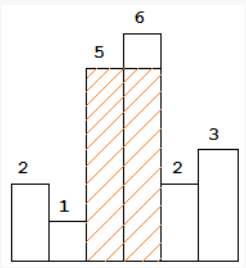
The area of largest rectangle possible in the given histogram is 10.
02
Round
Easy
Video Call
Duration45 mins
Interview date7 Mar 2022
Coding problem1
This is a F2F interview round through google meet. The interviewer started with asking my intro and then asked a DSA question.
As the round is only for 40-45 minutes, he told me not to write the code as he is satisfied with the explanation. Then he told me about his work at zomato and his recent achievements. I asked a few doubts regarding his work and how did they tackle a few problems (about the search option in the Zomato app as the interviewer worked on this particularly). This discussion went on for another 5 minutes and he ended the interview by adding a few points on work culture at zomato.
1. LRU Cache Implementation
Moderate
25m average time
65% success
0/80
Asked in companies



Design and implement a data structure for Least Recently Used (LRU) cache to support the following operations:
1. get(key) - Return the value of the key if the key exists in the cache, otherwise return -1.

2. put(key, value), Insert the value in the cache if the key is not already present or update the value of the given key if the key is already present. When the cache reaches its capacity, it should invalidate the least recently used item before inserting the new item.
You will be given ‘Q’ queries. Each query will belong to one of these two types:
Type 0: for get(key) operation.
Type 1: for put(key, value) operation.
Note :
1. The cache is initialized with a capacity (the maximum number of unique keys it can hold at a time).

2. Access to an item or key is defined as a get or a put operation on the key. The least recently used key is the one with the oldest access time.
Problem approach
He first asked me to discuss my approach. I started with a basic brute force approach using 3-4 hashmaps and in linear time. Then I optimized it to O (log N) time complexity. I tried to convert it into O (1) time complexity using LinkedList. But my logic will not work for a few edge cases. He then gave a hint, and I am able to solve the question properly. It took around 30 minutes for the discussion of the approach to get an O (1) solution.


Here's your problem of the day 
Solving this problem will increase your chance to get selected in this company
Skill covered: Programming
What does dict.keys() return?
Choose another skill to practice
Similar interview experiences
SDE - 1
2 rounds | 4 problems
Interviewed by Zomato
Selected 
2569 views

0 comments

0 upvotes
SDE - 1
2 rounds | 0 problems
Interviewed by Zomato
Rejected
7243 views
1 comments
0 upvotes
SDE - 1
2 rounds | 5 problems
Interviewed by Zomato
Selected 2928 views
0 comments
0 upvotes
SDE - 1
2 rounds | 3 problems
Interviewed by Zomato
Selected 1868 views
0 comments
0 upvotes
Companies with similar interview experiences
SDE - 1
5 rounds | 12 problems
Interviewed by Amazon
 Selected
 117625 views
24 comments
0 upvotes

SDE - 1
4 rounds | 5 problems
Interviewed by Microsoft
Selected 60211 views
5 comments
0 upvotes
SDE - 1
3 rounds | 7 problems
Interviewed by Amazon
 Selected
 36160 views
7 comments
0 upvotes