





ZS interview experience Real time questions & tips from candidates to crack your interview
Software Engineer
ZS


2 rounds | 3 Coding
problems

Rejected
Interview preparation journey

Preparation
Duration: 3 months
Topics: Data structures, algorithms, OOPS, Dynamic programming, SQL.

Tip 1 : Practice popular questions from Arrays, Binary Trees, LinkedLists from CodeStudio's Interview Problems
Tip 2 : Make sure you are aware of calculating the time and space complexity for every problem you're coding.
Tip 3 : Prepare through Mock Interviews to practice explaining your approach while solving in an actual interview.
Application process
Where: Campus
Eligibility: Above 8 CGPA
Tip 1 : Describe best of your projects in minimum words. Don't forget to add buzz words like REST APIs/ DB Indexing/ Benchmarking etc if you worked on backend.
Tip 2 : Don't add school achievements like Olympiads or Class Topper in your resume.
Tip 3 : If you've some work experience, put it in a way ,you're marketing yourself. Add terms like 'Created/Owned the Project through entire SDLC'
Tip 4 : Make sure you mention how your work experience actually impacted the company. Or how your self project can be actually useful to end user.

Interview rounds
01
Round
Easy
Face to Face
Duration45 minutes
Interview date10 Jul 2020
Coding problem2
1. Quadratic Probing in Hashing
Easy
25m average time
65% success

0/40
Asked in companies



‘Hashing’ is a technique in which a large non-negative integer is mapped with a smaller non-negative integer using a function called ‘hash function’ and this smaller integer is used as an index of an array called ‘hash table’.
We define ‘Collision’ as a situation when a large integer is mapped to the index in a hash table that is already mapped with some other integer.
‘Quadratic Probing’ is a collision handling technique in which we take the original hash value and successively add ‘i*i’ in ‘ith’ iteration until an unmapped index is found in the hash table. This technique works as follows:
Let ‘x’  be a larger integer, ‘n’ be the size of the hash table, and ‘h(x) = x mod n’ be a hash function. Then in Quadratic Probing -:

1. If we find that the index h(x), is already mapped to some other integer in the hashtable, then we try for index (h(x) + 1 * 1) mod n.

2. If the index (h(x) + 1*1) mod n, is also already mapped to some other integer in the hashtable, then we try for index (h(x) + 2 * 2) mod n.

3. If the index (h(x) + 2*2) mod n, is also already mapped to some other integer in the hashtable, then we try for index ‘(h(x) + 3 * 3) mod n.

4. We repeat this process until an unmapped index is found in the hashtable or index values start repeating.
In Quadratic probing, sometimes, it is possible that we cannot map an integer with any index in the hashtable.
Given an array ‘keys’ consisting of ‘n’ non-negative integers. Let's consider the hash function h(x) = x mod n. Assume that you are traversing the array ‘keys’ from left to right and you need to insert all these keys in the hash table. For each element of the array ‘keys’, your task is to determine the index by which this element is mapped in the hash table if ‘Quadratic Probing’ technique is used to handle the collision. Return an array ‘hashTable’ of size ‘n’ where the element at index ‘i’ is the element from the given array ‘keys’ that is mapped to that index or -1 if no element is mapped to that index.
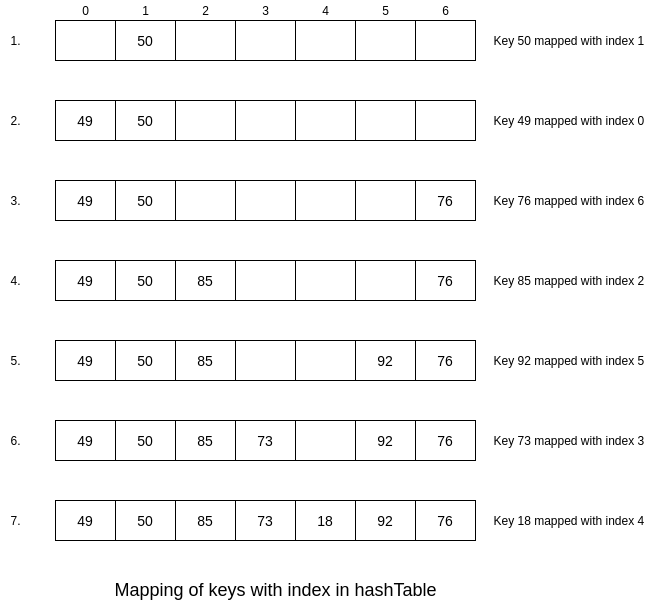
For Example -:  Consider, array  ‘keys’ = {50, 49, 76, 85, 92, 73, 18},  ‘n’ = 7 and the hash function h(x) = x mod 7. Then -:

1. h(50) = 50 mod 7 = 1, thus it will be mapped to index ‘1’ in the hashtable.

2. h(49) = 49 mod 7 = 0, thus it will be mapped to index ‘0’ in hashtable.

3. h(76) = 76 mod 7 = 6, thus it will be mapped to index ‘6’ in the hashtable.

4. h(85) = 85 mod 7 = 1, thus it should be mapped to index ‘1’ in the hashtable, but index ‘1’is already mapped with 50,  so we try for index (h(85) + 1*1) mod 7 = ‘2’, as index ‘2’ is not mapped previously, thus it will be mapped to index ‘2’ in hashtable’.

5. h(92) = 92 mod 7 = 1,  thus it should be mapped to index ‘1’ in the hashtable, but index ‘1’ is already mapped with 50, so we try for index (h(92) + 1*1) mod 7 = 2,  but index ‘2’ is also occupied so we try for index (h(92) + 2*2) mod 7 = ‘5’, as index ‘5’ is not mapped previously, thus it will be mapped to index ‘5’ in hashtable

6. h(73) = 73 mod 7 = 3,  thus it will be mapped to index ‘3’ in the hashtable.

7. h(18) = 18 mod 7 = 4,  thus it will be mapped to index ‘4’ in the hashtable.
Thus the resultant array ‘hashTable’ should be {49, 50, 85, 73, 18, 92, 76}.
Note:
1. Consider ‘0’ based indexing.
2. Don’t print anything, just return the integer array ‘hashTable’.
Problem approach
‘Hashing’ is a technique in which a large non-negative integer is mapped with a smaller non-negative integer using a function called ‘hash function’ and this smaller integer is used as an index of an array called ‘hash table’.
We define ‘Collision’ as a situation when a large integer is mapped to the index in a hash table that is already mapped with some other integer.
‘Quadratic Probing’ is a collision handling technique in which we take the original hash value and successively add ‘i*i’ in ‘ith’ iteration until an unmapped index is found in the hash table. This technique works as follows:
2. Queue Using Stack
Moderate
30m average time
60% success
0/80
Asked in companies


Implement a queue data structure which follows FIFO(First In First Out) property, using only the instances of the stack data structure.
Note:
1. To implement means you need to complete some predefined functions, which are supported by a normal queue such that it can efficiently handle the given input queries which are defined below.


2. The implemented queue must support the following operations of a normal queue:

a. enQueue(data) : This function should take one argument of type integer and place the integer to the back of the queue.

b. deQueue(): This function should remove an integer from the front of the queue and also return that integer. If the queue is empty, it should return -1.

c. peek(): This function returns the element present in the front of the queue. If the queue is empty, it should return -1.

d. isEmpty(): This function should return true if the queue is empty and false otherwise.


3. You will be given q queries of 4 types:

a. 1 val - For this type of query, you need to insert the integer val to the back of the queue.

b. 2 - For this type of query, you need to remove the element from the front of the queue, and also return it.

c. 3 - For this type of query, you need to return the element present at the front of the queue(No need to remove it from the queue).

d. 4 - For this type of query, you need to return true if the queue is empty and false otherwise.


4. For every query of type:

a. 1, you do not need to return anything.

b. 2, return the integer being deQueued from the queue.

c. 3, return the integer present in the front of the queue.

d. 4, return “true” if the queue is empty, “false” otherwise.
Example
Operations:
1 5
1 10
2
3
4

Enqueue operation 1 5: We insert 5 at the back of the queue.
Queue: [5]

Enqueue operation 1 10: We insert 10 at the back of the queue.
Queue: [5, 10]

Dequeue operation 2: We remove the element from the front of the queue, which is 5, and print it.
Output: 5
Queue: [10]

Peek operation 3: We return the element present at the front of the queue, which is 10, without removing it.
Output: 10
Queue: [10]

IsEmpty operation 4: We check if the queue is empty.
Output: False
Queue: [10]
Problem approach
Implement a queue data structure which follows FIFO(First In First Out) property, using only the instances of the stack data structure.
02
Round
Easy
Face to Face
Duration45 minutes
Interview date11 Jul 2020
Coding problem1
1. System Design Questions
Q1. Had to design DB for an ecom website.
Q2. Had to design a DB and system design of a company don't exactly remember
Q3. It was algo design for a computer graphic type problem.


Here's your problem of the day 
Solving this problem will increase your chance to get selected in this company
Skill covered: Programming
How do you remove whitespace from the start of a string?
Choose another skill to practice
Similar interview experiences
Software Engineer
4 rounds | 4 problems
Interviewed by ZS
 Selected
2299 views

0 comments

0 upvotes
Software Engineer
4 rounds | 5 problems
Interviewed by ZS
 Selected
 1547 views
0 comments
0 upvotes
Software Engineer
4 rounds | 7 problems
Interviewed by ZS
 Selected
 1446 views
0 comments
0 upvotes
SDE - 1
2 rounds | 4 problems
Interviewed by ZS
Selected 1065 views
0 comments
0 upvotes
Companies with similar interview experiences

Software Engineer
4 rounds | 1 problems
Interviewed by Newgen Software
 Selected
 3571 views
2 comments
0 upvotes

Software Engineer
3 rounds | 6 problems
Interviewed by HashedIn
 Selected
 2838 views
0 comments
0 upvotes

Software Engineer
2 rounds | 2 problems
Interviewed by Ernst & Young (EY)
 Selected
 0 views
0 comments
0 upvotes