





Zuora interview experience Real time questions & tips from candidates to crack your interview
SDE - Intern
Zuora


2 rounds | 4 Coding
problems

 Selected
 Interview preparation journey

Journey
I first learned a programming language in my first year. Then, I practiced DSA on various coding platforms. For other subjects like OS, CN, DBMS, etc., I prepared using my college materials.
Application story
I saw openings on the Zuora portal for this position. So, I reached out to a lot of Zuora employees on LinkedIn for a referral. One of the employees agreed to give me a referral. So, I applied through his referral.
Why selected/rejected for the role?
My main reason for the selection was an in-depth knowledge of advanced DSA topics like Trees. I hadn't prepared Trees very well, so, I was able to give optimized approaches for Tree-based questions.
Preparation
Duration: 3 months
Topics: Data Structures, OOPS, Operating Systems, Algorithms, C

Tip 1: Code More.
Tip 2: Study Data Structures.
Tip 3: Be Confident.
Application process
Where: Linkedin
Eligibility: 6
Tip 1: Mention only what you are confident about.
Tip 2: Mention tools & technologies used in the project as well.

Interview rounds
01
Round
Medium
Online Coding Interview
Duration95 mins
Interview date2 Dec 2022
Coding problem2
25 MCQs and 2 coding questions & Webcam was on.
1. Longest Repeating Subsequence
Moderate
15m average time
85% success

0/80
Asked in companies



You are given a string ‘st’, Your task is to find the length of the longest repeating subsequence such that two subsequences don’t have the same character at the same position.
For Example :
The given string st = AABCBDC.
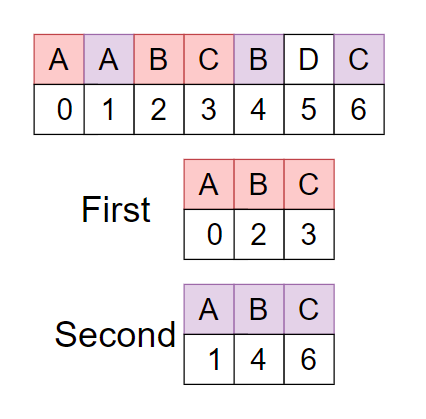
As you can see there are two repeating longest subsequences “ABC” with the same character but different position. Therefore the required answer is ‘3’ as the length of “ABC” is 3.
Problem approach
I first thought of the brute force approach. Then, I tried to solve for LIS, which I had already solved once. Finally, I implemented the DP approach for LDS.
2. Next Greater Element
Easy
10m average time
90% success
0/40
Asked in companies



You are given an array 'a' of size 'n'.
Print the Next Greater Element(NGE) for every element.
The Next Greater Element for an element 'x' is the first element on the right side of 'x' in the array, which is greater than 'x'.
If no greater elements exist to the right of 'x', consider the next greater element as -1.
For example:
Input: 'a' = [7, 12, 1, 20]

Output: NGE = [12, 20, 20, -1]

Explanation: For the given array,

- The next greater element for 7 is 12.

- The next greater element for 12 is 20.

- The next greater element for 1 is 20.

- There is no greater element for 20 on the right side. So we consider NGE as -1.
Problem approach
Stack implementation
02
Round
Medium
Video Call
Duration50 mins
Interview date3 Dec 2022
Coding problem2
The next day at 8 AM, the interviewer was very friendly and provided various hints. The interview covered complex coding questions on tree data structures.
1. Minimum Time To Visit All Points
Moderate
15m average time
85% success
0/80
Asked in companies


Ninja lives in a 2D plane where each location is represented with integer coordinates ‘[X, Y]’. You are given an array ‘POINTS’ containing ‘N’ such points. Ninja lives at the location ‘POINTS[0]’ and wants to visit all the remaining ‘N-1’ points in the order given by the ‘POINTS’ array. Your task is to help ninja find the minimum time (in seconds) required to visit all the points in the given order (starting from ‘POINTS[0]’).
The ninja can travel according to the following rules :
- In one second, the ninja can either:
- Move vertically by one unit, i.e., along the y-direction.
- Move horizontally by one unit, i.e., along the x-direction.
- Move diagonally by ‘sqrt(2)’ units, i.e., move one unit horizontally then one unit vertically.
- The ninja must visit the points in the exact order as they are given the ‘POINTS’ array.
- The ninja is allowed to pass through points that may be given later in the order, but these points will not be counted as visited.
- Move vertically by one unit, i.e., along the y-direction.
- Move horizontally by one unit, i.e., along the x-direction.
- Move diagonally by ‘sqrt(2)’ units, i.e., move one unit horizontally then one unit vertically.
For Example :
‘POINTS = [ [3, 1], [-1, 3], [2, 0] ]’, ‘N = 3’
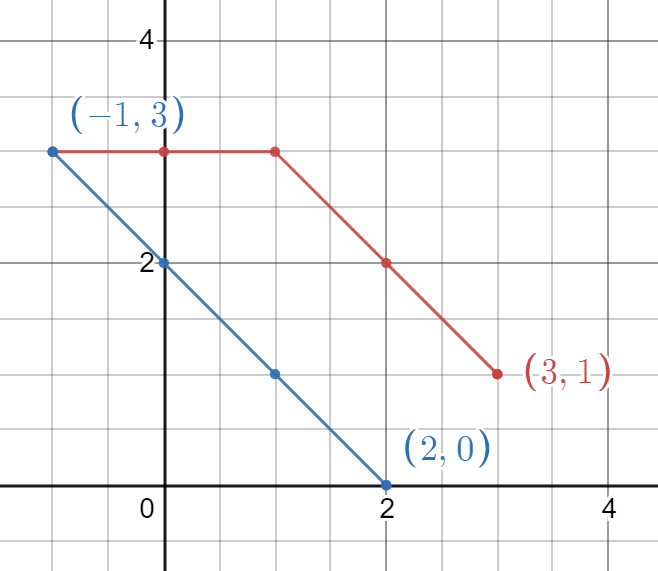
The path with minimum time is: ‘[3,1] -> [2,2] -> [1,3] - > [0,3] -> [-1,3] -> [0,2] -> [1,1] -> [2,0]’.

Time taken from [3,1] to [-1,3] = 4 seconds.
Time taken from [-1,3] to [2,0] = 3 seconds.

Total time = 7 seconds. Thus, you should return ‘7’ as the answer.
Problem approach
I first thought of DFS, and BFS approaches but then tried using heap but couldn't solve since the approach was wrong.
2. Distance between nodes of a binary tree
Moderate
25m average time
60% success
0/80
Asked in companies


Given a binary tree and the value of two nodes, find the distance between the given two nodes of the Binary Tree.
Distance between two nodes is defined as the minimum number of edges in the path from one node to another.
Problem approach
Since, I messed up in the first question and already wasted a lot of time. I couldn't come with any approach.


Here's your problem of the day 
Solving this problem will increase your chance to get selected in this company
Skill covered: Programming
How do you remove whitespace from the start of a string?
Choose another skill to practice
Similar interview experiences

SDE - 1
3 rounds | 7 problems
Interviewed by OYO
 Selected
6182 views

0 comments

0 upvotes
SDE - Intern
2 rounds | 3 problems
Interviewed by Amazon
Rejected
1566 views
0 comments
0 upvotes

SDE - 1
2 rounds | 5 problems
Interviewed by Meesho
Rejected
7246 views
0 comments
0 upvotes

SDE - 1
3 rounds | 9 problems
Interviewed by Salesforce
 Selected
 4552 views
0 comments
0 upvotes
Companies with similar interview experiences
SDE - Intern
3 rounds | 6 problems
Interviewed by Amazon

Rejected
16213 views
4 comments
0 upvotes
SDE - Intern
4 rounds | 7 problems
Interviewed by Microsoft
 Selected
 16224 views
1 comments
0 upvotes
SDE - Intern
2 rounds | 4 problems
Interviewed by Amazon
Selected 10541 views
2 comments
0 upvotes