




Problem
Submissions
Hints & solutions
Discuss
Boundary Traversal
Easy

0/40
3 upvotes
Asked in company

Problem statement
You have been given a binary tree of integers. Your task is to print the boundary nodes of this binary tree in an Anti-Clockwise direction starting from the root node.
NOTE: The boundary nodes of a binary tree include nodes from the left boundary, right boundary and the leaf nodes without duplicate nodes. However, the values from the nodes may contain duplicates.
For Example: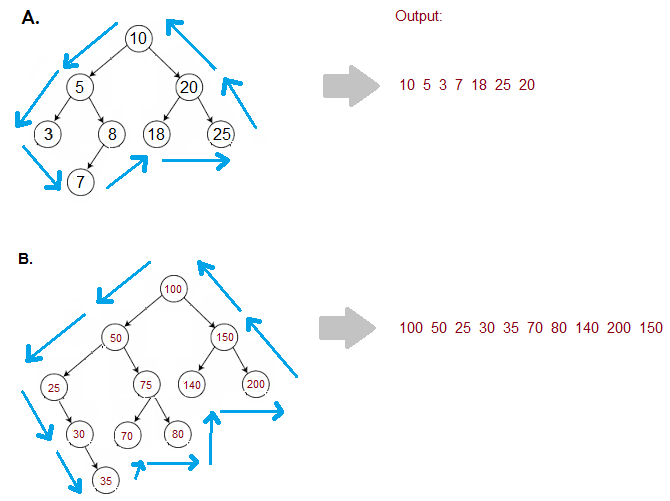
Detailed explanation ( Input/output format, Notes, Images )
Input Format:
The first line contains an integer 'T' which denotes the number of test cases or queries to be run. Then the test cases follow.

The only line of each test case contains elements in the level order form. The line consists of values of nodes separated by a single space. In case a node is null, we take -1 on its place.

For example, the input for the tree depicted in the below image will be:
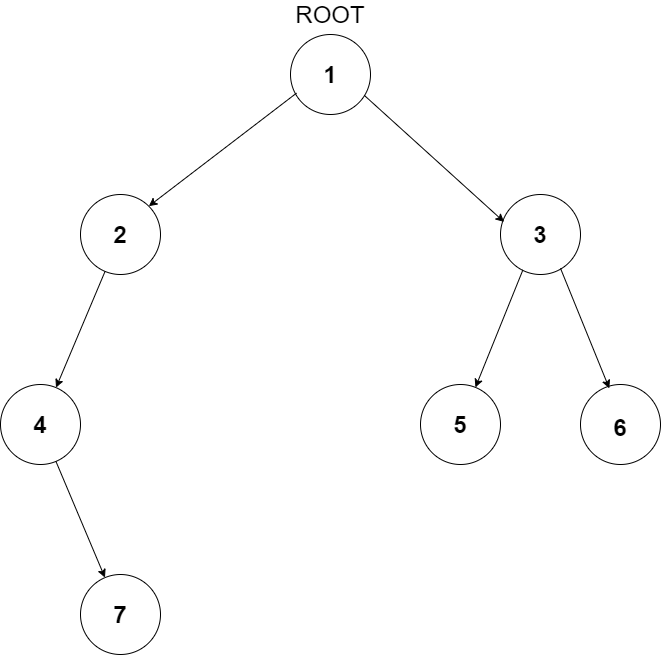
1
2 3
4 -1 5 6
-1 7 -1 -1 -1 -1
-1 -1
Explanation :
Level 1 :
The root node of the tree is 1

Level 2 :
Left child of 1 = 2
Right child of 1 = 3

Level 3 :
Left child of 2 = 4
Right child of 2 = null (-1)
Left child of 3 = 5
Right child of 3 = 6

Level 4 :
Left child of 4 = null (-1)
Right child of 4 = 7
Left child of 5 = null (-1)
Right child of 5 = null (-1)
Left child of 6 = null (-1)
Right child of 6 = null (-1)

Level 5 :
Left child of 7 = null (-1)
Right child of 7 = null (-1)

The first not-null node(of the previous level) is treated as the parent of the first two nodes of the current level. The second not-null node (of the previous level) is treated as the parent node for the next two nodes of the current level and so on.
The input ends when all nodes at the last level are null(-1).
The above format was just to provide clarity on how the input is formed for a given tree.
The sequence will be put together in a single line separated by a single space. Hence, for the above-depicted tree, the input will be given as:

1 2 3 4 -1 5 6 -1 7 -1 -1 -1 -1 -1 -1
For each test case, print the boundary nodes of the given binary tree separated by single spaces.

Print the output of each test case in a separate line.

Note:
You are not required to print the expected output, it has already been taken care of. Just implement the function.
Constraints:
1 <= T <= 100
0 <= N <= 5000
1 <= val <= 10^5 and val != -1

Where ‘T’ is the number of test cases, and ‘N’ is the total number of nodes in the binary tree, and “val” is the value of the binary tree node

Time Limit: 1 sec
Sample Input 1:
2
1 2 3 4 -1 5 -1 -1 -1 -1 -1
1 2 -1 3 4 5 -1 6 -1 -1 -1 -1 -1
Sample Output 1:
1 2 4 5 3
1 2 3 5 6
Explanation of Sample Input 1:
For the first test case, we have 1 as the root node. 2, 4 as left boundary nodes. 3, 5 as the right boundary nodes. We don't have any leaf nodes.

For the second test case, we have 1 as the root node. 2, 3 as the left boundary nodes and 5, 6 as leaf nodes. We don't have any right boundary. Notice that we don’t include 4 in our traversal because the right boundary will start from the right child of the root node.
Sample Input 2:
2
1 2 3 4 5 6 7 -1 -1 -1 -1 -1 -1 -1 -1
4 7 6 -1 -1 8 9 -1 -1 -1 -1
Sample Output 2:
1 2 4 5 6 7 3
4 7 8 9 6
Explanation of Sample Input 1:
For the first test case, we have 1 as the root node. 2, 4 as left boundary nodes and 5,6 as leaf nodes and 3, 7 as the right boundary nodes.

For the second test case, we have 4 as the root node. 7 as the left boundary node and 8 as a leaf node and 9,6 as the right boundary.
Hint
Hint 1
Traverse the left, right boundaries and leaf nodes separately and then combine the result.
Approaches (1)
Approach 1
Recursion based Approach
The boundary traversal of a binary tree can be broken down into 4 parts. These parts are given in the same order as they are present in the traversal-
- The root node - The root node will always be our first node in the whole boundary traversal.
- The left boundary - The left most nodes of the left subtree are also included in the boundary traversal, so we will process them next except for the leaf node as it will be processed in our next part. We can use recursion for this and traverse for only the left child until a leaf node is encountered. If the left child is not present, we recurse for the right child.
- The leaf Nodes - The leaf nodes of the binary tree will be processed next. We can use a simple inorder traversal for that. Inorder traversal will make sure that we process leaf nodes from left to right.
- The right boundary - The rightmost nodes of the right subtree will be processed at last in reverse order except for the leaf node as it is already processed in the previous part. For this, we can use recursion in a postorder manner and traverse for the right child only until we encounter a leaf node. If the right child is not present, we will recurse for the left child. The postorder recursion will make sure that we traverse the right boundary in reverse order.
Time Complexity
O(N), where N is the total number of nodes in the binary tree.
Traversing for left and right boundaries in a binary tree takes at most linear time. Also, traversing for leaf nodes can also be performed in linear time.
Space Complexity
O(N), where N is the total number of nodes in the binary tree.
The recursion stack can grow to the maximum height of the binary tree. In the worst-case scenario, the height of a binary tree can be up to N (Skewed Trees).
Code Solution
(100% EXP penalty)
Boundary Traversal
C++ (g++ 5.4)

Console