




Problem
Submissions
Hints & solutions
Discuss
Bridge and Query
Hard

0/120
Average time to solve is 60m

Contributed by
3 upvotes
Asked in companies

Problem statement
You are given a connected, unweighted and undirected graph with ‘N’ nodes [0 to N - 1] and ‘M’ edges. Your task is to answer ‘Q’ queries on this graph. Each query consists of four integers ‘A’, ‘B’, ‘C’, and ‘D’. For the current query add an edge between nodes numbered ‘A’ and ‘B’ (note that this operation is temporary and only for the current query). Now, output the maximum number of bridge edges occurring on any path between ‘C’ and ‘D’.
Note: An edge between node ‘u’ and ‘v’ is said to be a bridge edge, if after removal of an edge ‘u’ - ‘v’, there is no path between node ‘u’ and ‘v’.
For example:
For given N = 4, M = 3, Q = 1, A = 2, B = 3, C = 0 and D = 3
For all queries, we are temporarily adding an edge between nodes, and here, after the addition of an edge 2 - 3,  the graph looks like this:
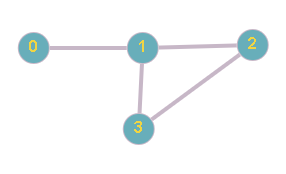
So, the number of bridge edges on the path from node 0 to 3 is 1 i.e 0 - 1.
Detailed explanation ( Input/output format, Notes, Images )
Input Format:
The first line of input contains three integers ‘N’, ‘M’, and ‘Q, denoting the number of nodes, number of edges, and number of queries.

The next ‘M’ line contains two space-separated integers ’u’ and ‘v’, denoting an undirected edge between ‘u’ and ‘v’.

The next ‘Q’ line contains four space-separated integers ‘A’, ‘B’, ‘C’ and ‘D’.
For each query, print a single integer ‘X’, denoting the maximum number of bridge edges occurring on any path between ‘C’ and ‘D’.

The output of each test case will be printed on a separate line.
You do not need to print anything, it has already been taken care of. Just implement the given function.
Constraints:
1 <= Q <= 100
1 <= N, M <= 100
0 <= u, v <= N - 1
0 <= A, B, C, D < N - 1

Time Limit: 1 sec.
Sample Input 1:
4 3 2
0 1
1 2
1 3
2 3 0 3
2 3 2 3
Sample Output 1:
1
0
Explanation of Sample Output1:
In the first query, after the addition of an edge 2 - 3, the graph looks like this:
So, the number of bridge edges on the path from node 0 to 3 is 1 i.e 0 - 1.

In the second query, there is no bridge edge in the above graph after adding edges 2-3. So the number of bridge edges is equal to 0.

Note: For each query, we are temporarily adding an edge between nodes.
Sample Input 2:
6 5 1
0 1
1 2
1 3
3 4
4 5
0 4 2 5
Sample Output 2:
2
Explanation of Sample Output 2:
In the first query, after the addition of an edge 0 - 4 the graph looks like this:
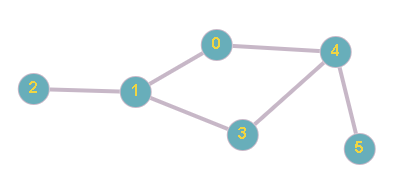
So, the number of bridge edges are 2 i.e( 2 - 1 and 4 - 5)
Hint
Hint 1
Take help from a bridge tree.
Approaches (1)
Approach 1
Precalculate Bridge Tree and LCA (Lowest common ancestor)
Recommended to know before proceeding further
- Concept of bridge and Bridge Tree in a graph.
- LCA (Lowest Common Ancestor) of n -array tree (Dynamic Programming)
The idea is to first build a “Bridge Tree” and then handle the query using this “Bridge Tree”.
Let’s say for the given query ‘A’, ‘B’, ‘C’ and ’D’.The Node ‘A’ lies in component ‘Ca’ of the “Bridge tree”. Similarly, node ‘B’ lies in 'Cb’, ‘C’ lies in ‘Cc’ and ‘D’ lies in ‘Cd’ component of “Bridge Tree”.
After adding nodes ‘A’ and ‘B’ in the graph, all bridges from ‘Ca’ to ‘Cb’ in the bridge tree are destroyed ( property of bridge tree). So, our answer would be the distance between components of ‘C’ and ‘D’ (‘Cc’ and ‘Cd’ ) in the tree minus the edges which occur on the path from ‘Ca’ to ‘Cb’ (ie. a number of edges in the intersection of paths Ca' - ‘Cb’ and ‘Cc’ - ‘Cd’).
Now, we just have to find the length of intersection of paths ‘A' - ‘B’ and ‘C’ - ‘D’. components Let's break down each path into two parts because finding intersections between straight chains would be easier. So, let u = LCA(A, B) and v = LCA(C, D) , so total intersection would be intersection(u, a, v, c) + intersection(u, a, v, d) + intersection(u, b, v, c) + intersection(u, b, v, d).
Note, the above ‘A’, ‘B’, ‘C’ and ‘D’ are components of given nodes respectively.
To find the distance between two nodes in a tree we will use the formula, D( A, B) = Distance of node ‘A’ from root + Distance of node ‘B’ from the root - 2 * distance of node LCA(A, B) from the root, where distances from root to all nodes can be calculated using a DFS and for calculating LCA we can use Dynamic Programming.
Algorithm :
Consider the following global variables
- Array of integer list, ‘graph’ to store graph
- Array ‘U’ and ‘V’ to store the edge
- Array ‘isBridge’, to check whether ‘i-th’ edge is bridge or not
- Array of integer list, ‘graph’ to store bridge tree
- Array ‘visited’, to check whether ‘i-th’ node is visited or not
- Array ‘parent’, to store the parent of each node
- Variable ‘timer’, to give discovery time of each node
- Array ‘disc’ to store the discovery time of each node
- Variable ‘component’, to give the component-time of each node
- Array ‘L’ to store the ancestor of ‘i-th’ node
- 2D array P[][] to store the LCA
- Array ‘C’ to store the component
- Array ‘start’ and ‘finish’ to store the discovery and discovered time of each node in the bridge tree.
Let ‘countBridge(n, m, q, edges, operation) ’ be the function to count the number of bridges between edge ‘C’ and ‘D’ after adding edge ‘A’ and ‘B’.
- Run a loop from 0 to m to construct graph using given edges
- Let ‘u’ = edges[i][0] and ‘v’ = edges[i][1]
- Decrement ‘u’ and ‘v’ by 1.
- Push back ‘i’ in graph[‘v’]
- Push back ‘i’ in graph[‘u’]
- Initialize visited array with 0
- Make function dfs0(start, parent)
- Call function dfs0(0, -1),
- Make function dfs1(start) , to construct a bridge tree.
- Call function dfs1(0)
- Make function dfs2(start, parent), to fill P[][] array ( for finding LCA )
- Call function dfs(0, -1)
- Take an array ‘ans’ to store the answer to the ‘q’ query.
- Run a loop from 0 to q
- Let ‘a’ = operation[i][0], ‘b’ = operation[i][1], ‘c’ = operation[i][2] and ‘d’ = operation[i][3].
- Decrement ‘a’, ‘b’, ‘c’ and ‘d’ by 1.
- Take a temporary variable ‘temp’ and store the return ans of countBridge(component[‘a’], component[‘b’], component[‘c’], component[‘d’])
Description of dfs( start(u), parent(p)) function:
This function finds the discovery time of each node in the given graph, also it marks the ‘isBridge’ array if the edge between U[i] - V[i] is a bridge. This function returns the ‘low’ value of node ‘u’.
- Mark ‘visited[u]’ true
- Increment ‘timer’ by 1.
- Store ‘timer’ is ‘disc[u]’
- Take a variable ‘low’ , initialize it to ‘timer’
- Run a loop from 0 to the size of graph[u], to visit all adjacent vertices
- Take a variable ‘adj’ initialize it to graph[u][i]
- Make a function ‘adjacent( ‘u’, adj)’ that returns the node adjacent to ‘u’ and edge numbered ‘adj’
- call function ‘adjacent(u, adj)’ and store the return value in variable ‘v’.
- If ‘visited[‘v’] is equal to 0
- Call recursively dfs0(‘v’, ‘adj’) and store the return value in ‘mn’.
- Update ‘low’ with a minimum of ‘mn’ and ‘low’.
- If ‘disc[u]’ is less than ‘mn’
- Mark ‘isBridge[adj]’ equal to 1.
- Else if ‘adj’ is not equal to parent ‘p’
- Update ‘low’ with a minimum of ‘disc[v]’ and ‘low’.
- Return ‘low’.
Description of ‘adjacent(node(u), edgeNumber(adj))’ function:
- If U[‘adj’] == ‘u’
- Return V[‘adj’]
- Else
- Return U[‘adj’]
Description of dfs1(node(s)) function:
This function is used to construct a bridge tree.
- Push ‘s’ in ‘Queue[component]
- Mark ‘visited’[s]’ equal to 1.
- Take a variable ‘currComponent’ initialize it to ‘component’
- While Queue[currComponent] is not empty
- Take a variable ‘node’ initialize it with the front element of Queue[currComponent]
- Pop front from ‘Queue[currComponent]’
- Store ‘currComponent’ at ‘componentNo[node]’
- Run a loop from 0 to size of ‘graph[node]’
- Take a variable ‘adj’ and store the value graph[node][i]
- Take a variable ‘v’ and store the return value of adjacent(node, adj)
- If edge ‘adj’ is a bridge and ‘visited[v] is false
- Increment the ‘component’ number
- Push back ‘component’ in ‘Tree[currComponent]
- Push back ‘currComponent’ in ‘Tree[‘component’]
- Recursively call ‘dfs1(‘v’)
- Else if visited[‘v’] is false
- Mark visited[‘v’] true
- Push back ‘v’ in ‘Queue[currComponent].
Description of dfs2(node(u), parent(p)) function:
- If ‘p’ is not equal to -1, make L[u] equal to L[p] + 1, otherwise 1.
- Store ‘p’ in p[0][u]
- Increment ‘now’ by 1
- Initialize ‘start[u]’ with ‘now’
- Run a loop from 1 to ‘MAXL’
- Take a variable ‘x’ initialize it with P[j - 1][u]
- If ‘x’ is less than 0
- Break
- Else
- Store P[j - 1][x] in P[j][u]
- Increment ‘vis’ by one
- Run a loop from 0 to the size of ‘Tree[u]’
- Take a variable ‘v’ initialize it with ‘Tree[u][i]
- If ‘v’ is equal to ‘p’ continue the loop
- Else recursively call dfs2( v, u)
- Increment ‘now’ by 1
- Store ‘now’ in ‘finish[u]’
- Return
Description of ‘countBridge(a, b, c, d)’ function:
- Make function ‘lca(u, v)’, that returns the lowest common ancestor of node ‘u’’ and ‘v’
- Call function lca(a, b) and store the return value in variable ‘u’
- Call function lca(c, d) and store the return value in variable ‘v’,
- Make function ‘getdist(c, d, v) , that return the distance between node ‘c’ and node ‘d’ with the help of lca ‘v’,
- Call function ‘getdist(c, d, v)’ and store the return value in variable ‘ret’.
- Take a variable ‘X’
- Make function getCommonPath(u, a, v, c), it returns the common path between path ‘u’ to ‘a’ and path ‘v’ to ‘c’
- Call function getCommonPath(u, a, v, c) and store the return value in ‘X’
- Call function getdist(X.first, X.second, lca(X.first,X.second)) store the return value in variable ‘temp’
- Subtract ‘temp’ from ‘ret’.
- Call function getCommonPath(u, a, v, d) and store the return value in ‘X’
- Call function getdist(X.first, X.second, lca(X.first,X.second)) store the return value in variable ‘temp’
- Subtract ‘temp’ from ‘ret’.
- Call function getCommonPath(u, b, v, c) and store the return value in ‘X’
- Call function getdist(X.first, X.second, lca(X.first,X.second)) store the return value in variable ‘temp’
- Subtract ‘temp’ from ‘ret’.
- Call function getCommonPath(u, b, v, d) and store the return value in ‘X’
- Call function getdist(X.first, X.second, lca(X.first,X.second)) store the return value in variable ‘temp’
- Subtract ‘temp’ from ‘ret’.
- Return ‘ret’
Description of lca(p, q) function:
This function returns the LCA of node ‘p’ and ‘q’
- Take a variable ‘log’ and ‘i’
- If ‘L[p]’ is less than ‘L[q]’
- Swap ‘p’ and ‘q’
- Initialize ‘log’ with 1 and run a loop from 1 to L[p] while 2 times of log is less than L[p]
- Increment ‘log’ by 1.
- Run a loop from ‘i’ equal to ‘log’ to 0 , decrementing ‘i’ in each step
- if (L[p] - (1 << i) is greater than equal to L[q])
- Store P[i][p] in ‘p’.
- if (L[p] - (1 << i) is greater than equal to L[q])
- If p is equal to ‘q’
- Return ‘p’
- Run a loop from ‘i’ equal to ‘log’ 0
- if ‘P[i][p]’ is not equal to -1 and P[i][p] is not equal to P[i][q])
- Store ‘P[i][p]’ in ‘p’
- Store ‘P[i][q]’ in ‘q’
- if ‘P[i][p]’ is not equal to -1 and P[i][p] is not equal to P[i][q])
- Return ‘P[0][p]’
Description of ‘getCommonPath( u, a, v, b)’ function:
This function returns a common path between path u -> a and v -> b.
- Make a function ‘isAncestor(v, a)’ , checks whether ‘v’ is the ancestor of ‘a’ or not
- If ‘isAncestor(v,a)i is true
- return pair(0,0) because ‘v’ has to be an ancestor of ‘a’ to have any common path
- Else take a variable ‘x’ and store the return value of ‘lca(a, b)’
- If L[v] is less than L[u] , ‘ v’ is an ancestor of ‘u’, so the beginning of the common path should be from ‘u’
- If ‘isAncestor(u,x)’ is true i.e if ‘u’ is not an ancestor of ’x’ no common path exists
- return pair(u ,x) i.e u -> x is the common path
- If ‘isAncestor(u,x)’ is true i.e if ‘u’ is not an ancestor of ’x’ no common path exists
- Else, ‘u’ is an ancestor of ‘v’, so the beginning of the common path should be from’ ‘v
- If ‘isAncestor(v,x)’ is true, i.e if ‘v’ is not an ancestor of ‘x’ no common path exists
- return pair(v, x); i.e v -> x is the common path
- If ‘isAncestor(v,x)’ is true, i.e if ‘v’ is not an ancestor of ‘x’ no common path exists
- return pair(0, 0)
Description of ‘isAncestor(u, a)’ function:
This function checks whether node ‘u’ is the ancestor of node ‘a’ or not. If yes then return true else return false.
- If ‘u’ is equal to ‘a’ return true
- If ‘start[u]’ is less than ‘start[a]’ and ‘finish[u]’ is greater than ‘finish[a]’
- return true
- else
- return false
Description of getdist(a, b, lca) function
This function returns the distance between node ‘a’ and node ‘b’ with the help of lca node.
- Return L[a] + L[b] - 2 * L[lca]
Time Complexity
O((M + N) * logN) where ‘N’ is the number of nodes ‘M’ is the number of edges
Every dfs function is O(M + N) and for each query, we are finding LCA that takes O(logN).
In the worst case, the number of queries is equal to the number of nodes ‘N. So the overall time complexity is O((M + N) log(N)).
Space Complexity
O(M + N) where ‘N’ is the number of nodes ‘M’ is the number of edges
Mainly we are using space in creating graphs and trees, which takes O(N + M) space.
Code Solution
(100% EXP penalty)
Bridge and Query
C++ (g++ 5.4)

Console