




Problem
Submissions
Hints & solutions
Discuss
Ceil from BST
Easy

0/40
Average time to solve is 15m

Contributed by
123 upvotes
Asked in companies



Problem statement
Ninja is given a binary search tree and an integer. Now he is given a particular key in the tree and returns its ceil value. Can you help Ninja solve the problem?
Note:Ceil of an integer is the closest integer greater than or equal to a given number.
For example:
arr[] = {1, 2, 5, 7, 8, 9}, key = 3.
The closest integer greater than 3 in the given array is 5. So, its ceil value in the given array is 5.
Detailed explanation ( Input/output format, Notes, Images )
Input Format:
The first line of input contains a single integer T, representing the number of test cases.

The first line of each test case contains elements in the level order form. The line consists of values of nodes separated by a single space. In case a node is null, we take -1 in its place.

The second line of each test case contains integer X, denoting the key value.
The first and only line of each test case in the output contains ceil of integer X from given BST.
You are not required to print the expected output; it has already been taken care of. Just implement the function.
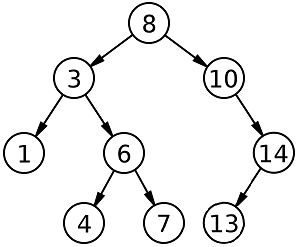
for the above tree
X=2
ceil =3
X=7
ceil =8
X=12
ceil =13
Constraints:
1 <= T <= 10
1 <= N <= 10^5
0 <= node data <= 10^9
1 <= X <= 10^9

Time limit: 1 second
Sample Input 1:
2
8 5 10 2 6 -1 -1 -1 -1 -1 7 -1 -1
4
8 5 10 2 6 -1 -1 -1 -1 -1 7 -1 -1
7
Sample Output 1:
5
7
Explanation for Sample Output 1:
 In the first test case, we traverse the tree starting from the root node which has a value of 8. Now the value of its left child is 5 and its right child is 10. Key-value 4 is less than the left child so we traverse the left subtree. Now we reach a node with value 5 and then again repeat the above process till we reach a null node. Finally, we return 5 as our answer.

In the second test case, we traverse the tree starting from the root node which has a value of 8. Now the value of its left child is 5 and its right child is 10. Key-value 7 is less than the right child and more than the left child, so we traverse the right subtree. Now we reach a node with value 10 and then again follow the same procedure and reach a node with value 7 and stop there and return 7 as our final answer.
Sample Input 2:
2
55 25 82 13 34 67 86 6 21 28 47 61 70 84 92 1 10 17 24 26 29 45 54 56 65 68 81 83 85 91
96 -1 -1 -1 -1 -1 -1 -1 -1 -1 -1 -1 -1 -1 -1 -1 -1 -1 -1 -1 -1 -1 -1 -1 -1 -1 -1 -1 -1 -1 -1 -1 -1
34
84 19 97 0 56 96 99 -1 8 50 83 -1 -1 -1 -1 -1 -1 -1 -1 -1 -1
50
Sample Output 2:
34
50
Hint
Hint 1
Can you traverse the tree?
Approaches (1)
Approach 1
Brute Force
We will traverse the Binary search tree from the root node till we find the node whose key value is given, and upon getting that, we return the ceil value of it.
The steps are as follows:
- Initialize ‘ceilValue’ to store the ceil value to be returned.
- We run a while loop till the value of the node is not equal to NULL.
- If the value of the node is equal to ‘X’’ then we return the node value.
- If the key value is greater than the node value, then we traverse the right subtree.
- If the key value is less than the node value, then we traverse the left subtree and store the value of the node in ‘ceilValue’ simultaneously.
- Finally, return ‘ceilValue’ as our answer.
Time Complexity
O(H), where H is the tree’s height and H = logN, where ‘N’ is the number of nodes in the tree.
As we are traversing all the levels of the tree, there are most ‘H’ iterations. Hence, the overall complexity is O(log N).
Space Complexity
O(logN), where ‘N’ is the number of nodes in the tree.
As we are doing recursive calls heap is being utilized. Hence, the overall space complexity is O(logN).
Video Solution
Unlock at level 3
(75% EXP penalty)
Code Solution
(100% EXP penalty)
Ceil from BST
C++ (g++ 5.4)

Console