




Problem
Submissions
Hints & solutions
Discuss
Cut Logs
Hard

0/120
Average time to solve is 50m
54 upvotes
Asked in companies



Problem statement
Ninja is a log cutter. He has a ‘K’ number of axes and an infinite amount of logs. But, Ninja has a log cutting stand that has a capacity of ‘N’, which means he can only try to cut at max ‘N’ logs in one go. All the axes are exactly the same and can cut up to some logs in one go. If we try to cut more logs than its capacity the axe will break.
To improve efficiency, Ninja wants to know how many logs he can cut with an axe in one go without breaking it. But, he wants to know this is the minimum number of moves and in the allotted number of axes.
Can you calculate the minimum number of moves in which Ninja can know the limit of axes?
Some points to notice about axes are:1. An axe that is used to cut a lesser or equal number of logs than its limit can be used again.
2. An axe that is used to cut more logs than its limit will be broken. Thus, it cannot be used again.
3. All the axes have the same limit of cutting logs until broken.
4. An axe may also cut N logs or may not even cut a single log.
Example
Let the number of axes (K) be 2 & the capacity of the log cutting stand (N) be 6.
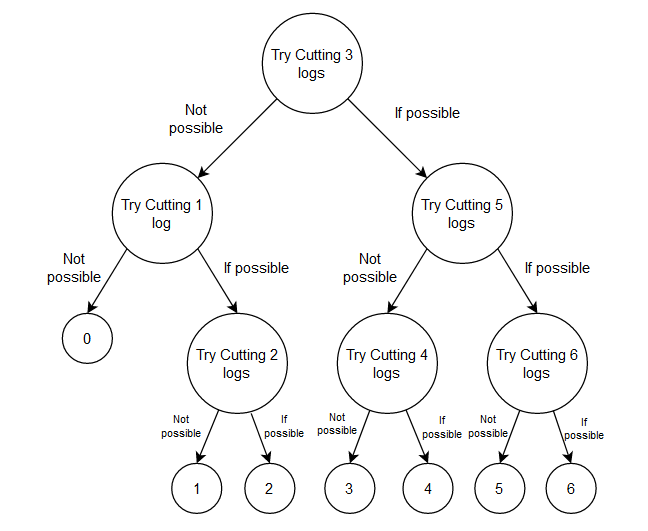
From the above example, we can see that the maximum number of moves is 3 for 2 axes and a capacity of 6 logs.
Detailed explanation ( Input/output format, Notes, Images )
Input format:
The first line of input contains an integer ‘T’ denoting the number of queries or test cases.

The first and only line of each input consists of 2 space-separated integers ‘K’ and ‘N’ denoting the number of axes and the capacity of log cutting stand simultaneously.
For each test case, print the minimum number of moves required to know the limit of the axe.

Print the output of each test case in a separate line.
You do not need to print anything, it has already been taken care of. Just implement the given function.
Can you solve this in the worst-case time complexity of N ^ (1/3)
Constraints:
1 <= T <= 10
1 <= K <= 100
1 <= N <= 10000
Sample Input 1:
2
2 6
3 3
Sample Output 1:
3
2
Explanation:
For test case 1: Refer to the example explained above.

For test case 2:
First, try to cut 2 logs:
If it cuts 2 logs, try to cut 3 logs.
If it couldn’t cut 2 logs, try to cut 1 log.

Thus, the maximum number of moves required are 3.
Sample Input 2:
2
4 11
3 8
Sample Output 2:
4
4
Hint
Hint 1
Hint 2
Hint 3
Hint 4
Hint 5
The very first approach can be to try cutting logs and find the one with the minimum number of moves.
Approaches (5)
Approach 1
Approach 2
Approach 3
Approach 4
Approach 5
Recursion
The very first approach can be to try cutting logs and find the one with the minimum number of moves.
- The idea is to use recursion to reduce the big problem into several small subproblems.
- We will try to cut each possible number of logs and get the answer for checking the remaining number of logs.
- The algorithm for the following will be:
cutLogs( K, N ):
- If N <= 1 or K <= 1, return N.
- Initialize a variable ans = N
- Loop for ( i=1; i <= N; i++ ):
- Initialize cur = max of
- cutLogs(K-1, i-1), (If axe couldn’t cut i logs)
- cutLogs(K, N-i) ( If axe could cut i logs)
- Initialize cur = max of
- Minimize the answer i.e. ans = min( ans, cur )
- Return answer + 1
Time Complexity
O(N ^ K), where N is the capacity of log cutting stand and K is the available number of axes.
In the worst case, we are making N calls for each K that takes O(N ^ K) time. Hence, the overall Time Complexity is O(N ^ K).
Space Complexity
O(K + N), where N is the capacity of the log cutting stand and K is the available number of axes.
In the worst case, extra space will be used by the recursion stack as there can be a maximum of K + N number of recursive calls at a time. Hence, the overall Space Complexity is O(K + N).
Video Solution
Unlock at level 3
(75% EXP penalty)
Code Solution
(100% EXP penalty)
Cut Logs
Javascript (node v10.20.0)

Console