




Problem
Submissions
Hints & solutions
Discuss
Cut The Paper
Hard

0/120
Average time to solve is 10m
7 upvotes
Asked in company

Problem statement
You are given a paper with dimension N * M. Your task is to find the minimum number of squares in which you can cut the given paper.
Note:
1. Square is a quadrilateral whose all four sides are of equal length.
2. If the given paper is already a square then it is possible to cut the whole square in one move.
Detailed explanation ( Input/output format, Notes, Images )
Input Format:
The first line of the input contains an integer T, denoting the number of test cases.

The first line of each test case consists of two space-separated integers N and M denoting the dimensions of the given paper, in a separate line.
For each test case return, the minimum number of squares in which you can cut the given paper.
You don't have to print anything, it has already been taken care of. Just Implement the given function.
Constraints:
1<= T <= 50
1<= N, M <= 150

Time Limit: 1 sec.
Sample Input 1:
1
2 3
Sample Output 1:
3
Explanation of sample input 1:
We can cut one square with side 2 and two squares with side 1.
Sample Input 2:
1
13 11
Sample Output 2:
6
Explanation of sample input 2:
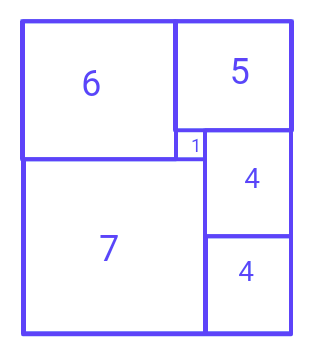
As given in the picture we can cut 5 squares out of paper with dimension 13*11.
Hint
Hint 1
Try all possible ways to cut the paper.
Approaches (1)
Approach 1
Dp Solution
- In order to try all possible ways to cut the paper, we make a recursive function that will compute the answer for the given (N, M).
- The base condition for this function will be when N==M (which means it is already a square), we will return 1 in such a case.
- In the case where the base condition is not satisfied, we will try out all possible ways to cut the paper horizontally and vertically as follows:
- For trying all possible horizontal cuts, we will find the answer for paper with dimensions (N-x, M) and (x, M) for x in the range from 1 to N/2(both inclusive) with the help of the same recursive function. And the summation of results from both calls for a given x will give one of the possible solutions.
- For trying all possible vertical cuts, we will find the answer for paper with dimensions (N, M-x) and (N, x) for x in the range from 1 to M/2(both inclusive) with the help of the same recursive function. And the summation of results from both calls for a given x will give one of the possible solutions.
- Taking the minimum of all possible solutions for given (N, M) will give the desired solution.
- One thing to observe here is that we can reach a state more than once for eg. the state (N-2, M-1) can be reached from (N-2, M) and (N-1, M-1).
- In order to avoid recomputation of solutions for a given state, we can use a 2-Dimensional table to store the results for a state, so that we can use those results for future calls to that state.
- There is one edge case for paper with dimension 13*11. Our algorithm will give 8 as the answer but since we can cut the paper in 6 squares only as shown in the following picture.

Eg. For paper with dimension (2, 3), the algorithm will work as follows:
- HELPER(2, 3)
- HELPER(1, 3)
- HELPER(1,2)
- HELPER(1,1)
- Return 1 ....(1)
- HELPER(1,1) // already computed
- Return 1 ....(2)
- Return 2 (sum of (1) + (2)) ….(3)
- HELPER(1,1)
- HELPER(1,1) // already computed
- Return 1 ….(4)
- Return 3 (sum of (3) + (4)) ….(5)
- HELPER(1,2)
- HELPER(1, 3) // already computed
- Return 3 ….(6)
- HELPER(2, 1)
- HELPER(1,1) // already computed
- Return 1 ….(7)
- HELPER(1,1) // already computed
- Return 1 ….(8)
- Return 2 (sum of (7) + (8)) ….(9)
- HELPER(1,1) // already computed
- HELPER(2,2)
- Return 1 // N==M ….(10)
- Return 3 // min(sum of (5) + (6), sum of (9,10))
- HELPER(1, 3)
Time Complexity
O(M*N^2 + N*M^2), where N and M are the dimensions of a given paper.
As there is N*M number of different pairs of (N, M), it takes O(N*M) order of time to compute the answer for all possible (N, M) states.
Also for calculating the answer for a state (N, M) it requires extra (N + M) operations.
Hence overall it takes O(M*N^2 + N*M^2) order of operations.
Space Complexity
O(N*M), where N and M are the dimensions of a given paper.
As we are storing answers for all pairs (N, M), hence it takes O(N*M) order of memory.
Code Solution
(100% EXP penalty)
Cut The Paper
C++ (g++ 5.4)

Console