




Problem
Submissions
Hints & solutions
Discuss
Distributing Coins
Moderate

0/80
Average time to solve is 45m

Contributed by
6 upvotes
Asked in companies



Problem statement
You are given the ‘ROOT’ of a binary tree with ‘N’ nodes where each node in the tree has some coins, and there are ‘N’ coins total. In one move, we may choose two adjacent nodes and move one coin from one node to another.
Your task is to return the number of moves required to make every node have exactly one coin.
Note:
A move may be from parent to child or from child to parent.
For example,
Given ‘ROOT’ = [2,-1,0,-1,-1]

The tree would look like this :
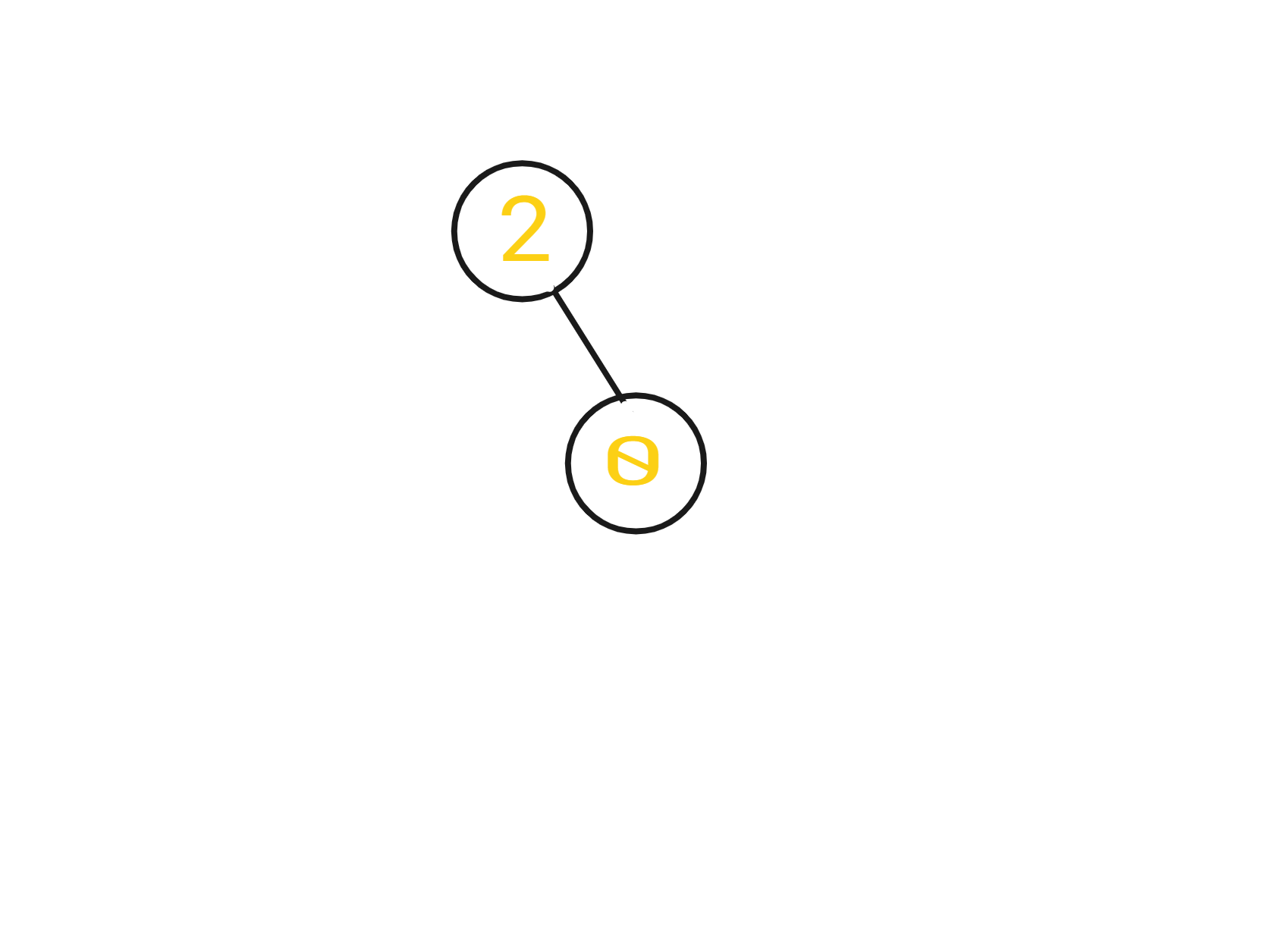
The answer would be 1, because the root node will transfer 1 coin to its right child. Thus both nodes have the same number of coins now.
Detailed explanation ( Input/output format, Notes, Images )
Input format :
The first line of input contains an integer ‘T’ denoting the number of test cases.

In the next T lines, the first line contains each test case contains space-separated integers denoting the nodes of the first binary tree, where -1 indicates that the NULL pointer has been appointed to the previous node.

The input is given in a preorder way, that is, the node then left subtree, and then right subtree as shown in the example.
Output format :
For each test case, print a single line containing a single integer denoting the number of coins moved.

The output of each test case will be printed in a separate line.
Note:
You do not need to print anything. It has already been taken care of. Just implement the given function.
Constraints:
1 <= T  <= 100
1 <=  N <= 10^5
-10^6 <= DATA <= 10^6

Where ‘T’ is the number of test cases and  ‘N’ denotes the number of nodes in the binary tree, and ‘DATA’ represents the value of the node.

Time limit: 1 sec.
Sample Input 1:
2
2 -1 0 -1 -1
2 0 2 -1 -1 -1 0 -1 -1
Sample Output 1:
1
2
Explanation of the Sample Input 1:
For the first test case:
The tree would look like this :
The answer would be 1 because the root node will transfer 1 coin to its right child. Thus both nodes have the same number of coins now.


For the second test case:
The tree would look like this :
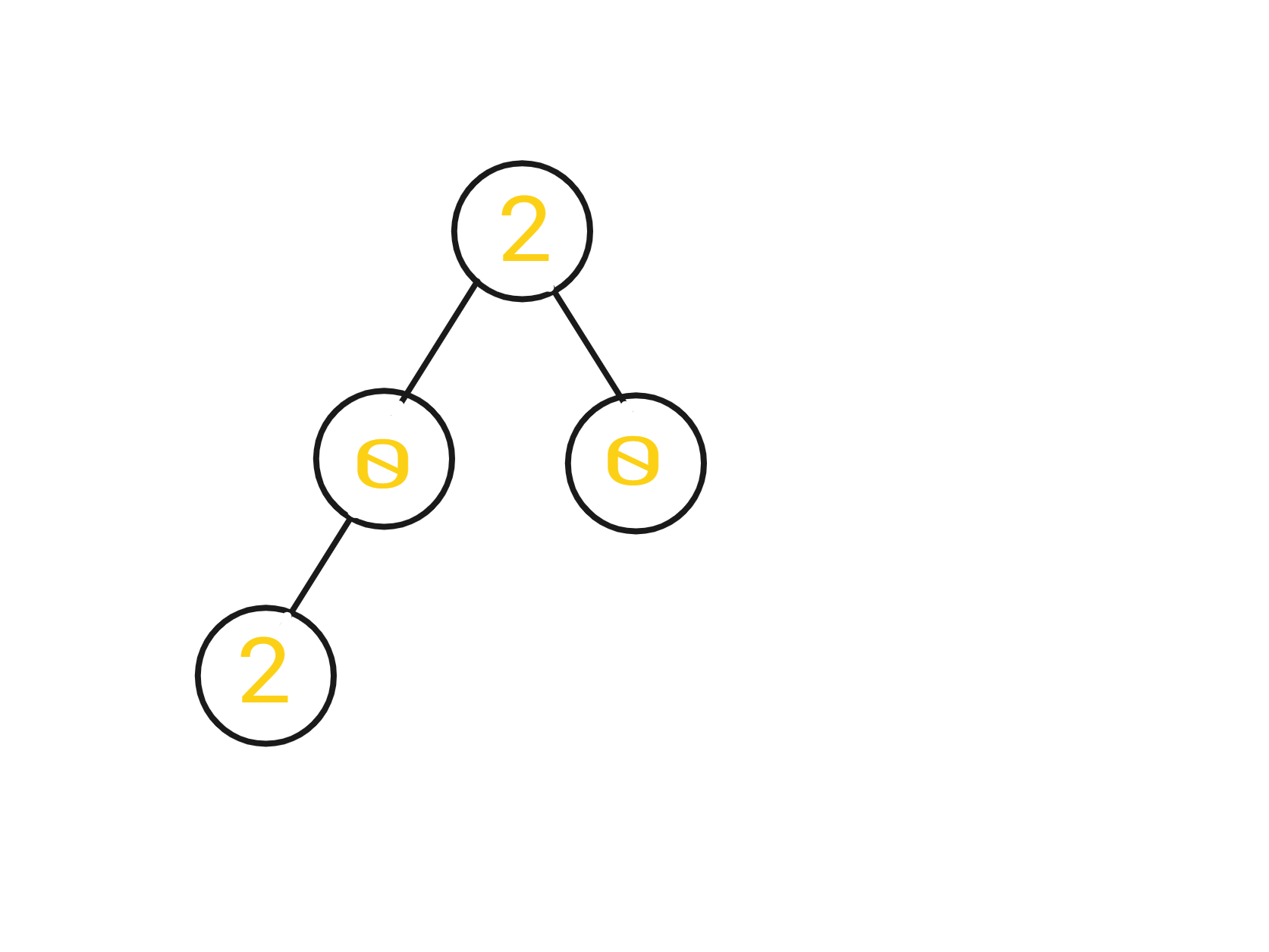
Therefore the root node will transfer 1 coin to its right child and the leaf node will transfer 1 coin to its parent node, hence each node will have 1 coin, and the total moves made will be 2.
Sample Input 2:
2
3 0 -1 -1 0 -1 -1
1 0 3 -1 -1 -1 0 -1 -1
Sample Output 2:
2
4
Hint
Hint 1
Can you find out the deficit or excess for each subtree?
Approaches (1)
Approach 1
Traverse the tree
The main idea is to use recursion to traverse the tree in a pre-order way and do the following :
- Go to the left subtree and figure how much do we need or if we have got extra? I'll give that/take it away to/from you via our direct edge and pass it to the right child, and if something remains, I'll take it.
- Go to the right subtree and figure how much do we need or if we have got extra? I'll give that/take it away to/from you via our direct edge and pass it to the right child, and if something remains, I'll take it.
- The answer will be the sum of values(absolute) returned after the asked questions from the left subtree and right subtree.
- But what should the root return to its parent? It will return how much "its subtree" needs/has extra. That will be the signed sum of its Left+Right (question's answer) + same question asked to the current root node.
Time Complexity
O(N), where ‘N’ is the number of nodes in the tree.
Since we are going through all the nodes of the tree, Hence net time complexity will be O(N).
Space Complexity
O(N), where ‘N’ is the number of nodes in the tree.
Since we are using recursion, hence ‘N’ call-stacks would be made.
Code Solution
(100% EXP penalty)
Distributing Coins
C++ (g++ 5.4)

Console