




Problem
Submissions
Hints & solutions
Discuss
Graph Connectivity Queries.
Moderate

0/80
Average time to solve is 15m
2 upvotes
Asked in companies


Problem statement
You have been given a graph consisting of ‘N’ nodes and a threshold value ‘THRESHOLDVALUE’. Two different nodes ‘X’ and ‘Y’ are directly connected to each other if and only if there exists a ‘Z’ such that all of the following are true:-
‘X’ % ‘Z’ == 0
‘Y’ % ‘Z’ == 0
‘Z’ >= ‘THRESHOLDVALUE’
You are given ‘Q’ queries where each query consists of two distinct nodes ‘U’ and ‘V’, you must determine if ‘U’ and ‘V’ are connected directly or indirectly. Return a vector/list of size ‘Q’ where ‘i-th’ element is ‘1’ if nodes in ith query are connected directly or indirectly otherwise it is ‘0’.
Example:Let’s say ‘N’ is 6 and 'M' is ‘2’. Then our graph will look as follows:-
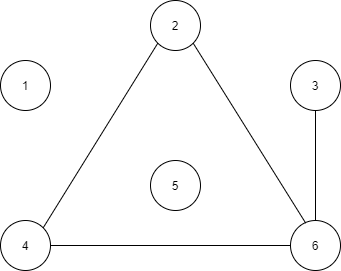
There is an edge between ‘2’ and ‘4’, ‘4’ and ‘6’ and ‘2’ and ‘6’ because their gcd is 2 which is equal to ‘m’. There is an edge between ‘3’ and ‘6’ because their gcd is 3 which is greater than ‘m’. If the query consists of vertices ‘2’ and ‘3’ answer will be ‘1’ because they are indirectly connected.
Detailed explanation ( Input/output format, Notes, Images )
Input Format:
The first line contains a single integer ‘t’ representing the number of test cases.

The first line of each test case contains two space-separated integers ‘n’ and ‘THRESHOLDVALUE’ representing the number of nodes and the threshold value.

The second line contains a single integer ‘q’ representing the number of queries.

Each of the next ‘q’ lines contains two space-separated integers representing the vertices for which you need to find if they are connected directly or indirectly.
For each test case, print a single line containing space-separated integers denoting answers to all the queries.

The output of each test case will be printed in a separate line.
You do not need to print anything; it has already been taken care of. Just implement the function.
Constraints:
1 <= T <= 10
1 <= N <= 100
1 <= THRESHOLDVALUE <= 100
1 <= Q <= 10000
1 <= U[i] <= N
1 <= V[i] <= N

Where ‘T’ is the number of test cases.‘N’ is the number of nodes in the graph. ‘THRESHOLDVALUE’ is the threshold value. ‘Q’ is the number of queries. ‘U[i]’ and ‘V[i]’ are vertices of the i-th query.

Time Limit: 1 sec.
Sample Input 1:
2
6 2
3
1 2
2 3
3 4
6 3
2
2 3
3 6
Sample Output 1:
0 1 1
0 1
Sample Output 1 Explanation:
Test case 1:

The graph looks as follows:-
Nodes 1 and 2 are not connected directly or indirectly. Therefore answer to this query is 0. Nodes 2 and 3 are connected indirectly. Therefore answer to this query is 1. Nodes 3 and 4 are connected indirectly. Therefore answer to this query is 1.

Therefore the answer is [0,1,1].

Test case 2:

The graph looks as follows:-
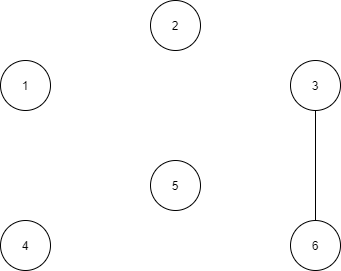
Nodes 2 and 3 are not connected directly or indirectly. Therefore answer to this query is 0. Nodes 3 and 6 are connected directly. Therefore answer to this query is 1.

Therefore the answer is [0,1].
Sample Input 2:
2
4 1
3
1 2
2 3
3 4
4 4
2
1 2
2 3
Sample Output 2:
1 1 1
0 0
Hint
Hint 1
Hint 2
Iterate over all possible pairs of vertices.
Approaches (2)
Approach 1
Approach 2
Breadth First Search.
We will iterate over all the possible pairs of nodes and check if they are directly connected. We will build the graph and using a breadth-first search we can find all the connected components. If two nodes in the query are part of the same component insert ‘1’ otherwise ‘0’ in the vector/list ‘ans’.
We will apply the algorithm as follows:-
- Declare a list of list/vector ‘adj’ of size ‘n’+1 where ‘adj[i]’ stores nodes that are directly connected to node ‘i’.
- Iterate ‘i’ from ‘1’ to ‘n’:-
- Iterate ‘j’ from ‘i+1’ to ‘n’:-
- If ‘gcd(i,j)>=thresholdValue’ then node ‘i’ and ‘j’ are directly connected. Therefore push ‘j’ in ‘adj[i]’ and ‘i’ in ‘adj[j]’.
- Iterate ‘j’ from ‘i+1’ to ‘n’:-
- Maintain an auxiliary array ‘vis’ which maintains if ‘i-th’ node has been visited.
- Maintain an auxiliary array ‘comp’ which stores which connected component is ‘i-th’ node part of.
- Declare ‘ctr’ and initialize it with ‘0’
- Iterate ‘i’ from ‘1’ to ‘n’:-
- If node ‘i’ has not been visited yet:-
- Mark node ‘i’ as visited and insert it in the queue.
- Increase ‘ctr’ by ‘1’ as it is a new component.
- Iterate till the queue is empty:-
- Pop the front element of ‘qu’ and store it in ‘u’.
- Initialize ‘comp[u]’ with ‘ctr’
- Iterate over ‘adj[u]’
- If the ‘adjacentNode’ is not visited yet. Mark ‘vis[adjacentNode]’ as true and insert ‘adjacentNode’ in queue.
- If node ‘i’ has not been visited yet:-
- Iterate over all the queries:-
- If ‘comp[u[i]]’ == ‘comp[v[i]]’ then u[i] and v[i] are connected directly or indirectly therefore push ‘1’ in ‘ans’.
- Else push ‘0’ in ‘ans’.
- Return ‘ans’.
Time Complexity
O(N * N * log(max(X, Y)’), where ‘N’ denotes the number of nodes in the graph and X and Y denotes the value of nodes.
We are calculating the greatest common divisor for each pair of nodes and checking if they are directly connected by an edge.
Space Complexity
O(N * N), where ‘N’ denotes the number of nodes in the graph.
We build an adjacency list where ‘i-th’ vector/list can be of size ‘N’.
Code Solution
(100% EXP penalty)
Graph Connectivity Queries.
C++ (g++ 5.4)

Console