




Problem
Submissions
Hints & solutions
Discuss
Is Height Balanced Binary Tree
Moderate

0/80
Average time to solve is 15m

Contributed by
90 upvotes
Asked in companies



Problem statement
You are given the root node of a binary tree.
Return 'true' if it is a height balanced binary tree.
Height of a tree is the maximum number of nodes in a path from the node to the leaf node.

An empty tree is a height-balanced tree. A non-empty binary tree is a height-balanced binary tree if
1. The left subtree of a binary tree is already the height-balanced tree.
2. The right subtree of a binary tree is also the height-balanced tree.
3. The difference between heights of left subtree and right subtree must not more than ‘1’.
Example:
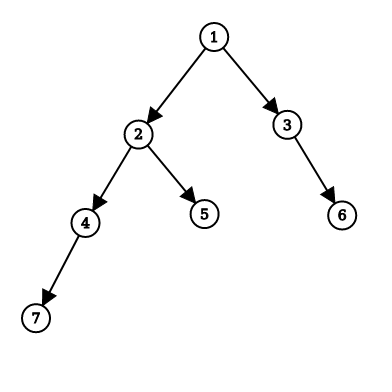
Input: Consider the binary tree given below:
Output: 'true'

Explanation:
Consider subtree at Node ( 7 )
Left subtree height is ‘0’ and right subtree height is ‘0’, the absolute height difference is ‘0-0 = 0’ and ‘0’ is not more than ‘1’ so subtree at Node ( 7 ) is a height-balanced binary tree.
Same for subtrees at Nodes ( 5, 6 ).

Consider subtree at Node ( 4 )
Left subtree height is ‘1’ and right subtree height is ‘0’, the absolute height difference is ‘1-0 = 1’ and ‘1’ is not more than ‘1’ so subtree at Node ( 4 ) is a height-balanced binary tree.
Same for subtree at Node ( 3)

Consider subtree at Node ( 2 )
Left subtree height is ‘2’ and right subtree height is ‘1’, the absolute height difference is ‘2-1 = 1’ and ‘1’ is not more than ‘1’ so subtree at Node ( 2 ) is a height-balanced binary tree.

Consider subtree at Node ( 1 )
Left subtree height is ‘3’ and right subtree height is ‘2’, the absolute height difference is ‘3-2 = 1’ and ‘1’ is not more than ‘1’ so subtree at Node ( 1 ) is a height-balanced binary tree.

Because the root node ( 1 ) is a height-balanced binary tree, so the complete tree is height-balanced.
Detailed explanation ( Input/output format, Notes, Images )
Input Format:
The only line contains elements in the level order form. The line consists of values of nodes separated by a single space. In case a node is null, we take -1 in its place.

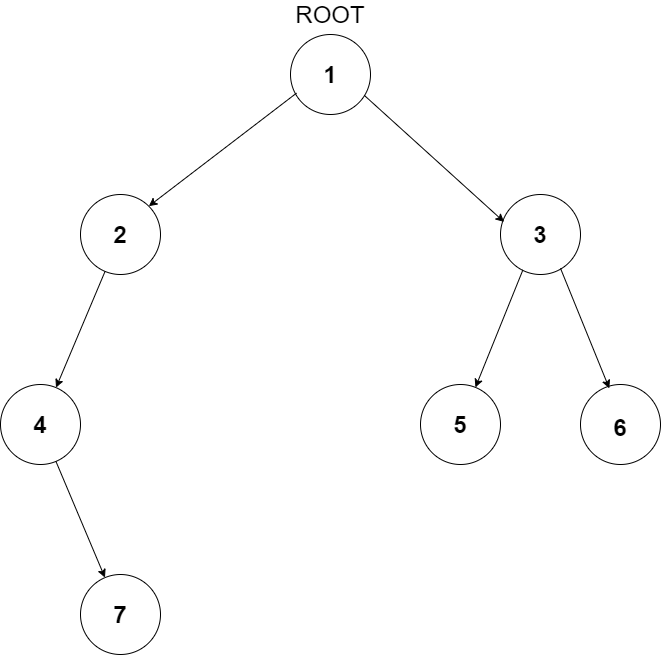
For example, the input for the tree depicted in the below image will be:
1
2 3
4 -1 5 6
-1 7 -1 -1 -1 -1
-1 -1

Explanation :
Level 1 :
The root node of the tree is 1

Level 2 :
Left child of 1 = 2
Right child of 1 = 3

Level 3 :
Left child of 2 = 4
Right child of 2 = null (-1)
Left child of 3 = 5
Right child of 3 = 6

Level 4 :
Left child of 4 = null (-1)
Right child of 4 = 7
Left child of 5 = null (-1)
Right child of 5 = null (-1)
Left child of 6 = null (-1)
Right child of 6 = null (-1)

Level 5 :
Left child of 7 = null (-1)
Right child of 7 = null (-1)

The first not-null node(of the previous level) is treated as the parent of the first two nodes of the current level. The second not-null node (of the previous level) is treated as the parent node for the next two nodes of the current level and so on.

The input ends when all nodes at the last level are null(-1).

The sequence will be put together in a single line separated by a single space. Hence, for the above-depicted tree, the input will be given as:

1 2 3 4 -1 5 6 -1 7 -1 -1 -1 -1 -1 -1
Return 'true' or 'false' as stated in the problem statement.
You do not need to print anything; it has already been taken care of. Just implement the given function.
Sample Input 1:
1 2 3 4 -1 -1 -1 -1 5 -1 -1
Expected Answer:
false
Output on console:
false
Explanation of sample input 1:

Consider the root  Node ( 1 )
Left subtree height is ‘3’ ( 1->2->4->5) and right subtree height is ‘1’ ( 1->3), the absolute height difference is ‘2-1 = 2’ and ‘2’ is more than ‘1’ so subtree at Node ( 1 ) is not a height-balanced binary tree.
Hence we return ‘false’.
Sample Input 2:
1 2 3 4 -1 -1 5 -1 -1 -1 -1
Expected Answer:
true
Output on console:
true
Explanation of sample input 2:
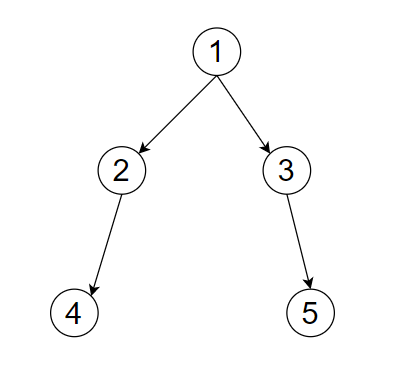
Consider the subtree at Node ( 4 )
Left subtree height is ‘0’ and right subtree height is ‘0’, the absolute height difference is ‘0-0 = 0’ and ‘0’ is not more than ‘1’ so subtree at Node ( 4 ) is a height-balanced binary tree.
Same for subtree at Node ( 5 ).

Consider the subtree at Node ( 2 )
Left subtree height is ‘1’ and right subtree height is ‘0’, the absolute height difference is ‘1-0 = 1’ and ‘1’ is not more than ‘1’ so subtree at Node ( 2 ) is a height-balanced binary tree.
Same for subtree at Node ( 3 ).

Consider the subtree at Node ( 1 )
Left subtree height is ‘2’ (1->2->4) and right subtree height is ‘2’ (1->3->5), the absolute height difference is ‘2-2 = 0’ and ‘0’ is not more than ‘1’ so subtree at Node ( 1 ) is a height-balanced binary tree.

Hence root node (1) is a height-balanced binary tree that’s why the complete tree is a height-balanced binary tree.
Hence we return ‘true’.
Expected Time Complexity:
Try to do this in O(n).
Constraints:
0 <= n <= 10000

Where 'n' is the total number of nodes in the binary tree.

Time Limit: 1 sec
Hint
Hint 1
Hint 2
Try to use recursion
Approaches (2)
Approach 1
Approach 2
Recursion
The basic idea is that, check for every subtree the current subtree is height-balanced or not
If the subtree is height-balanced then check for its parent subtree. So we need to check the height of the current subtree’s left and right and check the left subtree and right subtree’s height-balanced.
- To implement this approach we need to make sure two thing
- The height difference of the left child subtree and the right child subtree must not more than ‘1’.
- Left child subtree and right child subtree must be already balanced.
- In height function -
- We implement a height function in which we return the height of a given node
- Suppose given node is ‘currentNode’ than we first find the height of left child subtree height ‘currentNode->left’ and right child subtree height ‘currentNode->right’
- Return max of (currentNode->left, currentNode-> right) +1 , we are extra ‘1’ because ‘+1’ denotes height of current Node in its both children subtrees.
- If ‘currentNode’ has no left child and right child then return ‘1’.
- In ‘balancedBinaryTree’ method -
- In this function, we check if the given node’s subtree is height-balanced or not.
- To check the given subtree’s height balancing -
- The first check height difference of both left child subtree and right child subtree height is not more than ‘1’ and left subtree and right subtree both are height-balanced, to check height we use height function which we have already implemented
- If both conditions are true then return true else return false.
Time Complexity
O(N^2), Where ‘N’ is the number of nodes in a binary tree.
It is possible that this approach can achieve the worst time complexity in the case of a skew tree.
Suppose we have a ‘right’ skew tree with ‘n’ numbers of nodes then we call height method for root node ‘n’ times, for first ‘right’ child (root->right) ‘n-1’ time and second ‘right’ child (root->right->right) ‘n-2’.
So we call height method ‘ n + n-1 + n-2 + …………+ 1 = n*(n+1)/2’ times. so overall time complexity is o(n^2).
Space Complexity
O(N), Where ‘N’ is the number of nodes in a binary tree.
In the case of the skew tree, we will be using a linear space call stack.
Code Solution
(100% EXP penalty)
Is Height Balanced Binary Tree
Javascript (node v10.20.0)

Console