




Problem
Submissions
Hints & solutions
Discuss
Jump Game
Moderate

0/80
Average time to solve is 15m
Contributed by
63 upvotes
Asked in companies


Problem statement
You have been given an array 'ARR' of ‘N’ integers. You have to return the minimum number of jumps needed to reach the last index of the array i.e ‘N - 1’.
From index ‘i’, we can jump to an index ‘i + k’ such that 1<= ‘k’ <= ARR[i] .
'ARR[i]' represents the maximum distance you can jump from the current index.
If it is not possible to reach the last index, return -1.
Consider 0-based indexing.
Consider the array 1, 2, 3, 4, 5, 6
We can Jump from index 0 to index 1
Then we jump from index 1 to index 2
Then finally make a jump of 3 to reach index N-1

There is also another path where
We can Jump from index 0 to index 1
Then we jump from index 1 to index 3
Then finally make a jump of 2 to reach index N-1

So multiple paths may exist but we need to return the minimum number of jumps in a path to end which here is 3.
Detailed explanation ( Input/output format, Notes, Images )
Input format:
The first line contains an integer ‘N’ denoting the number of elements in the given sequence.

The second line contains ‘N’ space-separated integers denoting the elements in the sequence.
Print a single line containing a single integer denoting the minimum number of jumps required to reach the last index.
You do not need to print anything, it has already been taken care of. Just implement the given function.
Sample Input 1:
5
2 3 1 1 4
Sample Output 1:
2
Explanation of sample input 1 :
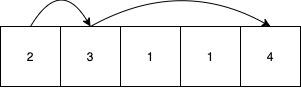
Consider the above figure:
We are initially at index 0, ARR[0] is 2 which represents we can jump a maximum of 2 steps.

We jump 1 index from 0 to 1. At index 1, 'ARR[1]' is 3 which represents we can jump a maximum of 3 steps so we jump 3 indices from 1 to 4 to reach the last index. Hence we return 2.

It can be proved that the end can't be reached in less than 2.
Sample Input 2:
5
3 2 1 0 1
Sample Output 2:
-1
Constraints:
1 <= N <= 10 ^ 4
1 <= ARR[i] <= 10 ^ 4

Where ‘ARR[i]’ denotes the ‘i-th’ element of the ‘ARR’.

Time limit: 1 sec.
Hint
Hint 1
Hint 2
Hint 3
Find all possible combinations of jumps which reach the last index and take the minimum of them.
Approaches (3)
Approach 1
Approach 2
Approach 3
Brute Force Approach
- For each index, we find all possible locations we can jump to i.e if we are currently at an index ’i’ and ‘ARR[i]’ = k then we recursively find the answer for all indices from i + 1 to i + k and take the minimum of the answer and add 1 to it to find the minimum number of jumps to reach index last index from index ‘i’.
- For example, Consider the array : 2, 3, 1, 4
- We will have the following recursion tree:
- We can see the arrows in red signify the least number of jumps to reach the last index. In this case, 2 paths are possible each with 2 jumps hence we return 2.
Keeping the above example in mind, we can write the following Recursive solution:
- If the current index is the last index return 0
- Let ‘CURRIDX; be the index we are currently at and trying to reach the last index from ‘CURRIDX’ in a minimum number of jumps. And ‘MINJUMP’ be the minimum number of jumps needed.
- Take a loop from ‘i = 1’ to arr[CURRIDX]’ and find the answer for all possible jumps from the current index
- Try all possible jumps from the current index(a store that in a variable ‘CURRANS’ and recursively find the minimum of all possible jumps.
- After each iteration, update the variable ‘MINJUMP’ which stores the minimum number of jumps needed to reach the last index.
- Finally, return the value of ‘MINJUMP’.
Time Complexity
O(N ^ N), Where ‘N’ denotes the number of elements present in the sequence.
In each recursive call, we can call at the max number of elements equal to the value at a current index which can be at most ‘n’ according to the constraints hence we get a time complexity of the order of N ^ N.
Space Complexity
O(N). Where ‘N’ denotes the number of elements present in the sequence.
As in the case of recursion the space complexity is proportional to the depth of the recursion tree. Which in this case is proportional to the number of elements in the sequence. Therefore overall space complexity is O(N).
Code Solution
(100% EXP penalty)
Jump Game
Javascript (node v10.20.0)

Console