




Problem
Submissions
Hints & solutions
Discuss
Largest Component Size by Common Factor
Hard

0/120
Average time to solve is 50m

Contributed by
4 upvotes
Asked in companies



Problem statement
Detailed explanation ( Input/output format, Notes, Images )
Input Format
The first line of input contains an integer 'T' representing the number of test cases.

The first line of each test case contains an integer ‘N’ representing the size of the ‘vertices’ array.

The second line of each test case contains the ‘N’ space-separated integers representing the element of the ‘VERTICES’ array.
Output Format:
For each test case, print a single line containing a single integer denoting the size of the largest connected component in the graph.

The output of each test case will be printed in a separate line.
Note:
You do not need to print anything, it has already been taken care of. Just implement the given function.
Constraints:
1 <= T <= 5
1 <= N <= 1000
1 <= VERTICES[i] <= 5000
All ‘VERTICES[i]’ are distinct.

Where ‘T’ is the number of test cases, ‘N’ is the size of the ‘VERTICES’ array, and ‘VERTICES[i]’ is an element in the ‘VERTICES’ array at index ‘i’.

Time limit: 1 sec.
Sample Input 1:
2
6
8 10 13 15 6 28
9
4 25 7 14 27 23 17 34 3
Sample Output 1:
5
5
Explanation of Sample Output 1:
Test Case 1 :

Connected Component 1: 8 10 15 6 28, Size = 5.
Connected Component 2: 13, Size = 1.

Therefore, the largest component size = max(5, 1) = 5.

Test Case 2 :
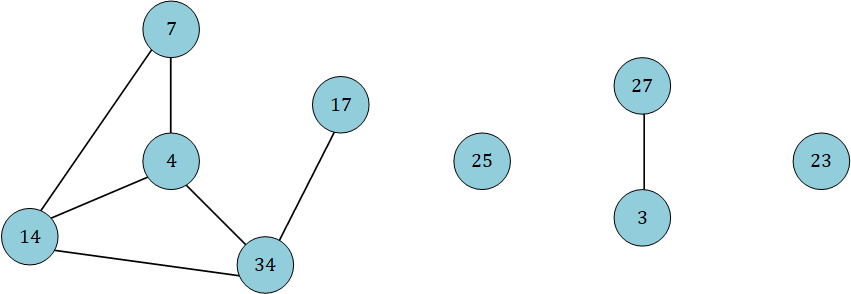
Connected Component 1: 4 7 14 17 34, Size = 5.
Connected Component 2: 25, Size = 1.
Connected Component 3: 27 3, Size = 2.
Connected Component 4: 23, Size = 1.

Therefore,the largest component size = max(5, 1, 2, 1) = 5.
Sample Input 2:
2
4
847 644 54 965
7
1 2 3 4 5 6 6
Sample Output 2:
3
4
Hint
Hint 1
For every number, find and link all of its factors to a unique parent number. This ensures that numbers that have a common factor greater than 1 are in the same group. Can you now find the largest connected component?
Approaches (1)
Approach 1
Disjoint Set
The idea is to use a disjoint set data structure. We will maintain a disjoint set where different numbers are linked together if and only if they have a common factor greater than 1. So, we have to link each element in ‘VERTICES’ with all its factors greater than 1. For this purpose, we will check all the integers ranging from 2 to sqrt(VERTICES[i]). Since if ‘X’ is a factor of ‘P’ then ‘P / X’ is also a factor of 'P’.
After linking, we only have to find which set has the maximum number of elements from the ‘VERTICES’ array. This can be done by maintaining the frequency of the representative element of every set. We will count the elements from ‘VERTICES’ that have the given representative element and output the maximum such frequency.
Algorithm:
- Declare an integer variable, ‘result’ initialize with zero. The ‘result’ will hold the size of the largest connected component.
- Find the maximum element present in ‘vertices’ and store it in an integer variable, ‘maxElement’.
- Create an object ‘ds’ of ‘DisjointSet’ and pass ‘maxElement + 1’ as the parameter.
- Run a loop for every element, ‘num’ in the ‘vertices’.
- Run a loop from i = 2 to sqrt(num).
- If num % i == 0 that shows that ‘i’ is a factor of ‘num’. Therefore,
- Add ‘i’ and ‘num’ in the same set by calling ‘ds.Union’ function.
- Add ‘num / i’ and ‘num’ in the same set by calling ‘ds.Union’ function.
- If num % i == 0 that shows that ‘i’ is a factor of ‘num’. Therefore,
- Run a loop from i = 2 to sqrt(num).
- Declare a hashmap, ‘hashMap’ to store the frequency of representative elements.
- Run a loop for every element, ‘num’ in the ‘vertices’.
- Find the representative element of ‘num’ by ‘ds.find’ function and store it in an integer variable, ‘numRep’.
- Increment ‘hashMap[numRep]’ by 1.
- Update ‘result’ by ‘max(result, hashMap[numRep])’.
- In the end, return ‘result’.
Description of ‘DisjointSet’ class
private:
The private part of the ‘DisjointSet’ class will contain two data members:
- parent: An integer array to store the parent of each vertex in the graph.
- rank: An integer array to store the rank of each vertex in the graph.
public:
The private part of the ‘DisjointSet’ class will contain one constructor and two member functions:
Description of ‘DisjointSet’ constructor
The constructor will take one parameter:
- n: An integer variable that represents the number of vertices in the graph (i.e., number of points in the ‘coordinates’ array).
DisjointSet(n):
- Resize the size of the ‘parent’ and ‘rank’ array to ‘n’.
- Run a loop from i = 0 to n - 1.
- Assign ‘i’ to ‘parent[i]’ and set ‘rank[i]’ to zero.
Description of ‘find’ function
The function will take one parameter:
- x: An integer variable that represents the vertex (element) whose representative element has to be searched.
find(x):
- If parent[x] == x that shows that ‘X’ itself is the representative element. So, return ‘X’.
- Else, call the ‘find’ function for ‘parent[x]’ and store the returned result in ‘parent[x]’.
- Return ‘parent[x]’.
Description of ‘Union’ function
The function will take two parameters:
- u: An integer variable that represents vertex in the graph (or point in ‘coordinates’ array).
- v : Another integer variable that represents vertex in the graph (or point in ‘coordinates’ array).
Union(u, v):
- Pass ‘u’ to the ‘find’ function and store the returned value in an integer variable, ‘uRep’.
- Pass ‘v’ to the ‘find’ function and store the returned value in an integer variable, ‘vRep’.
- If uRep == vRep that shows ‘u’ and ‘v’ are already in the same set. So, return.
- Else if rank[uRep] < rank[vRep] that shows that the rank of ‘uRep’ is less than the rank of ‘vRep’.
- Update parent of ‘uRep’ by ‘vRep’.
- Else if rank[uRep] > rank[vRep] that shows that the rank of ‘uRep’ is more than the rank of ‘vRep’.
- Update parent of ‘vRep’ by ‘uRep’.
- Else rank of ‘uRep’ and ‘vRep’ are the same.
- Update parent of ‘uRep’ by ‘vRep’.
- Increment rank of ‘vRep’ by 1.
Time Complexity
O(N * sqrt(maxElement)), where ‘N’ is the size of ‘vertices’ array and ‘maxElement’ is the maximum element in the ‘vertices’ array.
The time complexity of linking factors of every element to a parent element is O(N * sqrt(maxElement)). Since the loop will make ‘N’ iterations and in every iteration, we are traversing till sqrt(num) which will be sqrt(maxElement) in the worst case.
The time complexity of finding the maximum frequency of representative element is O(N * log(maxElement)). Since the for loop will make ‘N’ iterations and in every iteration, we are finding the representative element of ‘num’ which is O(log(num)) operation that will become log(maxElement) in the worst case.
Hence, overall time complexity is O(N * sqrt(maxElement)) + O(N * log(maxElement)) = O(N * sqrt(maxElement)).
Space Complexity
O(maxElement), where ‘maxElement’ is the maximum element in the ‘vertices’ array.
Since O(maxElement) space is required for the DisjointSet ‘ds’ object and also for ‘hashMap’ in the worst case.
Code Solution
(100% EXP penalty)
Largest Component Size by Common Factor
C++ (g++ 5.4)

Console