




Problem
Submissions
Hints & solutions
Discuss
Merge Point of Two Linked Lists
Moderate

0/80
10 upvotes
Asked in companies



Problem statement
Given two singly linked lists, 'FIRST_HEAD' and 'SECOND_HEAD'. Your task is to find the 'MERGING POINT' i.e. the data of the node at which merging starts. If there is no merging, return -1.
For example:-
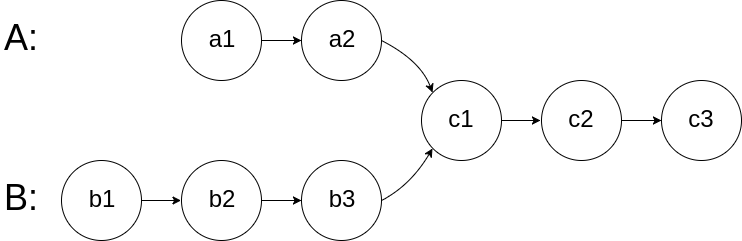
The given Linked Lists are merging at node c1.
In this case, c1 is 'MERGING POINT'.
Detailed explanation ( Input/output format, Notes, Images )
Input Format:
The input format contains three lines consisting of three singly-linked lists.

All three lines contain the elements of the singly linked list separated by a single space and terminated by -1.

So first linked list would contain
       a1, a2, ...an, c1, -1.

Similarly, the second line would contain
       b1,b2, ...bm, c1, -1.

The third line would contain
       c2, c3, ....ck, -1.


Refer 'a1, a2, ......, b1, b2, ......, c1, c2, ....., ck' from this image.
The only line of output contains data of the first merged node's data.
<b>If there is no merging output should contain -1. </b>

You don't have to explicitly print by yourself. It has been taken care of.
Constraints :
0 <= N <= 10^5
0 <= M <= 10^5
0 <= K <= 10^5.
-10^9 <= data <= 10^9 and data != -1


 Time Limit: 1 sec
Sample Input 1 :
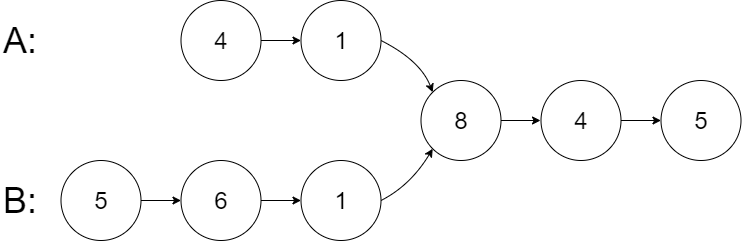
4 1 8 -1
5 6 1 8 -1
4 5 -1
Sample Output 1 :
8
Explanation For Sample Input 1:
As shown in the diagram the node with data is 8 at which merging starts
Sample Input 2 :
1 2 3 4 5 -1
2 3 4 5 -1
6 7 -1
Sample Output 2 :
5
Sample Input 3 :
2 6 4 -1
1 5 -1
-1
Sample Output 3 :
-1
Approaches (1)
Approach 1
App-1
Time Complexity
Space Complexity
Code Solution
(100% EXP penalty)
Merge Point of Two Linked Lists
C++ (g++ 5.4)

Console