


Problem
Submissions
Hints & solutions
Discuss
NAKSHA
Easy

0/40
0 upvote
Problem statement
Ninja’s company is growing day by day and touching new milestones. Now Ninja company got the tender to develop a map where the railway station and bus stand can be built in his city by the government of India. He wants to develop the map in such a way that railway stations and bus stands can be near to each other so people are able to use them easily. So he asks for the locations of the city where the railway station and bus stand can be built. These locations are in the form that when combined form a ‘Binary Search Tree’ like structure.
So ninja wants to find out the minimum difference between any two node values so that one node can be used for a bus stand and the other can be used for the railway station and the distance between them will remain minimum.
So help our ninja to find out the minimum distance between two nodes values of a ‘Binary Search Tree’.
So your task is to find out the minimum absolute difference between any two node values.
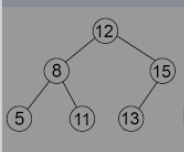
Example:consider the following binary search tree so the minimum absolute difference is between the node value i.e | 15-13 |= ‘2’so ‘2’is our answer.
Detailed explanation ( Input/output format, Notes, Images )
Input Format:
The first line contains an integer  ‘T' which denotes the number of test cases or queries to be run. Then the test cases follow.

The first line of each test case contains the elements of the tree in the level order form separated by a single space.

If any node does not have a left or right child, take -1 in its place. Refer to the example below.

Example:

Elements are in the level order form. The input consists of values of nodes separated by a single space in a single line. In case a node is null, we take -1 in its place.

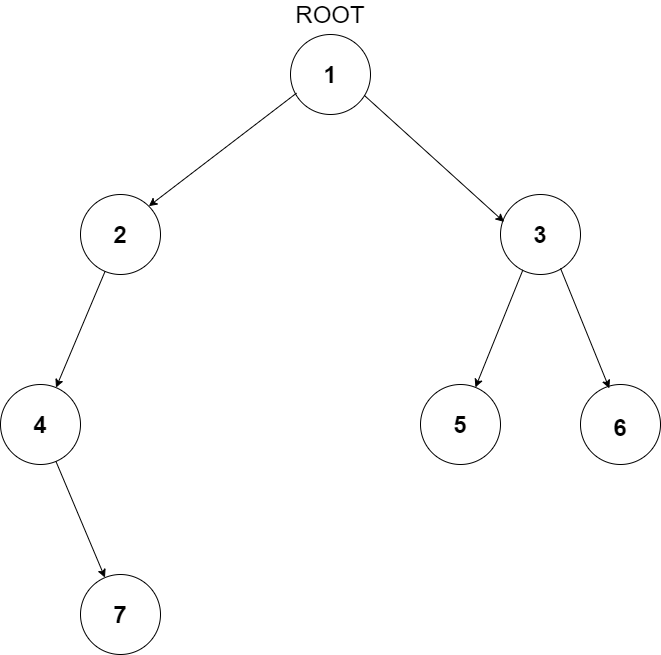
For example, the input for the tree depicted in the below image would be :
1
2 3
4 -1 5 6
-1 7 -1 -1 -1 -1
-1 -1

Explanation :
Level 1 :
The root node of the tree is 1

Level 2 :
Left child of 1 = 2
Right child of 1 = 3

Level 3 :
Left child of 2 = 4
Right child of 2 = null (-1)
Left child of 3 = 5
Right child of 3 = 6

Level 4 :
Left child of 4 = null (-1)
Right child of 4 = 7
Left child of 5 = null (-1)
Right child of 5 = null (-1)
Left child of 6 = null (-1)
Right child of 6 = null (-1)

Level 5 :
Left child of 7 = null (-1)
Right child of 7 = null (-1)

The first not-null node (of the previous level) is treated as the parent of the first two nodes of the current level. The second not-null node (of the previous level) is treated as the parent node for the next two nodes of the current level and so on.

The input ends when all nodes at the last level are null (-1).
The above format was just to provide clarity on how the input is formed for a given tree.

The sequence will be put together in a single line separated by a single space. Hence, for the above-depicted tree, the input will be given as:

1 2 3 -1 5 6 7 -1 -1 -1 -1
For each test case, print the minimum absolute difference between two different node values.

Print output of each test case in a separate line.
You are not required to print anything explicitly. It has already been taken care of. Just implement the function.
Constraints:
1 <= T <= 100
1 <= N <= 3000
0 <= data <= 10^5

Where ‘T’ is the total number of test cases, ‘N’ is the number of nodes of the tree, and data is the value mentioned on the node.
Time Limit: 1 sec
Sample Input 1:
2
5 3 7 2 4 6 8 -1 -1 -1 -1 -1 -1 -1 -1
1 -1 6 -1 -1
Sample Output 1:
1
5
Explanation for Sample 1:
Test case 1:

The level order traversal of a given tree is 5 3 7 2 4 6 8 -1 -1 -1 -1 -1 -1 -1 -1, thus its first root is root number with value 5, and left and right nodes of the 5 are nodes with 3 and 7 respectively.

The binary tree according to the test case is:
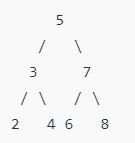
So we choose the node which has a minimum absolute difference i.e ‘1’ so our answer is ‘1’.


Test case 2:

The binary tree according to the test case is:

So as there are only two nodes in this tree so on taking their absolute minimum difference we get ‘5’ so our answer is ‘5’.
Sample Input 2:
2
2 1 -1 -1 -1
10 -1 20 -1 30 -1 40 -1 -1
Sample Output 2:
1
10
Hint
Hint 1
Hint 2
Can you sort the elements of the tree?
Approaches (2)
Approach 1
Approach 2
Brute Force
We have to find the minimum difference between two node’s values, suppose we have an array instead of a tree then the minimum difference of two values will always be two consecutive elements.
Suppose ‘array = { 3, 1, 4, 6, 12, 8}’ , sort the ‘array ={ 1, 3, 4, 6, 8, 12 }’
so minimum difference will be ‘min( 3-1, 4-3, 6-4, 8-6, 12-8 ) = min( 2, 1, 2, 2, 4) = 1’
We want to sort the values of nodes in the tree. For this we need a vector for storing all the values then simply we can sort them and find the minimum absolute value.
- So we declare a vector of ‘int’ type named as ‘arr’.
- Then with the help of the queue, we do the level order traversal of our tree and fill the values of the nodes in our vector ‘arr’.
- Now we use a queue ‘q’ for the level order traversal of our tree and fill our vector ‘arr’ accordingly.
- Now we sort our vector ‘arr’ and run a loop to iterate over the vector ‘arr’ and by checking which consecutive pair of the vector ‘arr’ has a minimum absolute value stored in our ‘ans’ variable.
- Now we simply return ‘ans’.
Time Complexity
O(NLogN), where ‘N’ is the number of nodes in the tree.
As we are sorting our vector.
Space Complexity
O(N), where ‘N’ is the number of nodes in the tree.
As we are using a vector of size ‘N’.
Code Solution
(100% EXP penalty)
NAKSHA
C++ (g++ 5.4)

Console