




Problem
Submissions
Hints & solutions
Discuss
Paths in a Maze
Easy

0/40
22 upvotes
Asked in companies



Problem statement
You are given a 2-D matrix consisting of 0’s and 1’s with ‘N’ rows and ‘N’ columns, you are supposed to find all paths from the cell (0,0) (top-left cell) to the cell (N-1, N-1)(bottom-right cell). All cells with value 0 are blocked and cannot be travelled through while all cells with value 1 are open.
If you are currently at cell (x,y) then you can move to (x+1,y)(denoted by ‘D’), (x-1,y)(denoted by ‘U’), (x,y+1)(denoted by ‘R’), (x,y-1)(denoted by ‘L’) in one move. You cannot move out of the grid.
Example :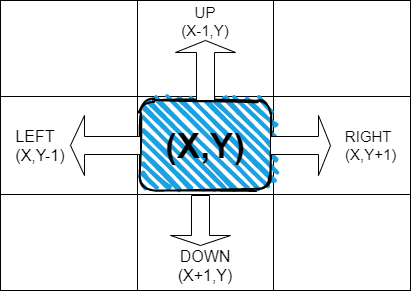
Detailed explanation ( Input/output format, Notes, Images )
Input Format :
The first line contains a single integer ‘T’ denoting the number of test cases. The test cases follow.

The first line of each test case contains a single integer ‘N’ denoting the number of rows and columns in the given matrix.

Next ‘N’ lines contain ‘N’ single space-separated integers each denoting the elements in the matrix.
For each test case, print all paths from (0,0) to (N-1, N-1) separated by a single space.

The output of every test case will be printed in a separate line.
You don’t need to print anything; It has already been taken care of.
Constraints :
1 <= T <= 5
1 <= N <= 5
0 <= ARR[i][j] <= 1

Where ‘T’ denotes the number of test cases, ‘N’ denotes the number of rows and columns of the given matrix, and ARR[i] denotes the value of the cell (i,j) in the given matrix.

Time Limit: 1 sec
Sample Input 1 :
2
2
1 1
1 1
2
1 0
1 1
Sample Output 1 :
DR RD
DR
Explanation of Sample Input 1 :
In the first test case, there are two paths from (0,0) to (1,1). The first path is (0,0)->(1,0)->(1,1) and the second path is (0,0)->(0,1)->(1,1)

In the second test case, there is only one path since the cell at (0,1) is blocked. The path is (0,0)->(1,0)->(1,1).
Sample Input 2 :
2
3
1 0 1
1 0 0
1 1 1
3
1 1 1
1 0 1
1 1 1
Sample Output 2 :
DDRR
DDRR RRDD
Explanation of Sample Input 2 :
In the first test case, there is only one path from (0,0) to (2,2). The path is (0,0)->(1,0)->(2,0)->(2,1)->(2,2).

In the second test case, there are two paths from (0,0) to (2,2). The first path is (0,0)->(1,0)->(2,0)->(2,1)->(2,2). and the second path is (0,0)->(0,1)->(0,2)->(1,2)->(2,2).
Hint
Hint 1
Can you think about exploring all possible paths using recursion?
Approaches (1)
Approach 1
Recursion Based Approach
The idea is to use recursion to try all possible paths and include the paths in our answer through which we can reach the cell (N-1, N-1).
The steps are as follows:
- Let’s define a recursive function as allPossiblePaths( i, j, currentPath, allPaths, visited, arr). Here, ‘i’ and ‘j’ denote the current cell, i.e. (i,j), “currentPath” is a string which denotes our current path from (0,0) to (i,j), and “allPaths” is an array for storing all paths from (0,0) to (N-1, N-1), “visited” is a matrix of size N*N which we will use to mark the cells we have already visited and “arr” is the given matrix.
- Start from the cell (0,0) and recursively explore all paths; let’s say our current cell is (i,j).
- If the value of the current cell is 0, then return because this cell is blocked.
- Otherwise, if the current cell is (N-1, N-1) then return after adding the “currentPath” to “allPaths” because our current path is a valid path from (0,0) to (N-1, N-1).
- Mark visited[i][j] as true.
- If (i+1, j) is a valid cell in the matrix and visited[i+1][j] is false then, add ‘D’ (denoting down) to the “currentPath” and recursively call allPossiblePaths( i+1, j, currentPath, allPaths, visited, arr) to traverse all possible paths from (i+1, j) . After this pop the ‘D’ from “currentPath” because we have explored paths from (i+1, j).
- If (i-1, j) is a valid cell in the matrix and visited[i-1][j] is false then, add ‘U’ (denoting up) to the “currentPath” and call allPossiblePaths(i-1, j, currentPath, allPaths, visited, arr) to traverse all possible paths from (i-1, j) . After this pop the ‘U’ from “currentPath” because we have explored paths from (i-1, j).
- If (i, j+1) is a valid cell in the matrix and visited[i][j+1] is false then, add ‘R’ (denoting right) to the “currentPath” and call allPossiblePaths(i, j+1, currentPath, allPaths, visited, arr) to traverse all possible paths from (i, j+1) . After this pop the ‘R’ from “currentPath” because we have explored paths from (i, j+1).
- If (i, j-1) is a valid cell in the matrix and visited[i][j-1] is false then, add ‘L’(denoting left) to the “currentPath” and call allPossiblePaths(i, j-1, currentPath, allPaths, visited, arr) to traverse all possible paths from (i,j-1) . After this pop the ‘L’ from “currentPath” because we have explored paths from (i, j-1).
- Now we have traversed all paths from (i,j) so we will mark visited[i][j] as false.
- Return “allPaths” array as this will contain all possible paths from (0,0) to (N-1, N-1).
Time Complexity
O(3 ^ (N ^ 2)), where ‘N’ is the number of rows in the given matrix.
As there are at most 3 unvisited neighbouring cells for any cell, we will make a maximum of 3 recursive calls from any cell, and there are a total of N ^ 2 cells. Thus, the total Time Complexity will be O(3 ^ (N ^ 2)).
Space Complexity
O(3 ^ (N ^ 2)), where ‘N’ is the number of rows in the given matrix.
When there are no blocked cells in the matrix, our answer will contain 3 ^ (N ^ 2) cells. Thus the total Space Complexity is O(3 ^ (N ^ 2) ).
Code Solution
(100% EXP penalty)
Paths in a Maze
C++ (g++ 5.4)

Console