




Problem
Submissions
Hints & solutions
Discuss
Phone Code
Hard

0/120
Average time to solve is 50m

Contributed by
9 upvotes
Asked in company

Problem statement
One day ninja saw his father using an old phone with a number pad and thought of a scenario. She saw that the phone had a numeric keypad and each number was mapped to some alphabets as shown in the figure below. She has a list of valid words. She wants to create an algorithm that would take a given sequence of numbers as input and return a list of matching words that are also present in her list of valid words.
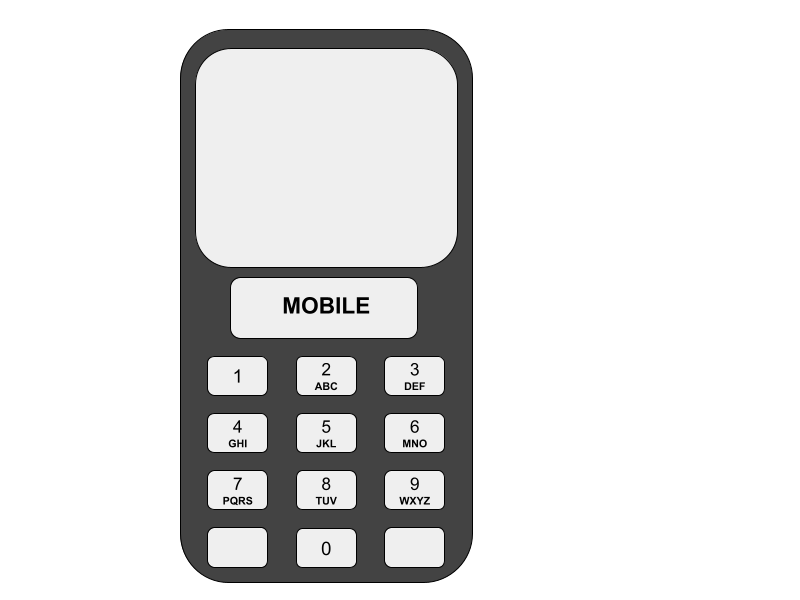
You can convert the list of valid words into any data structure you desire.
If the sequence of number = 2633, and the list of valid words = [ride, used, code, tree, boed],
Then you would print “code” and “boed” as they can be formed by using the digit sequence and they are also present in the list of valid words.
Detailed explanation ( Input/output format, Notes, Images )
Input Format:
The first line contains an integer ‘T’ which denotes the number of test cases or queries to be run. Then the test cases are as follows.
The first and line of each test case consist of the sequence of numbers.
The second line of each test case consists of ‘W’, which denotes the number of given valid words.
The third and final line of each test case consists of the list of ‘W’ valid words.
For each test case, print the list of words that can be formed using the given sequence of numbers and are also present in the given list of valid words.

Print the output of each test case in a separate line.
You don’t need to print anything; It has already been taken care of. You just need to complete the given function.
Constraints:
1 <= T <= 10
1 <= Sequence <= 10
1 <= W <= 200

where ‘T’ is the number of test cases, “sequence” is the length of the given sequence of numbers, and “W”, is the number of valid words each test case can have.

Time limit: 1 sec
Sample Input 1:
1
2633
5
used code ride tree boed
Sample Output 1:
code
boed
Explanation of sample input 1:
In the first test case,
The words that can be formed by using the digit sequence and that are also present in the list of valid words are: “code and boed
Sample Input 2:
2
22
6
ab ac mn op bc ws
234
6
bcd cde efg bdg cfh aei
Sample Output 2:
ab
ac
bc
bdg
cfh
aei
Explanation of sample input 1:
In the first test case,
The words that can be formed by using the digit sequence and that are also present in the list of valid words are: ab, ca, and bc.

In the second test case,
The words that can be formed by using the digit sequence and that are also present in the list of valid words are: bdg, cfh, and aei.
Hint
Hint 1
Hint 2
Can you think of trying every possible value for each digit?
Approaches (2)
Approach 1
Approach 2
Brute-Force
This is the most basic approach and we will simply try every possible value for each digit in the sequence with all other possible values.
- We start by taking the first digit of the sequence and run through all the characters that map to that digit.
- For every character, we then add it to a variable let’s say “pre” and recurse, by passing the “pre” downwards.
- We do this until we run out of characters and then simply print the variable “pre” that would by now contain the full word, if we can find it in the vector of valid words, meaning if it is a valid word.
Algorithm:
- We start by mapping the digits with their corresponding letters.
- For the main function, we start with creating a vector that will store our final “result”
- Create a recursive function with the base case:
- If there are no more digits to check, meaning if the length of the word is equal to the length of the sequence:
- Add the word “pre”, which is the current word to the “result” vector
- For the main function, we get characters that match the given digit with the help of the precomputed mapping of digits with their corresponding letters.
- Recursively call for the rest of the digits until we reach the end of the sequence.
- Check for “pre” in the list of valid words:
- If found:
- Push it into “result”.
- If found:
- If there are no more digits to check, meaning if the length of the word is equal to the length of the sequence:
- Finally, return the result vector.
Time Complexity
O(4 ^ N), where ‘N’ is the length of the sequence of digits.
We are recursively calling a maximum of four times for each digit to get valid words in the worst case, the overall time complexity is O(4 ^ N).
Space Complexity
O(N), where ‘N’ is the length of the sequence of digits.
We are using a vector to store the final result, the overall space complexity is O(N).
Code Solution
(100% EXP penalty)
Phone Code
C++ (g++ 5.4)

Console