


Problem
Submissions
Hints & solutions
Discuss
Postorder Traversal
Easy

0/40
Average time to solve is 15m

Contributed by
50 upvotes
Asked in companies



Problem statement
You have been given a Binary Tree of 'n' nodes, where the nodes have integer values. Your task is to return its postorder traversal.
For the given tree below,
Postorder traversal for the given tree will be [4, 5, 2, 3, 1]. Hence, the answer is [4, 5, 2, 3, 1].

Detailed explanation ( Input/output format, Notes, Images )
Input Format:
The first line contains the elements of the tree in the level order form separated by a single space. If any node does not have a left or right child, take -1 in its place. Refer to the example for further clarification.
Elements are in the level order form. The input consists of values of nodes separated by a single space in a single line. In case a node is null, we take -1 in its place.

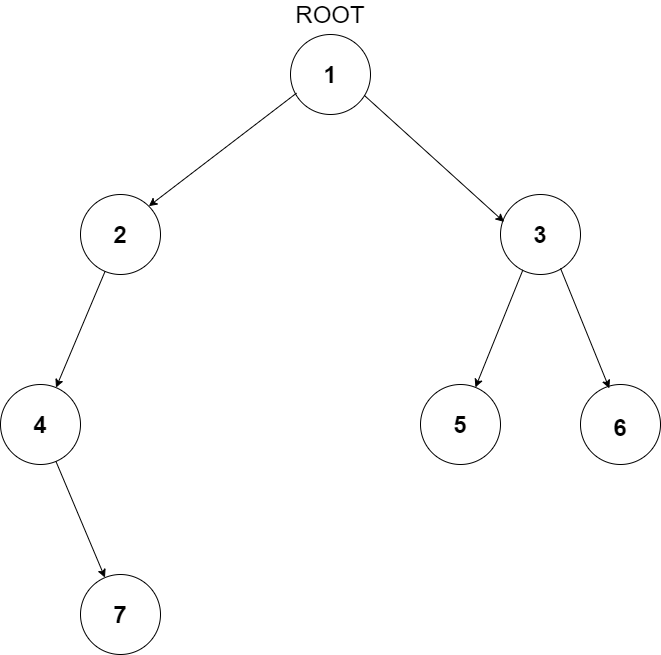
For example, the input for the tree depicted in the below image would be :
1
2 3
4 -1 5 6
-1 7 -1 -1 -1 -1
-1 -1

Explanation :
Level 1 :
The root node of the tree is 1

Level 2 :
Left child of 1 = 2
Right child of 1 = 3

Level 3 :
Left child of 2 = 4
Right child of 2 = null (-1)
Left child of 3 = 5
Right child of 3 = 6

Level 4 :
Left child of 4 = null (-1)
Right child of 4 = 7
Left child of 5 = null (-1)
Right child of 5 = null (-1)
Left child of 6 = null (-1)
Right child of 6 = null (-1)

Level 5 :
Left child of 7 = null (-1)
Right child of 7 = null (-1)

The first not-null node (of the previous level) is treated as the parent of the first two nodes of the current level.

The second not-null node (of the previous level) is treated as the parent node for the next two nodes of the current level and so on.

The input ends when all nodes at the last level are null (-1).
The output contains single line of 'n' space-separated integers denoting the post-order traversal of the given binary tree.
You do not need to print anything. It has already been taken care of. Just implement the function.
Sample Input 1:
1 2 3 4 -1 -1 5 6 7 -1 -1 -1 -1 -1 -1
Sample Output 1:
6 7 4 2 5 3 1
Explanation:
The given tree is:
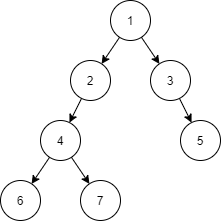
Postorder traversal for the given tree will be [6, 7, 4, 2, 5, 3, 1]. Hence, the answer is [6, 7, 4, 2, 5, 3, 1].
Sample Input 2:
10 20 11 -1 -1 -1 -1
Sample Output 2:
20 11 10
Expected time complexity:
The expected time complexity is O(n).
Constraints :
1 <= 'n' <= 10^5
0 <= 'data' <= 10^5

where 'n' is the number of nodes and 'data' denotes the node value of the binary tree nodes.

Time limit: 1 sec
Javascript (node v10.20.0)

Console