




Problem
Submissions
Hints & solutions
Discuss
Strobogrammatic Number ll
Moderate

0/80
Average time to solve is 25m
Contributed by
20 upvotes
Asked in company

Problem statement
Given a length ‘N’, you need to find all the strobogrammatic numbers of length ‘N’.
A strobogrammatic number is a number that looks the same when rotated by 180.
In other words, a number that on rotating right side up and upside down appears the same is a strobogrammatic number.
‘986’ is a strobogrammatic number because on rotating ‘986’ by 180 degrees, ‘986’ will be obtained.
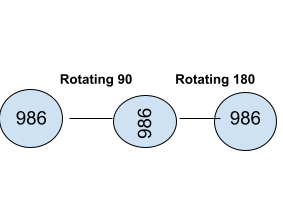
If N = 2, all the strobogrammatic numbers of length = 2 are “11”, “88”, “69”, “96”.
Detailed explanation ( Input/output format, Notes, Images )
Input Format:
The first line contains an integer ‘T’, denoting the number of test cases.

The first line of each test case contains a single integer denoting ‘N’.
For each test case, print space-separated strings denoting strobogrammatic numbers of the given length.

Print the output of each test case in a separate line.
You don’t need to print anything. It has already been taken care of. Just implement the given function.
Constraints:
1 <= T <= 5
1 <= N <= 7

Where ‘T’ is the number of test cases, and ‘N’ is the given length.

Time Limit: 1 sec
Sample Input 1:
2
3
1
Sample Output 1:
101 111 181 609 619 689 808 818 888 906 916 986
0 1 8
Explanation For Sample Input 1:
Test Case 1: All the possible Strobogrammatic numbers of length = 3 are “101”, “111”, “181”, “609”, “619”, “689”, “808”, “818”, “906”, “916”, “986”.

Test Case 2: Strobogrammatic numbers of length = 1 are “0”, “1”, and “8”.
Sample Input 2:
2
4
2
Sample Output 2:
1001 1111 1691 1881 1961 6009 6119 6699 6889 6969 8008 8118 8698 8888 8968 9006 9116 9696 9886 9966
11 69 88 96
Explanation For Sample Input 2:
Test Case 1: All the possible Strobogrammatic numbers of length = 4 are printed.

Test Case 2: All the possible Strobogrammatic numbers of length = 2 are printed.
Hint
Hint 1
Can you try to divide your problem into smaller sub-problems?
Approaches (1)
Approach 1
Recursion
Approach: Out of all the 10 digits, 0,1,6,8,9 will give a valid digit when rotated upside down(top part turned to bottom).
After rotating upside down digits will be-
0 -> 0
1 -> 1
6 -> 9
8 -> 8
9 -> 6
So We have to form numbers using only 0,1,6,8,9.
The basic idea is that we will reduce the problem into small problems. We will recursively solve the problem for length = length - 2. And then add digits out of (0,1,6,8,9) at the starting and the corresponding digits (0,1,9,8,6) at the end.
Recursion will be stopped when len = 0 and len - 1.
If len = 0, we will return an empty string and in case len = 1, we will return three strings “1”, “0”, “8” as these are the strobogrammatic numbers with pen = 1.
Let us understand this with an example for N = 4.

Algorithm:
- Let ‘findStrobogrammatic’ be the recursive function that will return an array of strings denoting all the strobogrammatic numbers.
- The recursive function will take ‘N’, denting the length given, and ‘len’ initialized as ‘N’.
- Base Cases
- If ‘N’ is ‘0’, return the empty string.
- If ‘N’ is ‘1’ return “1”, “0”, “8”.
- Recursively call for ‘N’ and ‘len-2’ and store the result of this recursive call in an array of strings “prev”.
- Initialize an array of strings “res” to store the strings after adding digits at start and end of the strings in “prev”.
- Run a loop i: 0 to (size of “prev” - 1) to traverse all the strings in “prev”.
- If N is not equal to len, add “0” + prev[ i ] “0”to “res”.
- Add “1” + prev[ i ] +“1” to “res”.
- Add “6” + prev[ i ] +“9” to “res”.
- Add “8” + prev[ i ] +“8” to “res”.
- Add “9” + prev[ i ] +“6” to “res”
- Return “res”.
Time Complexity
O(5^N), where ‘N’ is the given length.
Since for every pair of digits in the strobogrammatic number, we have 5 choices(0, 1, 6, 8, 9), and we are iterating over each of them. Therefore, the time complexity is O(5^N).
Space Complexity
O(5^N), where ‘N’ is the given length.
Since for every pair of digits in the strobogrammatic number, we have 5 choices(0, 1, 6, 8, 9), and there would be ‘N/2’ pairs. So there will be approximately 5^(N) strobogrammatic numbers of length ‘N’. Therefore, space complexity is O(5^N).
Code Solution
(100% EXP penalty)
Strobogrammatic Number ll
C++ (g++ 5.4)

Console