




Problem
Submissions
Hints & solutions
Discuss
Remove All Nodes with Value K
Easy

0/40
Average time to solve is 10m
Contributed by
23 upvotes
Asked in companies



Problem statement
You are given a Singly Linked List of integers and an integer 'K'. Your task is to remove all such nodes from the linked list whose value is equal to 'K'.
A singly linked list is a linear data structure in which we can traverse only in one direction i.e., from Head to Tail. It consists of several nodes where each node contains some data and a reference to the next node.
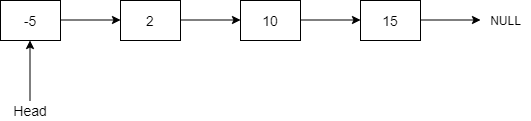
A sample Linked List-
Detailed explanation ( Input/output format, Notes, Images )
Input format:
The first line contains an integer 'T' which denotes the number of test cases or queries to be run. Then, the T test cases follow.

The first line of each test case contains space-separated integers denoting the values of nodes of the Linked List. The Linked List is terminated with -1. Hence, -1 is never a node value of the Linked List.

The second line of each test case contains a single integer 'K' which denotes the value of the nodes to be removed.
For each test case, print the elements of the resultant Linked List after removing all nodes having the value 'K'.
You do not need to print anything. It has already been taken care of. Just implement the given function.
Constraints:
1 <= T <= 10
1 <= N <= 10^5
0 <= node.data <= 10^9 and node.data != -1
0 <= K <= 10^9

Where 'node.data' denotes the value of a Linked list node, and 'K' denotes the value of the nodes to be removed.

Time limit: 1 sec
Sample Input 1:
2
2 5 7 10 -1
7
4 9 10 -1
3
Sample Output 1:
2 5 10 -1
4 9 10 -1
Explanation Of Sample Input 1:
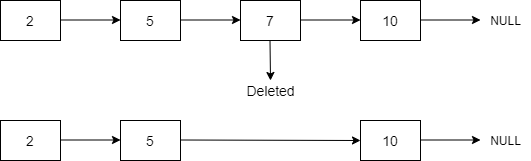
For the first test case, the given Linked List is

So, after deleting the node with value 7, the Linked List becomes
For the second test case, the given Linked List is

As no node in the Linked List has value 3, the Linked List remains unchanged.
Sample Input 2:
2
4 9 4 -1
4
1 2 -1
6
Sample Output 2:
9 -1
1 2 -1
Explanation Of Sample Input 2:
For the first test case, the given Linked List is [4, 9, 4]. So, after deleting both the node with value 4, the Linked List becomes [9].

For the second test case, the given Linked List is [1, 2]. As no node in the Linked List has value 6,  the Linked List remains unchanged.
Hint
Hint 1
Hint 2
Try to solve the current node and pass the other problem as sub problem.
Approaches (2)
Approach 1
Approach 2
Recursive Approach
Approach: The idea is to use recursion to solve the problem. The working of the recursive function is explained below. The basic idea is pretty simple that if a node has value K, then we will remove this node from the Linked List, and our output will be the node returned by the recursive call for its next node. Otherwise, our output will be the current node itself.
Working of the recursive function:
- If the node ‘HEAD’ is a NULL node, then we will return the node ‘HEAD’. This serves as the base case.
- Let ‘TEMP’ be a node that stores the value returned by recursive call for the node ‘HEAD → NEXT'.
- Update ‘HEAD -> NEXT' as ‘TEMP’, as ‘TEMP’ is the head of the Linked List after removing all occurrences of the value ‘K’.
- If ‘HEAD → DATA' is equal to K, then we will return the node ‘HEAD → NEXT'. As we want the current node to be removed from the Linked List, so we are returning its next node as the head of the Linked List.
- Otherwise, we will return the node ‘HEAD’.
Time Complexity
O(N), where N is the number of nodes in the Linked List.
The recursive function is called for each node of the Linked List only once. Hence, the overall Time Complexity is O(N).
Space Complexity
O(N), where N is the number of nodes in the Linked List.
As we are using recursive approach and it uses stack to store all the recursive calls. Thus, maximum number of calls can be upto N ans So, space complexity is O(N).
Code Solution
(100% EXP penalty)
Remove All Nodes with Value K
C++ (g++ 5.4)

Console