




Problem
Submissions
Hints & solutions
Discuss
Vertical Order Traversal
Moderate

0/80
Average time to solve is 35m
Contributed by
6 upvotes
Asked in companies



Problem statement
The Ultimate Ninja Ankush is a straightforward, no-nonsense guy and loves binary Trees, and he has given you a binary tree, and you have to return the vertical order traversal of the values of the nodes of the given tree.
For each node at position (‘X’, ‘Y’), (‘X’-1, ‘Y’-1) will be its left child position while (‘X’+1, ‘Y’-1) will be the right child position.
Running a vertical line from X = -infinity to X = +infinity, now whenever this vertical line touches some nodes, we need to add those values of the nodes in order starting from top to bottom with the decreasing ‘Y’ coordinates.
Print the vertical order of the tree, to make the Ultimate Ninja Happy.
Note:If two nodes have the same position, then the value of the node that is added first will be the value that is on the left side.
For the binary tree in the image below.

The vertical order traversal will be {2, 7, 5, 2, 6, 5, 11, 4, 9}.
Detailed explanation ( Input/output format, Notes, Images )
Input Format:
The first line contains an integer 'T' which denotes the number of test cases or queries to be run. Then the test cases are as follows.

The only line of each test case contains elements in the level order form. The line consists of values of nodes separated by a single space. In case a node is null, we take -1 in its place. So -1 would not be a part of the tree nodes.

For example, the input for the tree depicted in the below image will be:
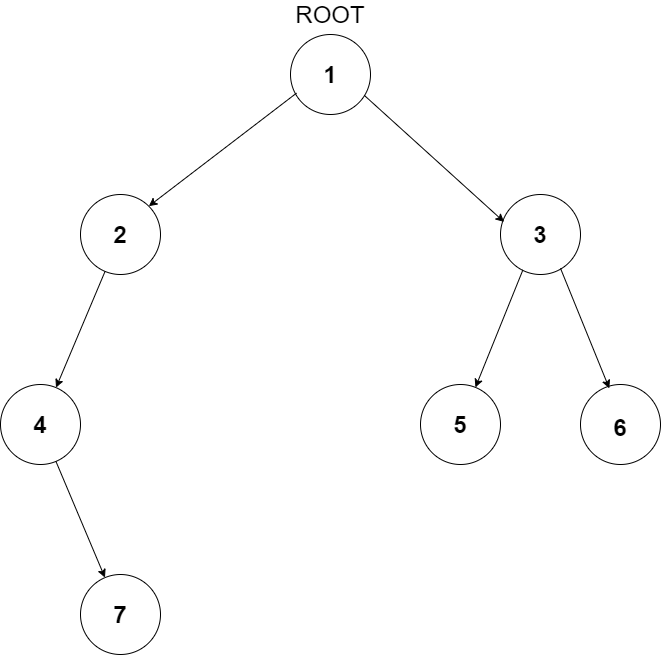
For example taking a tree:

1
2 3
4 -1 5 6
-1 7 -1 -1 -1 -1
-1 -1
Explanation :
Level 1 :
The root node of the tree is 1

Level 2 :
Left child of 1 = 2
Right child of 1 = 3

Level 3 :
Left child of 2 = 4
Right child of 2 = null (-1)
Left child of 3 = 5
Right child of 3 = 6

Level 4 :
Left child of 4 = null (-1)
Right child of 4 = 7
Left child of 5 = null (-1)
Right child of 5 = null (-1)
Left child of 6 = null (-1)
Right child of 6 = null (-1)

Level 5 :
Left child of 7 = null (-1)
Right child of 7 = null (-1)

The first not-null node(of the previous level) is treated as the parent of the first two nodes of the current level. The second not-null node (of the previous level) is treated as the parent node for the next two nodes of the current level and so on.

The input ends when all nodes at the last level are null(-1).
The above format was just to provide clarity on how the input is formed for a given tree.
The sequence will be put together in a single line separated by a single space. Hence, for the above-depicted tree, the input will be given as:

1 2 3 4 -1 5 6 -1 7 -1 -1 -1 -1 -1 -1
For each test case, print the vertical order traversal of the given binary tree separated by single spaces.

Print the output of each test case in a separate line.
You do not need to print anything, it has already been taken care of. Just implement the given function.
Constraints:
1 <= 'T' <= 100
0 <= 'N' <= 3000
0 <= 'VAL' <= 10^5

Where 'VAL' is the value of any binary tree node.

Time Limit: 1 sec
Sample Input 1:
2
1 2 3 4 -1 -1 -1 -1 -1
1 2 -1 3 -1 4 -1 -1 -1
Sample Output 1:
4 2 1 3
4 3 2 1
Explanation of Sample Input 1:
For the first test case, the vertical order traversal of the given binary tree will be {{4}, {2}, {1}, {3}}.

For the second test case, the vertical order traversal of the given binary tree will be {{4}, {3}, {2}, {1}}.
Sample Input 2:
2
2 1 -1 -1 -1
0 1 2 4 5 3 6 -1 -1 7 -1 -1 -1 -1 -1 -1 -1
Sample Output 2:
1 2
4 1 7 0 5 3 2 6
Explanation of Sample Input 2:
For the first test case, the vertical order traversal of the given binary tree will be {{1}, {2}}.

For the second test case, the vertical order traversal of the given binary tree will be {{4}, {1, 7}, {0, 5, 3}, {2}, {6}}.
Hint
Hint 1
Can you think about a more time efficient approach?
Approaches (1)
Approach 1
Efficient Approach
The intuition is to find the breadth of the tree first so that we can beforehand know the maximum horizontal distance and minimum horizontal distance of a node from the root node. We can use the absolute value of minimum horizontal distance as an offset. Now we can use an array/list visited to store the visited nodes where ith element will store the node at (i - offset”) distance horizontally from the root node. This way we can reduce the time complexity of inserting and accessing the nodes.
Let us define a function
getBreadth(TreeNode<int>* root, int hrDistance, int &minLeft,
int &maxRight)
Which finds the minimum horizontal distance and maximum horizontal distance and stores it in minLeft and rightLeft variables respectively. And hrDistance stores the horizontal distance between current node and the root node.
Now consider the following steps to implement this function:
- If root is NULL then return.
- Otherwise
- Recur for left subtree i.e. getBreadth(root->left, hrDistance-1, minLeft, maxRight)
- Similarly recur for right subtree i.e. getBreadth(root->right, hrDistance+1, minLeft, maxRight)
- Now update the “minLeft” and “maxRight” with the horizontal distance of the current node.
- minLeft = min(minLeft, hrDistance)
- maxRight = min(maxRight, hrDistance)
After getting the minimum horizontal distance and maximum horizontal distance, we can create an array/list visited of (maxRight - minLeft + 1) size to store the nodes. Also we can set the “offset” to negative of minimum horizontal distance.
We will follow the same approach as mentioned in approach 2 to visit the nodes.
Steps are as follows:
- Make a queue for traversing level by level like :
- queue< pair< TreeNode<int>*, int> > level, where the first element of the “level” is the node and the second element of the “level” is the horizontal distance of that node from the root node.
- Push the root node into the queue say “level” and make the horizontal distance 0 with the root node.
- Iterate until “level” does not become empty:
- Each time get the current node from the front of the “level” let’s say currNode. And get the horizontal distance of that node, let’s say hrDistance. Check if hrDistance is already visited or not? If it is not visited yet then make it visited with the value of “currNode” else ignore it because the previous node must have visited before the current node and its level will be less then current, so the previously-stored node will hide the current node.
- If the left node exists of currNode, then append the left node to the queue with one less horizontal distance than the “curNode”.
- level.push({currNode->left, hrDistance-1 }).
- If the right node exists of “curr”, then append the right node to the queue with one more horizontal distance than the “curr”.
- level.push({currNode->right, hrDistance+1 }).
- Finally, our values of visited have all the nodes which can be viewed from the top of the tree and store the whole vertical order. Store them and return the final answer.
Time Complexity
O(N), Where N is the number of nodes in the given binary tree.
Since we are using a post-order traversal to get the breadth of the tree and then traversing at every node and storing the horizontal distance of every node into an array/list, So inserting an element into the array/list will take O(1) time, and in the worst case (Skewed Trees) there will be ‘N’ distinct horizontal distance so it will take O(N).
Space Complexity
O(N), Where N is the number of nodes in the given binary tree.
We are storing the top view of the tree. So in the worst case (Skewed Trees), all nodes of the given tree will be the top view elements, and also there will be N distinct horizontal distance to be stored. So overall space complexity will be O(N).
Code Solution
(100% EXP penalty)
Vertical Order Traversal
C++ (g++ 5.4)

Console