

If you’ve typed “how to become a digital marketer” into Google, you’ve probably landed on a dozen conflicting answers; some say a free YouTube playlist is enough, others insist you…

How to Become a Counselling Psychologist in India After 12th
9 min read
6,036 views

Mental health awareness is growing rapidly across India and globally. As conversations around emotional well-being, stress, anxiety, relationships, and career pressures become more mainstream, the demand for trained mental health professionals is rising steadily. Among these professionals, counselling psychologists play a critical role in helping individuals navigate personal, emotional, academic, and professional challenges.
If you are a college student, fresher, or someone considering a meaningful career shift, this guide will walk you through how to become a counselling psychologist, eligibility after 12th, salary prospects, licensing requirements, time investment, and real-world career pathways.
What Is a Counselling Psychologist?
A counselling psychologist is a trained mental health professional who helps individuals manage emotional, psychological, behavioral, and interpersonal challenges. Their work focuses on helping people cope with life stressors, mental health concerns, relationship issues, academic pressure, workplace stress, grief, trauma, and personal growth.
Unlike clinical psychologists, who often deal with severe mental disorders, counselling psychologists typically work with individuals experiencing moderate to mild psychological distress and focus on improving overall well-being, coping skills, and self-understanding.
Key Responsibilities Of A Counselling Psychologist
Counselling psychologists use scientifically validated therapeutic approaches such as cognitive behavioral therapy (CBT), person-centered therapy, solution-focused therapy, and mindfulness-based interventions. Their goal is not just to treat symptoms but to help individuals lead more balanced, fulfilling lives.
Key responsibilities of a counselling psychologist include:
- Conducting one-on-one or group counselling sessions
- Helping clients manage anxiety, depression, stress, and emotional difficulties
- Supporting students with academic and career challenges
- Assisting individuals with relationship and family issues
- Conducting psychological assessments (depending on training)
- Promoting mental health awareness and emotional well-being
How to Become a Counselling Psychologist?
Becoming a counselling psychologist requires a structured academic journey, supervised training, and practical exposure. It is not an overnight process, but for those genuinely interested in psychology and helping people, it is a deeply rewarding career.
At a high level, the journey involves:
- Studying psychology at the undergraduate level
- Specializing in counselling psychology at the postgraduate level
- Gaining supervised practical training or internships
- Meeting licensing or certification requirements (where applicable)
The exact pathway can vary depending on whether you want to work in private practice, schools, corporate setups, hospitals, or NGOs.
Below is a step-by-step breakdown.
Step 1: Choose Psychology After 12th (or Any Stream)
You do not need to study psychology in school to become a counselling psychologist. Students from Science, Commerce, or Arts backgrounds are all eligible.
However, having psychology as a subject in Class 11 and 12 can make concepts easier to grasp later.
Step 2: Earn a Bachelor’s Degree in Psychology
Your first formal step is completing a Bachelor’s degree in Psychology, typically:
- BA in Psychology
- BSc in Psychology
This degree usually takes 3 years and introduces you to:
- Basics of psychology
- Developmental psychology
- Social psychology
- Abnormal psychology
- Research methods
While a bachelor’s degree does not qualify you to practice independently, it lays the foundation for advanced studies.
Step 3: Complete a Master’s Degree in Counselling Psychology
A Master’s degree is essential to become a counselling psychologist. Popular options include:
- MA in Counselling Psychology
- MSc in Counselling Psychology
- MA in Applied Psychology (with counselling specialization)
This postgraduate degree typically takes 2 years and focuses on:
- Counselling theories and techniques
- Psychopathology
- Psychological assessment
- Ethics in counselling
- Supervised practical training
During this phase, students begin seeing real clients under supervision, which is critical for skill development.
Step 4: Gain Practical Training and Supervised Experience
Practical exposure is the backbone of counselling psychology. Most reputable programs include:
- Mandatory internships
- Supervised counselling hours
- Case discussions and evaluations
Even after completing a master’s degree, many graduates pursue additional internships, diplomas, or supervised practice to strengthen their skills.
Step 5: Build Specializations and Certifications (Optional but Recommended)
To stand out in the job market, many counselling psychologists pursue certifications in:
- Child and adolescent counselling
- Career counselling
- Relationship and marriage counselling
- Trauma-informed therapy
- CBT or mindfulness-based therapy
These certifications improve employability and confidence, especially for freshers.
How to Become a Counselling Psychologist After 12?
If you are a student right after Class 12 and have already made it clear that you want to become a counselling psychologist, planning early gives you a strong advantage.
The journey after 12th usually looks like this:
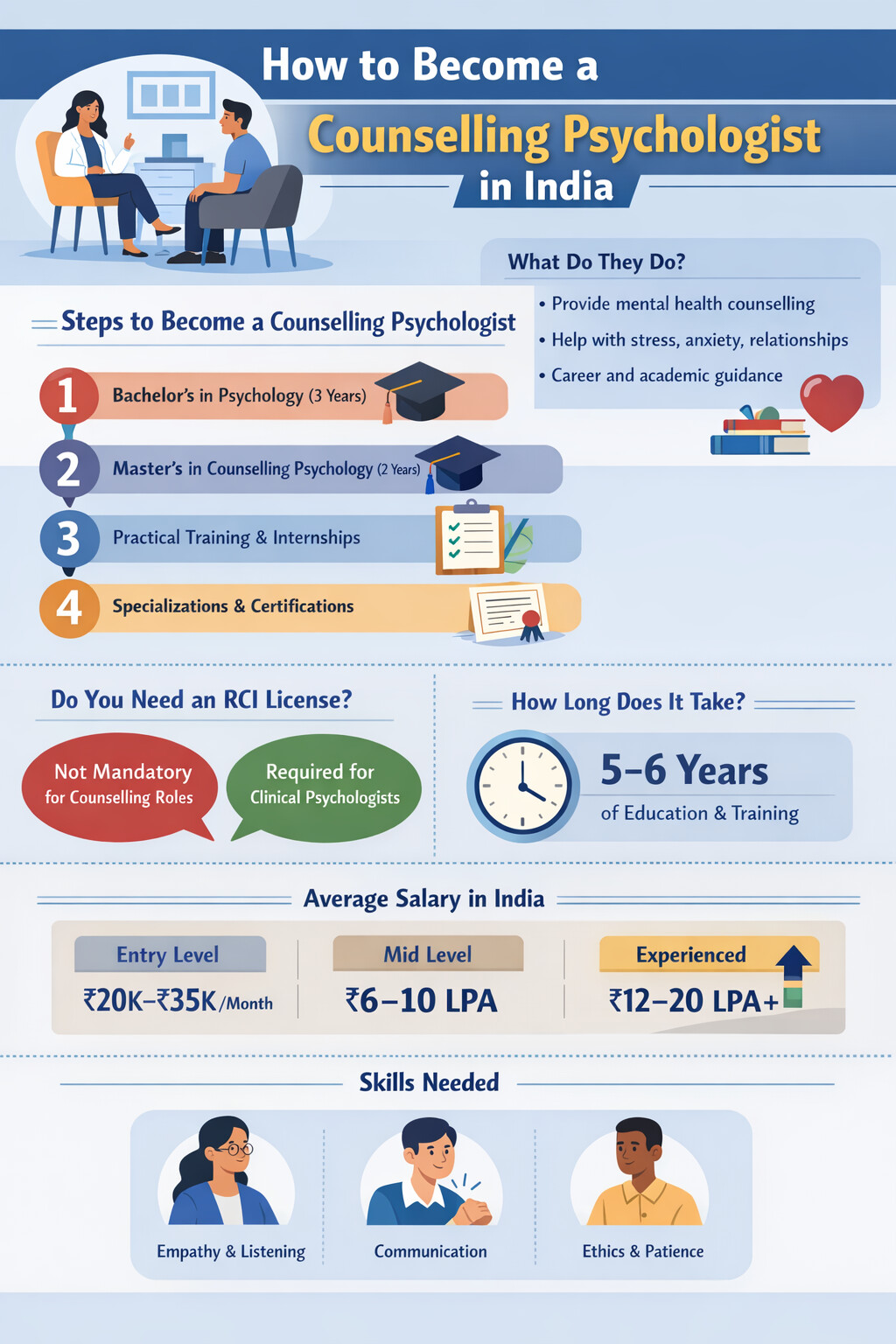
After 12th → Bachelor’s in Psychology (3 years) → Master’s in Counselling Psychology (2 years) → Training/Internship → Entry-level practice or job
Students from any stream can pursue psychology at the undergraduate level. However:
- Arts and Humanities students often find theory easier
- Science students may be comfortable with research and statistics
- Commerce students bring strong analytical and people skills
What matters more than your stream is your interest in human behavior, empathy, communication skills, and emotional intelligence.
During your undergraduate years, it is highly recommended to:
- Volunteer with NGOs or mental health helplines
- Attend psychology workshops and seminars
- Read research papers and mental health literature
- Develop listening and interpersonal skills
Early exposure helps you confirm whether counselling psychology is truly the right fit for you.
Does a Counselling Psychologist Need an RCI License?
This is one of the most frequently searched and confusing questions for students in India.
The short answer is: It depends on the role and workplace.
Understanding RCI (Rehabilitation Council of India)
The Rehabilitation Council of India (RCI) regulates professions related to clinical psychology, rehabilitation psychology, and disability assessment.
To legally use the title “Clinical Psychologist” in India and conduct clinical diagnosis, an RCI license is mandatory.
Counselling Psychologist and RCI License
For counselling psychologists:
- An RCI license is not always mandatory
- Many counselling psychologists work without RCI registration in:
- Schools and colleges
- Corporate wellness programs
- NGOs
- Career counselling centers
- Private practice (non-clinical settings)
However, there are important caveats:
- You cannot diagnose severe mental disorders without RCI credentials
- Hospitals and government institutions may prefer or require RCI-registered professionals
- Ethical practice requires clarity about your scope of work
If your long-term goal is to work in clinical or hospital settings, pursuing an RCI-recognized MPhil or equivalent program may be necessary.
For students focused on counselling, guidance, and emotional well-being, a strong master’s degree plus supervised training is often sufficient.
How Long Does It Take to Become a Counselling Psychologist?
Becoming a counselling psychologist is a long-term commitment, but knowing the timeline helps set realistic expectations.
On average, the journey looks like this:
- Bachelor’s degree: 3 years
- Master’s degree: 2 years
- Supervised training/internship: 6 months to 1 year
Total time required: 5.5 to 6 years
If you choose to pursue additional certifications, diplomas, or an MPhil, it may take 7–8 years to fully establish yourself.
It is important to understand that psychology is not a shortcut career. Skills deepen with experience, client exposure, and continuous learning. Most counselling psychologists continue professional development throughout their careers.
Counselling Psychologist Salary in India
Salary is a key concern for students and freshers, especially in a field driven by skill and experience rather than fixed pay scales.
Entry-Level Counselling Psychologist Salary
For freshers:
- ₹20,000 – ₹35,000 per month in schools, NGOs, or counseling centers
- ₹3 – ₹5 LPA in corporate wellness roles
Entry-level salaries may seem modest, but growth is steady with experience.
Mid-Level Salary (3–5 Years of Experience)
With specialization and consistent practice:
- ₹6 – ₹10 LPA
- ₹1,000 – ₹3,000 per session in private practice
Senior Counselling Psychologist Salary
Experienced professionals with strong reputations can earn:
- ₹12 – ₹20+ LPA
- ₹3,000 – ₹6,000 per session or more
Income in counselling psychology depends heavily on:
- Area of specialization
- City and client base
- Mode of practice (job vs private practice)
- Online vs offline consultations
Skills Required to Become a Successful Counselling Psychologist
Academic qualifications alone are not enough. Successful counselling psychologists develop a strong set of personal and professional skills.
Key skills include:
- Active listening
- Empathy and emotional sensitivity
- Non-judgmental attitude
- Communication and rapport building
- Ethical decision-making
- Patience and emotional resilience
Developing these skills takes time and self-awareness, which is why internships and supervised practice are so important.
Career Opportunities for Counselling Psychologists
Counselling psychology offers diverse career paths beyond private practice.
Popular options include:
- School and college counsellor
- Corporate mental wellness professional
- NGO and community mental health worker
- Career counsellor
- Rehabilitation centers
- Online counselling platforms
With growing awareness of mental health, demand is expanding across education, workplaces, healthcare, and digital platforms.
Is Counselling Psychology a Good Career Choice?
For those who value purpose, impact, and personal growth, counselling psychology can be deeply fulfilling. It may not offer instant high salaries, but it provides:
- Long-term career stability
- Emotional and intellectual satisfaction
- Opportunities for entrepreneurship through private practice
- Continuous learning and self-development
If you are empathetic, patient, and genuinely interested in helping people navigate life’s challenges, counselling psychology is a strong and future-proof career choice.
Becoming a counselling psychologist is a journey of education, self-reflection, training, and commitment. It requires patience, emotional maturity, and ethical responsibility, but it also offers the chance to create meaningful impact in people’s lives.
With the growing focus on mental health, counselling psychologists will continue to play a vital role in shaping healthier individuals and communities.
FAQs on Counselling Psychologist
Is counselling psychology a good career in India?
Yes, counselling psychology is a growing and meaningful career in India due to rising mental health awareness. Opportunities exist in schools, corporates, NGOs, hospitals, and private practice. Career growth improves significantly with experience, specialization, and strong counselling skills.
Can I become a counselling psychologist without studying psychology after 12th?
Yes, students from any stream, Science, Commerce, or Arts, can become counselling psychologists. You can pursue a bachelor’s degree in psychology after 12th, followed by a master’s in counselling psychology. Studying psychology early helps but is not mandatory.
What is the difference between a counselling psychologist and a clinical psychologist?
A counselling psychologist focuses on emotional well-being, life challenges, stress, and personal development, while a clinical psychologist diagnoses and treats severe mental disorders. Clinical psychologists require RCI licensing in India, whereas counselling psychologists usually work in non-clinical settings.
Is an RCI license mandatory for counselling psychologists?
No, an RCI license is not mandatory for counselling psychologists working in schools, corporates, NGOs, or private counselling setups. However, RCI registration is required for clinical psychologists and for roles involving diagnosis of severe mental health conditions.
How long does it take to become a counselling psychologist?
It typically takes 5–6 years to become a counselling psychologist, including a 3-year bachelor’s degree and a 2-year master’s degree. Additional internships, certifications, or supervised practice may extend the timeline but significantly improve career readiness.
What is the starting salary of a counselling psychologist?
Freshers can earn ₹20,000–₹35,000 per month in schools, NGOs, or counselling centers. With experience, specialization, and private practice, income increases steadily. Online counselling and corporate wellness roles often offer better early-career pay.
Can counselling psychologists open their own private practice?
Yes, counselling psychologists can start private practice after completing a master’s degree and gaining supervised experience. While an RCI license is not mandatory for counselling, ethical practice, proper training, and clear scope of work are essential to build trust and credibility.
What skills are required to become a counselling psychologist?
Key skills include empathy, active listening, emotional intelligence, communication, patience, and ethical judgment. Counselling psychologists must also manage emotional boundaries and continuously update their knowledge through training, supervision, and self-reflection.
Are online counselling jobs available for counselling psychologists?
Yes, online counselling jobs are increasingly popular. Counselling psychologists can work with mental health platforms, ed-tech companies, corporate wellness programs, or start their own independent online practices. Strong communication skills and ethical online practices are essential for success.
Is maths or science required to become a counselling psychologist?
No, advanced maths or science is not required. Basic statistics may be part of psychology coursework, but the field primarily focuses on human behavior, emotions, and the study of communication. Interest in people, mental health, and self-awareness matters more than academic background.
Latest Posts
Graduated. Taking a Gap Year. Now What?
You’ve just graduated; everyone around you is either starting a job or prepping for another exam, and you’re quietly wondering whether taking a year off is a smart reset or…
AI Jobs Are Booming in India: Here’s How to Land One in 2026
If you’ve been scrolling job portals wondering whether “AI jobs” are actually real career options or just buzzword listings, here’s the short answer: they’re very real, and they’re growing faster…
How to Optimize Your LinkedIn Profile as a Fresher
A standout LinkedIn profile as a college student combines a professional photo, a keyword-rich headline that goes beyond your default student title, a first-person summary highlighting your projects and coursework,…
What is SSC CGL Exam? – Complete Details for 2026
If you’re a college student or a fresh graduate wondering, “Should I appear for SSC CGL?” you’re in the right place. Every year, over 30 lakh students apply for this…
Popular Posts
How to Pass the TCS NQT Aptitude Test?
Every year, lakhs of engineering and graduation students apply to TCS, one of India’s largest IT employers. And almost every single one of them hits the same first wall: the…
What is SSC CGL Exam? – Complete Details for 2026
If you’re a college student or a fresh graduate wondering, “Should I appear for SSC CGL?” you’re in the right place. Every year, over 30 lakh students apply for this…
How to Make a Fresher Resume That Recruiters Notice
If you are a college student or a fresher stepping into the professional world, creating a well-structured resume is your first step to success. A polished and ATS-friendly resume can…
Engineering Student Resume: A Complete Guide for BTech Freshers
Engineering is a highly competitive field, with more than 1.5 lakh students graduating every year in India. That is why a strong engineering student resume is essential to secure a…
Best Fintech Companies for Freshers to Work at in India
India is one of the fastest-growing fintech markets in the world, with over 10,000 registered fintech startups and a market valuation projected to cross $150 billion by 2025. For freshers…