

If you’ve typed “how to become a digital marketer” into Google, you’ve probably landed on a dozen conflicting answers; some say a free YouTube playlist is enough, others insist you…


How to Become a Wealth Manager in India
8 min read
5,517 views

If you’ve ever wondered how high-net-worth individuals grow and protect their wealth, the answer often lies with one professional: a wealth manager. As India’s economy expands and financial literacy improves, the demand for skilled wealth managers is growing faster than ever, and for college students eyeing a high-earning, intellectually stimulating career in finance, this could be your calling.
This guide breaks down everything you need to know about becoming a wealth manager in India, from what the role actually involves to the qualifications you need, the certifications that make you stand out, and what salary you can realistically expect.
What Is a Wealth Manager?
A wealth manager is a financial professional who provides comprehensive financial planning and investment services to individuals and families, typically those with significant assets. Unlike a regular financial advisor who might only advise on a specific product, such as insurance or mutual funds, a wealth manager takes a holistic view of a client’s entire financial life.
This includes:
- Investment portfolio management
- Tax planning and optimization
- Retirement and succession planning
- Estate and trust planning
- Risk management and insurance advisory
- Goal-based financial planning
In simple terms, if someone has ₹50 lakh to ₹5 crore (or more) to invest and manage, a wealth manager is the person they turn to. The role is both advisory and relationship-driven; you need to understand numbers and people equally well.
Why Wealth Management Is a Smart Career Choice for Freshers?
India’s wealthy population is growing at a remarkable pace. According to multiple financial reports, India is expected to be among the top five countries globally in terms of high-net-worth individuals (HNIs) by 2030. This means:
- More people need professional help managing their wealth
- Banks, NBFCs, and wealth management firms are actively hiring
- The role offers strong career growth and compensation
- It combines finance, psychology, and client strategy, ideal for curious minds
For college students in India, this is one of the few finance careers where your earning potential grows directly with your skills and client base.
What Does a Wealth Manager Do Day-to-Day?
Before committing to this career path, it’s worth understanding what the job actually looks like on a typical day:
- Morning: Reviewing markets, portfolio performance, and economic news
- Client meetings: Discussing financial goals, reviewing investment performance, and suggesting changes
- Research: Analyzing new investment products, mutual funds, bonds, PMS, AIFs, and real estate
- Reporting: Preparing financial statements and portfolio summaries for clients
- Business development: Meeting prospective clients or attending networking events
- Compliance: Ensuring recommendations adhere to SEBI and regulatory guidelines
It’s a client-facing, target-driven role that rewards strong communication skills and financial acumen in equal measure.
Qualifications for Wealth Manager
One of the most common questions students ask is, “What is the minimum qualification to become a wealth manager in India?”
Minimum Educational Qualification
- A bachelor’s degree in Commerce (B.Com.), Economics, Business Administration (BBA/MBA), Mathematics, or Finance is the standard entry point.
- A master’s degree (MBA in Finance or M.Com) is strongly preferred by top firms such as Kotak Wealth, HDFC Bank’s Wealth Division, ICICI Private Banking, Avendus, and others.
- Some students also pursue CA (Chartered Accountancy) or CFA (Chartered Financial Analyst) alongside their degree for a significant competitive edge.
Skills Needed for a Wealth Manager
A degree gets you in the door. Skills and certifications keep you ahead. Key skills include:
- Analytical and numerical ability
- Strong communication and presentation skills
- Emotional intelligence, understanding client psychology
- Knowledge of financial products and markets
- Attention to detail and ethical judgment
Professional Certifications Needed for Wealth Manager
This is where you can truly differentiate yourself, especially as a fresh graduate competing for limited entry-level roles. Here are the most recognized and respected certifications for wealth managers in India:
- NISM Series-X-A & X-B: Investment Adviser Certification: Mandatory for anyone offering investment advisory services in India, as per SEBI guidelines. This is non-negotiable if you want to practice formally. Offered by the National Institute of Securities Markets (NISM), these exams are affordable, structured, and widely recognized.
- CFP – Certified Financial Planner: One of the most globally respected certifications in personal finance and wealth management. In India, it is offered through the Financial Planning Standards Board India (FPSB India). The CFP covers financial planning, investment planning, tax planning, retirement planning, and estate planning — essentially the full spectrum of wealth management.
- CFA – Chartered Financial Analyst: The gold standard in investment management globally. While the CFA is demanding (three levels, 900+ hours of study), it signals deep investment knowledge and opens doors to the most prestigious roles at asset management companies, private banks, and family offices.
- CWM – Chartered Wealth Manager: Offered by the American Academy of Financial Management (AAFM), the CWM is specifically tailored to wealth management and covers portfolio theory, client psychology, asset allocation, and alternative investments.
- AMFI Registration Number (ARN): If your role involves selling or distributing mutual funds, which is common in many entry-level wealth management positions, getting your ARN from AMFI (Association of Mutual Funds in India) is essential. It requires passing the NISM Series-V-A exam.
Student Tip: Start with NISM certifications while still in college. They’re affordable, recognized by regulators, and give you an immediate edge when applying for internships or entry-level roles.
Salary of a Wealth Manager in India
Now for the question that’s probably been on your mind: “What is the salary of a wealth manager in India?” The honest answer is that it varies significantly based on experience, firm, city, and your client base. Here’s a realistic breakdown:
| Experience Level | Typical Annual CTC (INR) |
| Entry-Level / Fresher (0–2 years) | ₹3.5 – ₹6 LPA |
| Mid-Level (3–6 years) | ₹8 – ₹18 LPA |
| Senior Wealth Manager (7–12 years) | ₹20 – ₹45 LPA |
| Private Banker / HNI Relationship Manager | ₹40 LPA – ₹1 Cr+ |
Many senior wealth managers work on a variable pay model, where a significant portion of their income comes from performance incentives tied to assets under management (AUM) and client retention. This means your earning potential is directly linked to the quality of relationships you build.
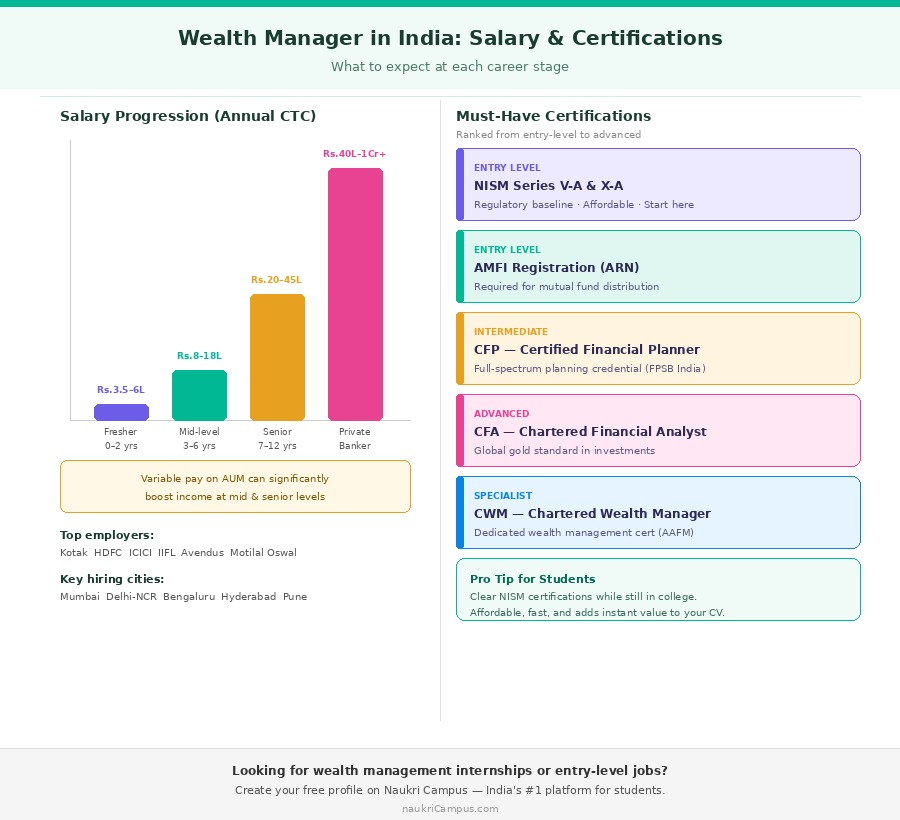
Top employers for wealth managers in India include Kotak Mahindra Bank, HDFC Bank, ICICI Bank, Axis Bank, IIFL Wealth, Avendus Capital, Motilal Oswal, and a growing number of fintech-driven wealth platforms.
How to Become a Wealth Manager: Step-by-Step Roadmap
Here’s the clearest path from where you are today to your first wealth management role:
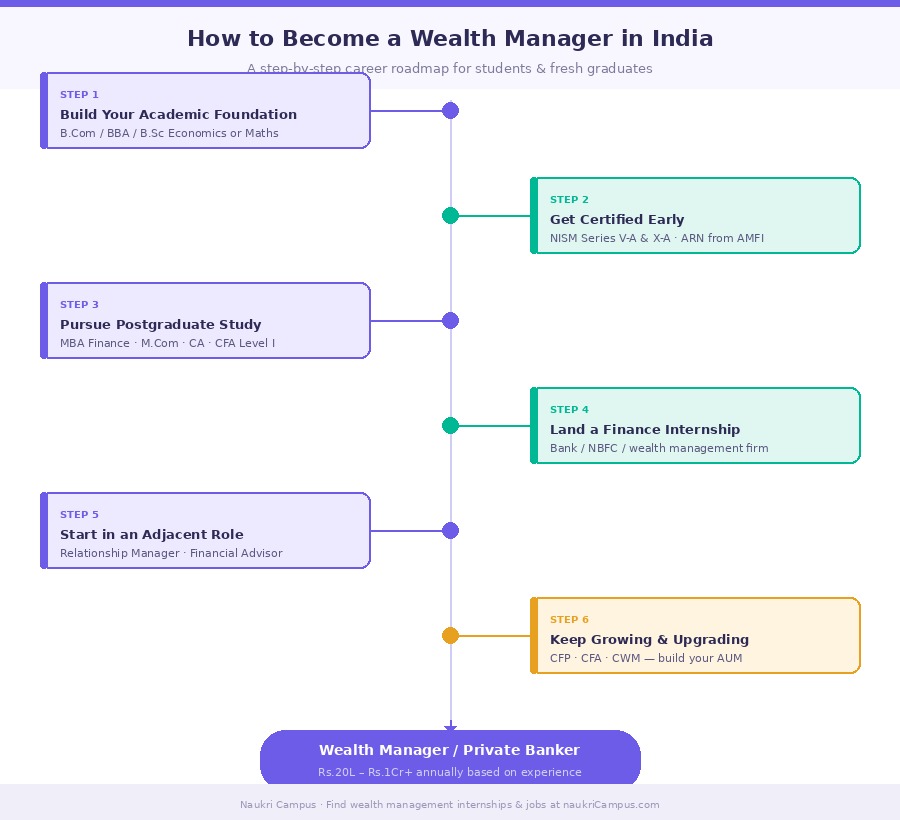
Step 1: Build the Right Academic Foundation
Choose commerce, economics, finance, or business as your undergraduate stream. If you’re already in college, consider adding finance electives and participating in finance clubs or investment competitions.
Step 2: Pursue a Relevant Postgraduate Degree (Optional but Recommended)
An MBA in Finance from a reputed institution (IIMs, NMIMS, Symbiosis, etc.) significantly improves your access to top-tier wealth management firms through campus placements.
Step 3: Get Certified While Still Studying
Start with the NISM Series-V-A (Mutual Funds) and NISM Series-X-A (Investment Adviser) certifications. These can be cleared in a few months and strengthen your resume considerably.
Step 4: Apply for Internships in Wealth Management
Internship experience at a bank, NBFC, or wealth firm is gold. It gives you real exposure to client servicing, portfolio tools, and financial products, and often converts into a full-time role.
Step 5: Start in an Adjacent Role If Needed
Many wealth managers start as relationship managers, financial advisors, or sales associates in banking and gradually transition into wealth management as they build their client base and expertise.
Step 6: Keep Learning and Upgrading
The financial world changes constantly. SEBI regulations evolve, new products launch, and client expectations shift. Continuous learning, whether through the CFA, CFP, or industry workshops, keeps you ahead.
Wealth Manager vs. Financial Advisor vs. Investment Banker: What’s the Difference?
Students often confuse these roles. Here’s a quick snapshot:
| Role | Focus | Typical Clients | Income Model |
| Wealth Manager | Comprehensive life-stage planning | HNIs, families | Fee + commission |
| Financial Advisor | Product-specific advice | Retail investors | Commission-based |
| Investment Banker | Corporate deals, fundraising | Companies | Deal fees, salary |
| Portfolio Manager | Pure investment management | Institutions, HNIs | Fee on AUM |
Wealth management is the most relationship-intensive of these, which is why soft skills matter just as much as technical knowledge.
Summing Up!
If you’re a student who finds yourself drawn to markets, curious about financial products, and comfortable building long-term relationships, this profession offers one of the most fulfilling and well-compensated paths in Indian finance.
India’s wealth management industry is still maturing, which means early movers who invest in the right skills and qualifications today will be the relationship managers and private bankers commanding premium salaries tomorrow. Start small, stay consistent, keep learning, and use platforms like Naukri Campus to connect with the right opportunities at every stage of your journey.
FAQs on Wealth Manager
What is the minimum qualification to become a wealth manager in India?
A bachelor’s degree in commerce, finance, economics, or business is the minimum. Most reputed firms prefer an MBA in finance or an equivalent postgraduate qualification.
Is the CFA necessary to become a wealth manager?
Not mandatory, but highly advantageous, especially for roles at top-tier firms, private banks, or family offices. NISM certifications are the regulatory baseline.
Can a fresher get a job in wealth management?
Yes, but typically through adjacent roles like financial advisor, relationship manager, or banking sales. Building certifications and internship experience improves your chances significantly.
What is the salary of a wealth manager in India for freshers?
Entry-level roles typically offer ₹3.5 to ₹6 LPA, with performance-based incentives that can increase your take-home significantly as you grow.
Which cities have the most wealth management jobs in India?
Mumbai is the hub, followed by Delhi-NCR, Bengaluru, Hyderabad, Pune, and Chennai. However, with digital wealth platforms growing rapidly, remote and hybrid roles are also emerging.
How long does it take to become a wealth manager in India?
With a B.Com. or BBA plus an MBA in finance, expect 5–6 years of education. That said, with NISM certifications and a solid internship, you can land a junior role within 3–4 years of starting college.
Is wealth management a good career for commerce students in India?
Yes, very much so. Subjects like accounts, economics, and business studies give commerce students a head start. A B.Com, NISM certifications, and an MBA in finance are some of the most direct routes into this field.
What is the difference between a wealth manager and a private banker?
Private bankers work within a bank’s HNI division and focus on banking products. Wealth managers take a broader view, covering investments, tax, estate planning, and more. In practice, senior wealth managers often move into private banking roles.
Do wealth managers work independently or at firms?
Both. Freshers typically start at banks or wealth firms. With experience, many professionals register as Independent Financial Advisers (IFAs) or SEBI-registered RIAs and build their own client book.
What soft skills matter most for a wealth manager?
Active listening, empathy, clear communication, and ethical judgment. Clients share sensitive financial information; trust is everything. These skills often matter more than technical knowledge in the long run.
How do I find wealth management internships as a college student?
Start with college placement drives, LinkedIn outreach, and company career pages. Naukri Campus is particularly useful; it lists internships specifically for students across BFSI companies, making it easy to apply without cold emailing.
Is wealth management a stressful career?
It can be target-driven and intense during market volatility. But those who enjoy client relationships and problem-solving tend to find it energizing. Strong client trust built over time significantly reduces day-to-day pressure.
Latest Posts
Graduated. Taking a Gap Year. Now What?
You’ve just graduated; everyone around you is either starting a job or prepping for another exam, and you’re quietly wondering whether taking a year off is a smart reset or…
AI Jobs Are Booming in India: Here’s How to Land One in 2026
If you’ve been scrolling job portals wondering whether “AI jobs” are actually real career options or just buzzword listings, here’s the short answer: they’re very real, and they’re growing faster…
How to Optimize Your LinkedIn Profile as a Fresher
A standout LinkedIn profile as a college student combines a professional photo, a keyword-rich headline that goes beyond your default student title, a first-person summary highlighting your projects and coursework,…
What is SSC CGL Exam? – Complete Details for 2026
If you’re a college student or a fresh graduate wondering, “Should I appear for SSC CGL?” you’re in the right place. Every year, over 30 lakh students apply for this…
Popular Posts
How to Pass the TCS NQT Aptitude Test?
Every year, lakhs of engineering and graduation students apply to TCS, one of India’s largest IT employers. And almost every single one of them hits the same first wall: the…
What is SSC CGL Exam? – Complete Details for 2026
If you’re a college student or a fresh graduate wondering, “Should I appear for SSC CGL?” you’re in the right place. Every year, over 30 lakh students apply for this…
How to Make a Fresher Resume That Recruiters Notice
If you are a college student or a fresher stepping into the professional world, creating a well-structured resume is your first step to success. A polished and ATS-friendly resume can…
Engineering Student Resume: A Complete Guide for BTech Freshers
Engineering is a highly competitive field, with more than 1.5 lakh students graduating every year in India. That is why a strong engineering student resume is essential to secure a…
Best Fintech Companies for Freshers to Work at in India
India is one of the fastest-growing fintech markets in the world, with over 10,000 registered fintech startups and a market valuation projected to cross $150 billion by 2025. For freshers…