

If you’ve been watching AI headlines and wondering how people actually land jobs building these systems, you’re asking the right question at the right time. Machine learning engineering is one…


How to Get an Internship in Top Companies
9 min read
31,378 views

Getting your first internship can feel overwhelming. Where do you apply? Is your resume good enough? Will you even get a call back? You’re not alone. Every year, lakhs of students ask the same questions, and the good news is that landing an internship at a top company is absolutely achievable if you follow the right strategy.
This guide breaks it all down, from building your profile to acing the interview, in a way that’s practical, actionable, and tailored for students just like you.
What Is an Internship and Why Does It Matter?
An internship is a short-term, structured work experience, typically 1 to 6 months, where you work in a real company and contribute to actual projects. It bridges the gap between classroom learning and professional work, giving you hands-on exposure before your full-time career begins.
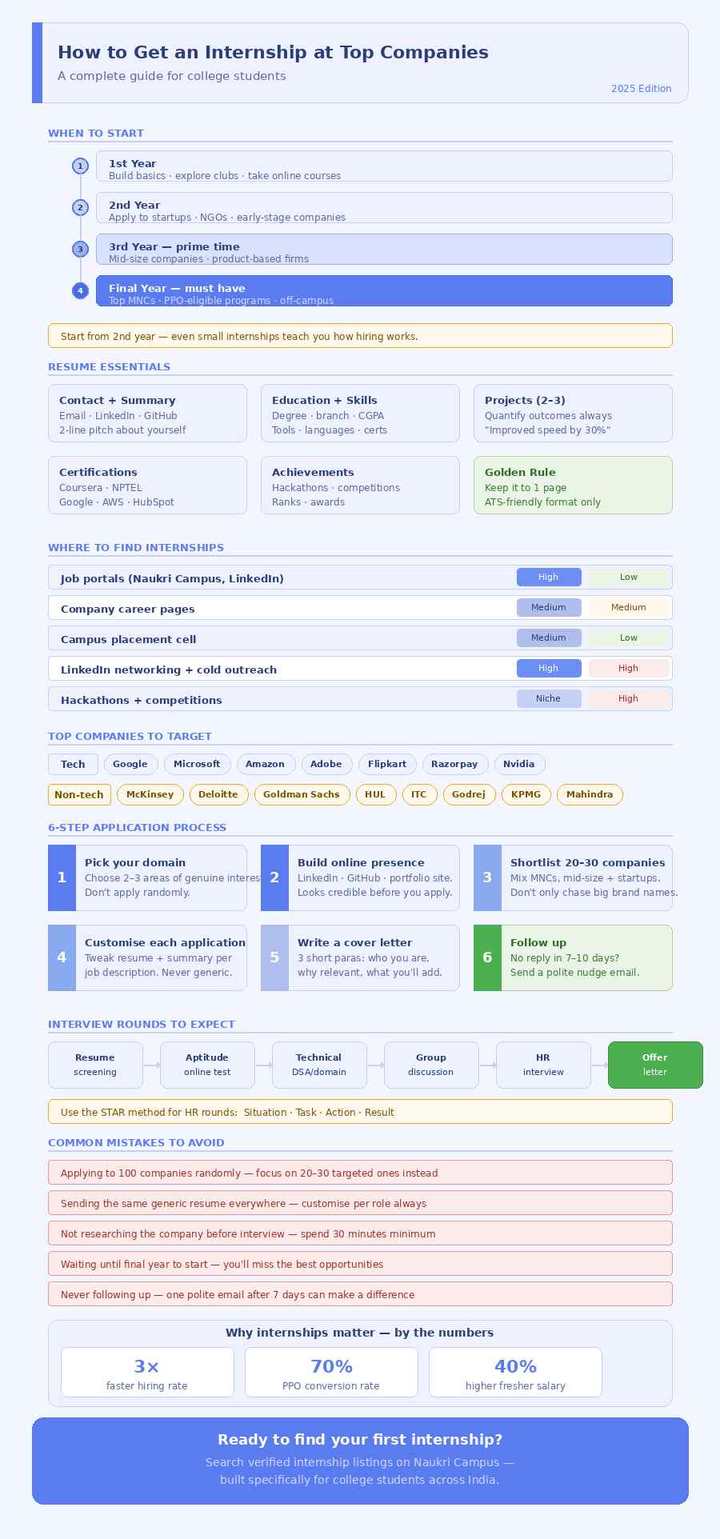
Here’s why top recruiters and hiring managers consistently prioritize candidates with internship experience over those without any.
| Fact | Statistic |
| Students with internship experience are hired faster | 3x more likely |
| Companies that convert interns to full-time employees | ~70% (for PPO roles) |
| Avg. salary hike for internship-experienced freshers | 20–40% higher |
| Students who get campus placements after interning | Significantly higher |
Internships also help you figure out what you don’t want, which is just as valuable. If a domain doesn’t suit you, better to know during an internship than after joining full-time.
When Should You Start Looking for Internships?
One of the most common doubts students have is “Am I too early? Too late? When is the right time?”
The answer depends on your year of study and the type of company you’re targeting:
| Year of Study | When to Apply | What to Target |
| 1st Year | Build basics and explore | Volunteering, college clubs, online courses |
| 2nd Year | Start applying | Startups, NGOs, early-stage companies |
| 3rd Year | Prime time | Mid-size companies, product-based firms |
| Final Year | Must-have | Top MNCs, PPO-eligible programs, off-campus roles |
The biggest mistake students make is waiting until their final year. Start applying from your 2nd year; even small internships add weight to your resume and teach you how hiring works.
Platforms like Naukri Campus list thousands of internship openings specifically for college students, sorted by role, city, and stipend, so you’re not wasting time scrolling through irrelevant listings.
How to Build a Strong Resume for Internship Applications
Your resume is the first thing a recruiter sees, and in most cases, you have less than 10 seconds to make an impression. Here’s what matters most:
Resume Essentials Checklist
| Section | What to Include |
| Contact Info | College email, LinkedIn, GitHub (if tech) |
| Summary | 2–3 lines: who you are, what you’re looking for |
| Education | Degree, branch, CGPA (include if above 7.0) |
| Skills | Technical tools, languages, certifications |
| Projects | 2–3 strong projects with measurable outcomes |
| Internships/Experience | Any prior experience, even college fests, counts. |
| Certifications | Coursera, NPTEL, Google, etc. |
| Achievements | Hackathons, competitions, ranks |
Key rules to follow:
- Keep it to one page (unless you’re a final-year student with extensive experience)
- Use action verbs: Built, Led, Designed, Improved, Reduced
- Quantify wherever possible: “Increased website speed by 30%” beats “Improved website.”
- Avoid spelling errors—run it through Grammarly before sending
- Use a clean, ATS-friendly format (no heavy graphics or tables that break parsing)
Naukri Campus tip: When you upload your resume to Naukri Campus, you get a Resume Score; it flags weak sections so you can fix them before recruiters see it. A small tweak can significantly improve your chances of getting shortlisted.
Where to Find Internship Opportunities in Top Companies
This is one of the most asked questions by students: “Where do I even look for internships?”
Here are the best channels, categorized by effectiveness:
| Channel | Best For | Effort Required |
| Job Portals (Naukri Campus, LinkedIn) | Volume + variety | Low–Medium |
| Company Career Pages | Targeted applications | Medium |
| Campus Placement Cell | On-campus drives | Low |
| LinkedIn Networking | Referrals, cold outreach | High |
| Hackathons & Competitions | Tech/product roles | High |
| Cold Emailing Professionals | Niche opportunities | High |
| College Alumni Network | Warm introductions | Medium |
Top companies with popular internship programs in India:
| Company | Internship Program | Domain |
| STEP / SWE Intern | Tech | |
| Microsoft | Internship India | Tech, PM |
| Deloitte | Deloitte India Internship | Finance, Consulting |
| Amazon | SDE Internship | Tech |
| McKinsey | Young Leaders Program | Consulting |
| Tata Group | Tata Imagination Challenge | Cross-domain |
| Goldman Sachs | Summer Analyst | Finance |
| Flipkart | Flipkart Grid | Tech/Business |
Most of these programs open applications months in advance, so timely awareness is everything. Naukri Campus aggregates listings from hundreds of such companies and sends alerts directly to your inbox so you never miss a deadline.
How to Apply for Internships: Step-by-Step Process
Many students build a great resume but fumble at the application stage. Here’s the exact process to follow:
Step 1: Identify Your Target Role and Domain
Don’t apply everywhere randomly. Pick 2–3 domains you’re genuinely interested in (e.g., data analytics, marketing, software development) and focus your energy there.
Step 2: Create a Professional Online Presence
- Update your LinkedIn with a clear headline, photo, and skills
- If you’re in tech, maintain a GitHub with clean project repos
- A personal portfolio website is a bonus, not a requirement
Step 3: Shortlist 20–30 Companies
A mix of large MNCs, mid-size firms, and startups. Don’t just aim for brand names; smaller companies often offer deeper learning.
Step 4: Customize Your Application
Avoid sending the same resume everywhere. Tweak your summary and skills section to match the job description. Mention relevant projects for each role.
Step 5: Write a Cover Letter (When Required)
Keep it to 3 short paragraphs:
- Who you are and why you’re applying
- What makes you relevant (skills + experience)
- What you hope to contribute and learn
Step 6: Follow Up
If you don’t hear back in 7–10 days, send a polite follow-up email. It shows initiative and keeps you top of mind.
How to Prepare for Internship Interviews
Getting shortlisted is just the beginning. The interview stage is where most students lose out, not because they lack knowledge, but because they don’t prepare strategically.
Common Internship Interview Rounds
| Round | What It Tests | How to Prepare |
| Resume Screening | Profile relevance | Strong resume + ATS keywords |
| Online Aptitude Test | Logical, quantitative, and verbal ability | Practice on mock test platforms |
| Technical Round (Tech roles) | DSA, coding, domain knowledge | LeetCode, HackerRank, CS fundamentals |
| Group Discussion | Communication, critical thinking | Practice with peers, current affairs |
| HR Interview | Personality, motivation, culture fit | STAR method for behavioral questions |
| Case Study (Consulting/Finance) | Problem-solving, analytical thinking | Frameworks like BCG matrix, Porter’s 5 forces |
Top Questions Asked in Internship Interviews
- “Tell me about yourself.” — Have a crisp 90-second pitch ready
- “Why do you want to intern at our company?” — Research the company; be specific
- “What projects have you worked on?” — Talk about impact, not just process
- “Where do you see yourself in 5 years?” — Be honest; show ambition
- “Do you have any questions for us?” — Always say yes; ask about team culture or role expectations
Many top companies now use structured, competency-based interviews. Practice articulating your experiences using the STAR format (Situation, Task, Action, Result).
Top Company Examples: Tech vs Non-Tech
For Tech Companies
When it comes to tech internships, the competition is stiff, but the rewards are equally high. Companies like Google, Microsoft, and Amazon run structured internship programs every year specifically designed for students, where you work on live projects alongside full-time engineers, not just shadow them. Closer to home, homegrown giants like Flipkart and Razorpay have built internship programs that are increasingly PPO-heavy, meaning strong performers often walk away with a full-time offer before graduation.
If you are in your 2nd or 3rd year and serious about a tech career, these programs should be on your radar well in advance; most open applications 4–6 months before the internship start date.
| Company | Internship Program | Role Types | Stipend Range (₹/month) |
| STEP Intern / SWE Intern | Software Engineering, PM | ₹80,000–₹1,50,000 | |
| Microsoft | Microsoft Internship India | SDE, PM, Data Science | ₹60,000–₹1,20,000 |
| Amazon | SDE Internship / AWS | Software Dev, Cloud, ML | ₹60,000–₹1,00,000 |
| Adobe | Adobe Research Internship | ML, Design, Engineering | ₹50,000–₹90,000 |
| Flipkart | Flipkart Grid / SDE Intern | Tech, Supply Chain, Data | ₹50,000–₹80,000 |
| Salesforce | Futureforce Internship | SDE, Admin, Consulting | ₹60,000–₹1,00,000 |
| Nvidia | Intern Program India | Deep Learning, Hardware | ₹70,000–₹1,20,000 |
| Razorpay | Razorpay Internship | Engineering, Product, Design | ₹40,000–₹80,000 |
For Non-Tech
Non-tech internships are just as competitive and often more transformative than students expect. A summer at McKinsey or Deloitte exposes you to real client problems, structured problem-solving frameworks, and a pace of work that most classrooms simply cannot replicate. On the FMCG and conglomerate side, programs like HUL’s Leadership Internship and ITC’s Young Manager Program are legendary in B-school circles; they put you in the field, give you a live project with a real business impact, and evaluate you like a full-time employee from day one.
Even if consulting or FMCG isn’t your end goal, the cross-functional exposure and brand value these internships add to your resume open doors across industries for years to come.
| Company | Internship Program | Role Types | Stipend Range (₹/month) |
| McKinsey & Company | Young Leaders Program | Consulting, Research | ₹80,000–₹1,50,000 |
| Deloitte India | Deloitte Internship Program | Audit, Tax, Consulting | ₹30,000–₹60,000 |
| Goldman Sachs | Summer Analyst Program | Finance, Risk, Operations | ₹80,000–₹1,20,000 |
| Hindustan Unilever | HUL Leadership Internship | Marketing, Sales, SCM | ₹50,000–₹80,000 |
| KPMG India | KPMG Internship | Audit, Advisory, Tax | ₹25,000–₹50,000 |
| Mahindra Group | Mahindra Internship | Strategy, HR, Operations | ₹20,000–₹40,000 |
| Godrej | Godrej Vikhroli Speaks | Marketing, Sustainability, HR | ₹25,000–₹45,000 |
| ITC Ltd | ITC Young Manager Program | Sales, Finance, Marketing | ₹30,000–₹60,000 |
Skills That Top Companies Look for in Interns
This is where many students overthink things. You don’t need to know everything; you need to demonstrate the right things.
Technical skills in demand in 2026:
| Domain | Skills to Highlight |
| Software Development | Python, Java, SQL, DSA, Git |
| Data & Analytics | Excel, Python, Tableau, SQL, Statistics |
| Marketing | SEO, Google Analytics, Content, Social Media |
| Finance | Excel, financial modeling, Accounting basics |
| Product Management | User research, Wireframing, agile, and Metrics |
| Consulting | Case frameworks, Excel, PowerPoint, Research |
Soft skills that recruiters always notice:
- Curiosity and willingness to learn
- Clear and concise communication
- Ability to work in a team
- Problem-solving mindset
- Ownership, taking responsibility without being told
Even if your technical skills are average, consistently demonstrating these soft skills can set you apart from stronger candidates.
How to Get Internships Without Prior Experience
“But I have no experience. Who will hire me?” This is the most common fear among first-time applicants.
Here’s the truth: everyone starts with zero experience. Recruiters know this. What they’re looking for is evidence of effort and initiative. Ways to build experience when you have none:
- Personal projects: Build something, a website, a small app, or a data dashboard. Document it on GitHub or Behance.
- Freelance work: Offer services on Fiverr or Upwork for small projects.
- Open source contributions: Even fixing documentation counts.
- Online certifications: Google, AWS, HubSpot, and Coursera all offer free/affordable certifications.
- College events: Organizing a fest, leading a club, coordinating a seminar; all of it is experience.
- Volunteering: NGOs, social projects, and community initiatives look great on a resume.
Start with smaller companies or startups if you’re applying for the first time. They’re more open to potential over experience. Naukri Campus specifically lists internships for freshers with 0–1 year of experience; it’s a great starting point.
Common Mistakes Students Make While Applying for Internships
Avoid these and you’re already ahead of 80% of applicants:
| Mistake | Why It Hurts | Fix |
| Applying to 100 companies randomly | Low quality, low response | Focus on 20–30 targeted applications |
| Generic resume for every role | Easy to ignore | Customize for each job description |
| Not researching the company | Exposed in interview | Spend 30 mins on company’s website/news |
| Ignoring the cover letter | Missed opportunity | Write a short, specific one |
| Applying only to big brands | Missing out on great startups | Diversify your list |
| Not following up | Applications get buried | Follow up politely after 7 days |
| Underestimating soft skills | Fails in HR rounds | Practice speaking, listening, and writing |
Landing an internship at a top company isn’t about luck; it’s about preparation, consistency, and knowing where to look. Start early, build your profile with intention, apply smartly, and treat every interview as a learning experience, whether you get selected or not.
If you’re a college student looking for a structured, student-friendly way to find internships, Naukri Campus is built exactly for that, with thousands of verified listings, resume-building tools, and placement preparation resources all in one place. Create your free profile today and take the first step toward your career.
FAQs on How to Get an Internship
Can I get an internship in a top company with a low CGPA?
Yes. A CGPA below 7 may disqualify you from some mass recruiters, but many companies care more about skills, projects, and attitude. Focus on building a strong portfolio.
Is a paid internship better than an unpaid one?
Not always. An unpaid internship at a top company with strong mentorship can be more valuable than a paid one at an unknown firm. Evaluate the learning opportunity first.
How long should an internship be?
2–6 months is the sweet spot. Long enough to contribute meaningfully, short enough to complete before your next semester begins.
Can I apply for internships online without campus placement support?
Absolutely. Off-campus applications are increasingly common, and many top companies prefer it. Platforms like Naukri Campus make this seamless for students.
What if I get rejected?
Rejection is part of the process; even the strongest students face it. Analyze what went wrong, improve, and reapply. Persistence is what separates candidates who succeed.
Latest Posts
How to Become a Digital Marketer: Step-by-Step Career Guide
If you’ve typed “how to become a digital marketer” into Google, you’ve probably landed on a dozen conflicting answers; some say a free YouTube playlist is enough, others insist you…
Graduated. Taking a Gap Year. Now What?
You’ve just graduated; everyone around you is either starting a job or prepping for another exam, and you’re quietly wondering whether taking a year off is a smart reset or…
AI Jobs Are Booming in India: Here’s How to Land One in 2026
If you’ve been scrolling job portals wondering whether “AI jobs” are actually real career options or just buzzword listings, here’s the short answer: they’re very real, and they’re growing faster…
How to Optimize Your LinkedIn Profile as a Fresher
A standout LinkedIn profile as a college student combines a professional photo, a keyword-rich headline that goes beyond your default student title, a first-person summary highlighting your projects and coursework,…
Popular Posts
What is SSC CGL Exam? – Complete Details for 2026
If you’re a college student or a fresh graduate wondering, “Should I appear for SSC CGL?” you’re in the right place. Every year, over 30 lakh students apply for this…
How to Make a Fresher Resume That Recruiters Notice
If you are a college student or a fresher stepping into the professional world, creating a well-structured resume is your first step to success. A polished and ATS-friendly resume can…
Engineering Student Resume: A Complete Guide for BTech Freshers
Engineering is a highly competitive field, with more than 1.5 lakh students graduating every year in India. That is why a strong engineering student resume is essential to secure a…
Best Fintech Companies for Freshers to Work at in India
India is one of the fastest-growing fintech markets in the world, with over 10,000 registered fintech startups and a market valuation projected to cross $150 billion by 2025. For freshers…
How to Find Off Campus Placement in 2026
You’ve just completed your degree, or you’re in your final year, and you realize your college’s placement cell might not be enough. Maybe your college doesn’t have top recruiters visiting,…