The Best Nursing Resume Format (What works in 2026)
The structure of your resume determines whether it passes the ATS scan and catches the attention of hospital recruiters. A well-organized format highlights clinical experience, certifications, and key skills in a way that is easy to read. There are three common resume formats, but not all work well for nursing professionals.
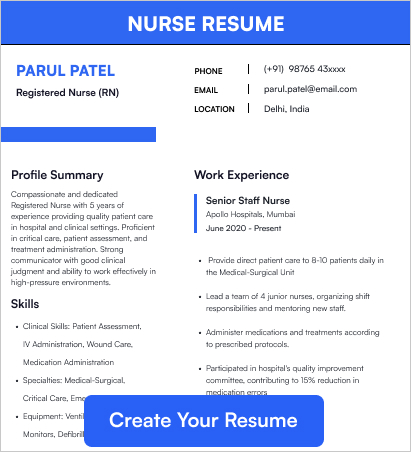
Chronological vs. Functional vs. Hybrid – Which One Works Best?
Chronological Nurse Resume Format (Best for most nurses)
Lists work experience in reverse order (latest job first).
Preferred by hospitals and recruiters because it clearly shows career progression.
You can use this resume format if you have a stable work history in nursing.
Functional Nursing Resume Format (Not recommended)
Focuses on skills instead of job history—hospitals dislike this format.
Can make employment gaps stand out more than helping.
Avoid this format unless you are switching careers into nursing.
Hybrid Nursing Resume Format (Best for new grads & career changers)
Mixes skills + experience, keeping a chronological work history.
Use this if you are a new graduate, have gaps, or are transitioning from another field.
Key Sections Every Nursing Resume Should Have
Here are the must-have sections for a nurse resume and how to write each effectively. You can also use this as a step-by-step guide to create a perfect resume that lands interviews.
1. Contact Information
The contact section should be clear, professional, and up to date. Any errors in this section can result in missed job opportunities.
What to include:
Full name (avoid nicknames)
Phone number
Professional email address (avoid unprofessional addresses like nurse_queen123@gmail.com)
Location (City, State) – Full address is not needed.
Optional: LinkedIn profile or personal website (if relevant).
What to avoid:
This part offers a glimpse of your nursing experience, main competencies, and professional objectives.
2. Professional Summary or Objective Statement
This section provides a snapshot of your nursing experience, key skills, and career goals. A professional summary is ideal for experienced nurses, while an objective statement works better for new graduates.
Professional Summary Example (for experienced nurses):
| "Compassionate and detail-oriented Registered Nurse (RN) with 5+ years of experience in critical care and emergency nursing. Skilled in patient assessment, medication administration, and EHR documentation. Seeking to leverage expertise in ICU patient management at [Hospital Name]." |
Objective Statement Example (for new nurses):
| "A recent BSN graduate with expertise in pediatrics and surgery. Passionate about providing exceptional patient care and eager to use skills in a fast-paced healthcare setting. I am delighted to begin working as an entry-level nurse at [Hospital Name]." |
What to Avoid:
3. Work Experience
This is the most important section of a nursing resume. It should clearly showcase your responsibilities, achievements, and the impact of your work.
How to structure it:
Job Title (e.g., Emergency Room Nurse)
Facility Name & Location (e.g., City Hospital, New York, NY)
Employment Dates (Month/Year – Month/Year or Present)
Bullet points describing key duties and accomplishments
Good Example:
Registered Nurse – ICU City Hospital, Mumbai | June 2020 – Present Manage care for 10+ critical patients per shift, ensuring adherence to hospital protocols. Implemented a new triage system that reduced emergency room wait times by 15%. Trained and mentored 5 junior nurses in patient care and electronic health record (EHR) documentation.
|
Bad Example:
Tips For Writing This Section:
Use action verbs like “administered,” “assessed,” “implemented,” and “coordinated.”
Include measurable results (e.g., reduced wait times by 15%, managed 10+ patients per shift).
Focus on achievements, not just responsibilities.
4. Education & Certifications
Nursing employers prioritize education and licensing, so this section should be clear and easy to find.
How to list it:
Degree Name (BSN, ADN, etc.)
University Name, Location | Year of Graduation
Example:
Bachelor of Science in Nursing (BSN) University of Mumbai, Mumbai) | Graduated: 2020 |
If you are a new graduate, include relevant coursework, honours, or clinical rotations.
For New Nurses:
Bachelor of Science in Nursing (BSN) University of Mumbai, Mumbai | 2023 |
What to avoid:
5. Licenses & Certifications
Nursing jobs require specific licenses, so this section must be up to date and accurate.
How to format it:
Registered Nurse (RN) – License #XXXXXXX | State | Year Issued
Certifications: Basic Life Support (BLS), Advanced Cardiac Life Support (ACLS), Pediatric Advanced Life Support (PALS), etc.
Example:
Registered Nurse (RN) – License #123456 Issued by: Mumbai Board of Nursing | Active Since 2019 |
What to avoid:
6. Skills Section (technical & soft skills)
A skills section helps ATS recognize relevant keywords and allows recruiters to quickly see core competencies.
Hard Skills (technical skills):
Patient assessment and monitoring
IV administration and wound care
Medication management
EHR documentation (Epic, Cerner, etc.)
Emergency response and triage
Soft Skills (essential but should be supported with examples in work experience):
Communication and patient education
Team collaboration
Critical thinking under pressure
Time management
Adaptability in fast-paced environments
What to avoid:
7. Additional Sections (if relevant)
Some nurses may need extra sections to strengthen their resume. These can include:
Professional Affiliations
Volunteer Work
Languages
Pro tip: When you are done creating your nurse resume, do not forget to write a good cover letter. It will make your application more appealing to hiring managers.
Next, we will look at a free nursing resume template and how to structure these sections properly.
Free Nursing Resume Template
Easily create your resume with this ready-to-use copy-paste nursing resume template designed for hospitals and healthcare facilities in India. Simply copy, edit, and personalize the details to match your experience and qualifications.
[Your Name] [Your Phone Number] [Your Email] [Your City, State]
Professional Summary Compassionate Registered Nurse (RN) with [X] years of experience in [ICU, Emergency, or General Ward]. Competent in patient evaluation, drug administration, and EHR recording. Dedicated to delivering excellent patient care and improving healthcare outcomes.
Work Experience
Registered Nurse [Hospital Name], [Location] | [Month/Year – Present] I provided patient care in a [department name] with an average of [X] patients every shift. Assisted with emergency procedures, IV treatment, and drug administration. Collaborated with doctors and healthcare teams to develop patient care plans.
Nursing Intern [Hospital Name], [Location] | [Month/Year – Month/Year] Completed clinical rotations in [ICU, Pediatric, Surgical, etc.]. Assisted senior nurses in patient care and record-keeping.
Education Bachelor of Science in Nursing (BSc Nursing) [University Name], [Year of Graduation]
Licenses & Certifications Registered Nurse (RN) – [State Nursing Council] Basic Life Support (BLS), Advanced Cardiac Life Support (ACLS)
Skills Patient care and monitoring Medication administration IV therapy and wound care Electronic Health Records (EHR) documentation Emergency response and critical care
Languages |
You can also View Staff Nurse Resume
ATS-Friendly Nursing Resume Formatting Tips
Here’s how to optimize your nurse resume for ATS (Applicant Tracking Systems)
1. Use Simple and Readable Fonts
Recommended fonts: Arial, Calibri, Times New Roman (Size 11-12).
Avoid decorative or script fonts, as ATS may misinterpret them.
2. Keep Margins and Section Headings Clear
Margins should be between 0.75 and 1 inch on all sides.
Use bold section titles like Work Experience, Education, Certifications for clarity.
Avoid underlines, italics, or coloured text, as ATS may not read them correctly.
3. Avoid Tables, Columns, and Graphics
ATS systems cannot process tables, multiple columns, or embedded images correctly.
Stick to plain text in a single-column layout to ensure readability.
4. Use Standard Job Titles and Nursing Terminology
ATS scans for exact matches, so use full job titles and common nursing terms.
Example: Instead of "ICU Nurse," write "Intensive Care Unit (ICU) Nurse" to improve searchability.
List certifications with full names, such as "Basic Life Support (BLS) Certified", instead of just "BLS Certified."
5. Include Relevant Keywords From Job Descriptions
ATS matches resumes with keywords from the job posting.
Use industry terms like patient care, IV therapy, medication administration, infection control, electronic health records (EHR) to improve ranking.
Avoid overloading keywords unnaturally; use them in context within experience and skills sections.
6. Save Your Resume in the Right Format
Best formats: Submit resumes in .docx (Microsoft Word) or PDF unless specified otherwise.
Some ATS systems struggle with PDFs, so check the job posting for format preferences.
7. Ideal Resume Length
One page: Best for new graduates or those with less than five years of experience.
Two pages: Recommended for nurses with five or more years of experience, advanced certifications, or leadership roles.
8. Test Your Resume for ATS Compatibility
Copy and paste your resume into a plain text document. If the formatting breaks, ATS may struggle to read it.
Use free online ATS resume checkers to identify missing keywords and formatting issues before submitting.
Wrapping up
And that’s all on how to create a nurse resume that gets interviews. Here are some key things to remember:
Use a chronological or hybrid nursing resume format to highlight your experience.
Include job-specific keywords to pass ATS screening.
Keep the format clean, simple, and ATS-friendly.
Use our free nursing resume template to create a strong application. Meanwhile, start searching for the best nursing jobs on Naukri.com and take the next step in your career!