Key highlights:
● What is a CV? A CV acts as an official career document used to present long-term educational and professional information.
● CV full form: The full form of CV is Curriculum Vitae.
● CV vs resume – main difference: A CV provides a complete record of academic and professional history while a resume presents a brief summary focused on a specific job role.
● When to use a CV? A CV is used for academic, research, medical, and international job applications.
● Where is a CV required? You usually need a CV when applying for jobs in the EU or for academic and research roles in the United States.
People often use the terms “CV” and “resume” interchangeably in India, but recruiters treat them as two different documents. If a job posting asks for a CV, you must share your Curriculum Vitae and not your resume. Nowadays, many recruiters specifically request CVs to get a more complete view of a candidate’s background. So, let’s learn CV meaning and how to write one using examples and templates.
What is a CV (curriculum vitae)? Meaning and definition
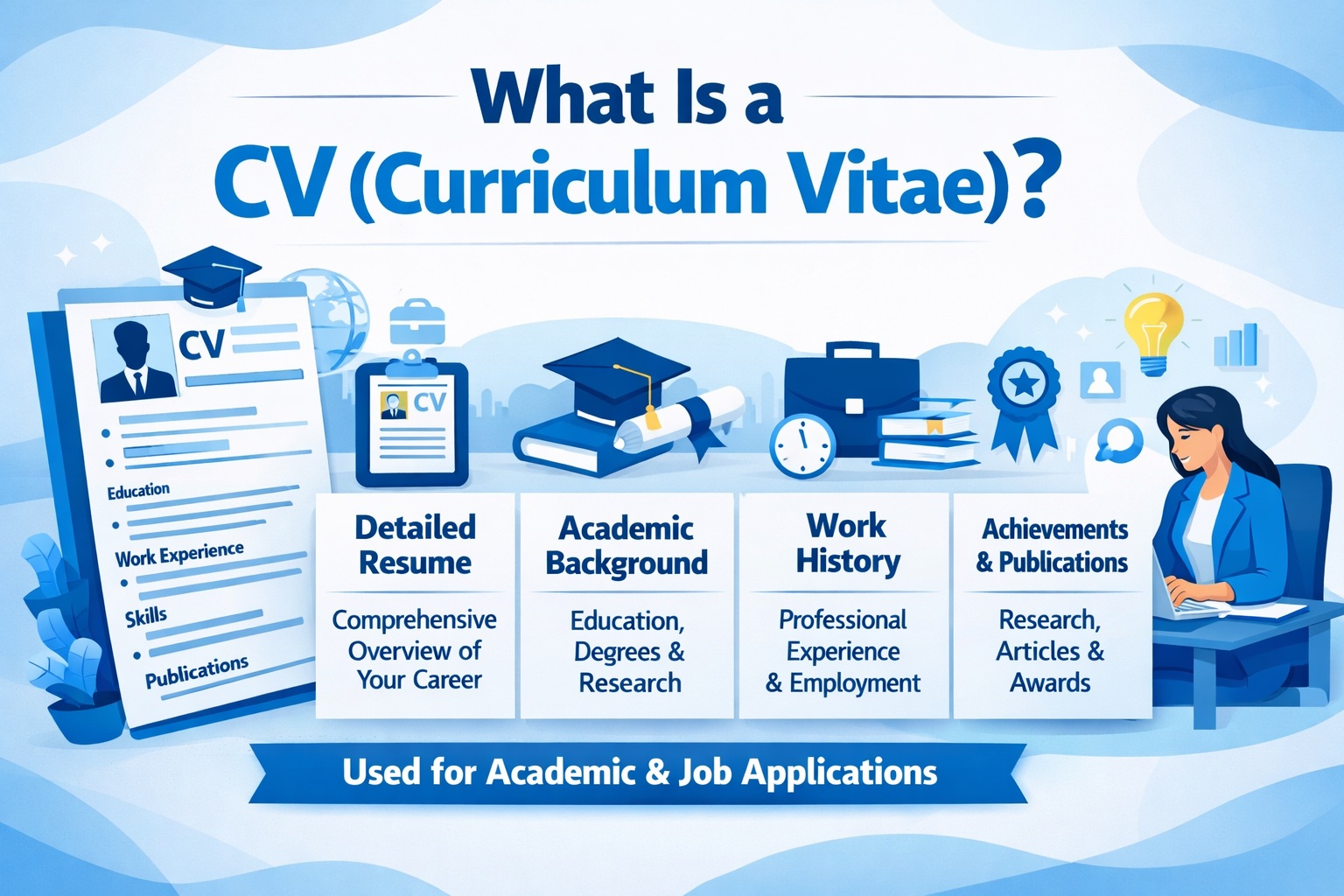
The term Curriculum Vitae (abbreviated as CV) originates from Latin and translates to “course of life.” Cambridge Dictionary defines a CV as “a short written description of your education, qualifications, previous jobs, and sometimes also your personal interests, that you send to an employer when you are trying to get a job.”
A CV is longer and in-depth job application document showcasing academic achievements, research experience, publications, and career progression. CVs provide a complete overview of a person's qualifications and are often preferred for positions requiring extensive expertise or specialization.
What is the purpose of a CV?
The purpose of a CV is to present your academic and professional profile in a clearly structured way so employers and institutions can assess your suitability and shortlist you for interviews. It works as a marketing tool that highlights your strengths and achievements for roles requiring detailed background information.
What is the difference between curriculum vitae (CV) and resume?
The difference between a CV and a resume often depends on the country and the type of role you are applying for. In the EU, employers usually use the terms CV and resume to mean the same short document for job applications. In the United States, a resume is a short (1 to 2 pages) summary used for most jobs. While a CV is a longer document mainly required for academic or research roles. In countries like India, Australia, and South Africa, people often use both terms in the same way. This is what adds to the confusion.
Also read: Difference between CV vs Resume?
What to include in a CV? Key sections
There is no single fixed format for a CV as it changes based on your experience level and the role you are applying for. However, some sections are essential and appear in almost every CV. These sections can help employers understand your background clearly.
Core sections every CV should include:
● Contact information
● CV summary or objective
● Professional experience
● Education or academic history
● Skills
Additional sections you can add based on your profile:
● Certifications and awards
● Publications and research work
● Professional memberships or associations
● Licences and grants
● Volunteer experience or personal projects
● Languages
● Personal details
● Hobbies and interests
For academic and research roles, employers may share specific CV formats or templates. Always follow the guidelines provided and include only the information that supports your application.
Now that you know what a CV means, the next step is to learn how to write one. Below are the steps you should follow when creating your curriculum vitae.
1. Review the job requirements: Carefully read the job description and note the skills, experience, and qualifications the employer is looking for. You must add these things in your CV.
2. Choose the right CV format: There are three main types of CV format – chronological, functional, and combination. Decide which format is right for you. A chronological format is best for experienced professionals and starts with your most recent experience. Functional format focuses on your skills and is best for freshers. Combination format is a mix of both.
3. Add your contact information: Include your full name, phone number, professional email address, and location at the top.
4. Write a personal statement: Summarise your professional background, key strengths, and career goals in a few clear lines. Write a summary statement if you have experience and objective statement if you are a fresher.
5. List your education: Mention degrees, institutions, dates, and relevant coursework if applicable.
6. Add work or professional experience: List roles in reverse chronological order with job titles, organisations, dates, and responsibilities in bullet points with action verbs and numbers.
7. Add skills and qualifications: Include technical skills, languages, tools, and soft skills relevant to the position.
8. Include role-specific sections: Add research, publications, teaching experience, grants or presentations if required for the role.
9. Add additional sections if relevant: This may include awards, volunteer work, professional memberships, or personal projects.
10. Add references if requested: Include references only when the employer specifically asks for them.
Also read: What Is a Resume? Definition & Meaning
CV samples for freshers and experienced professionals
CV samples help you understand how to structure and present your information based on your experience level and career stage. Here are two professional CV examples for freshers and experienced professionals.
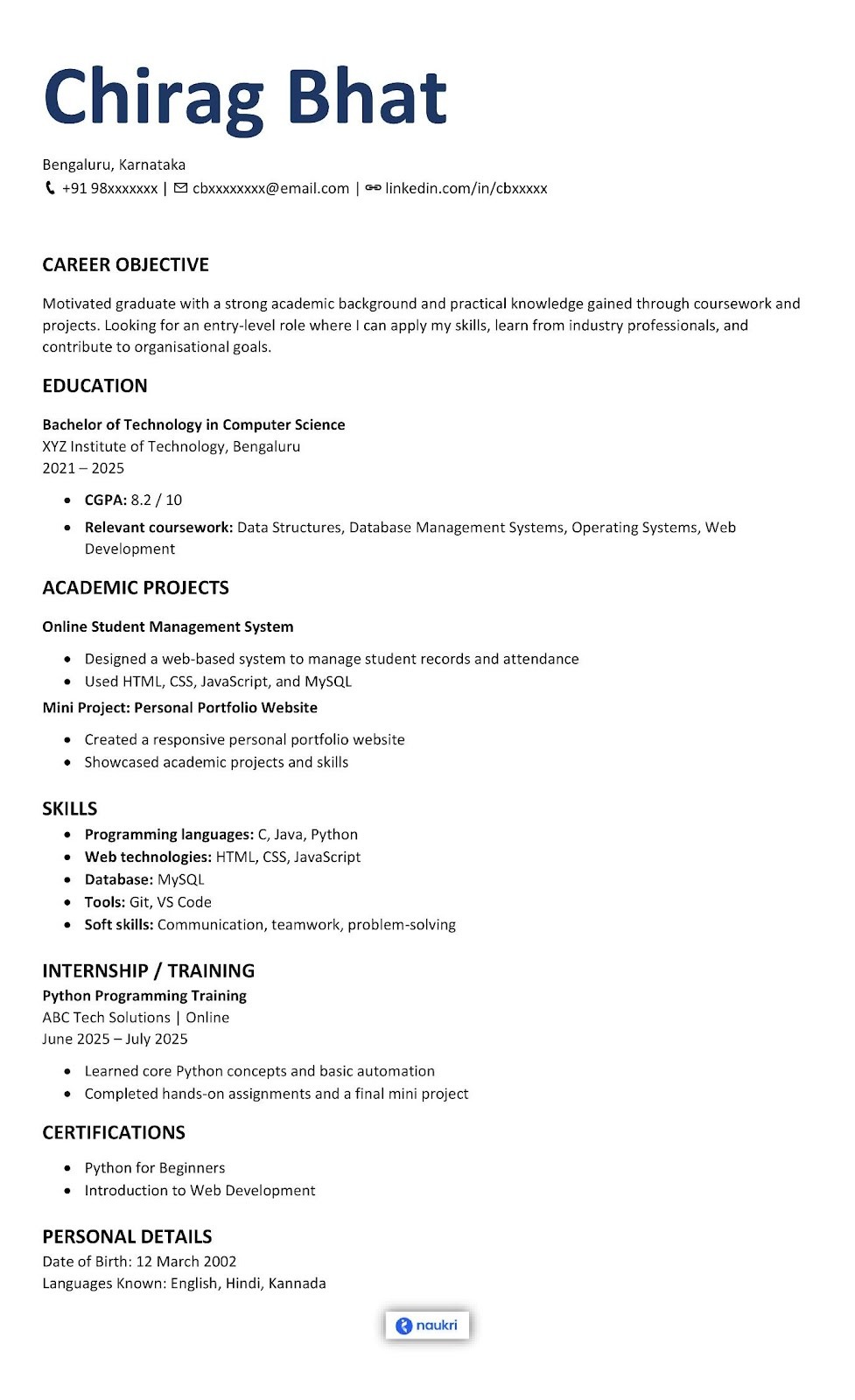
1. CV sample for freshers
Here's a CV sample for a fresher with no work experience. You can use this college CV template example for inspiration.
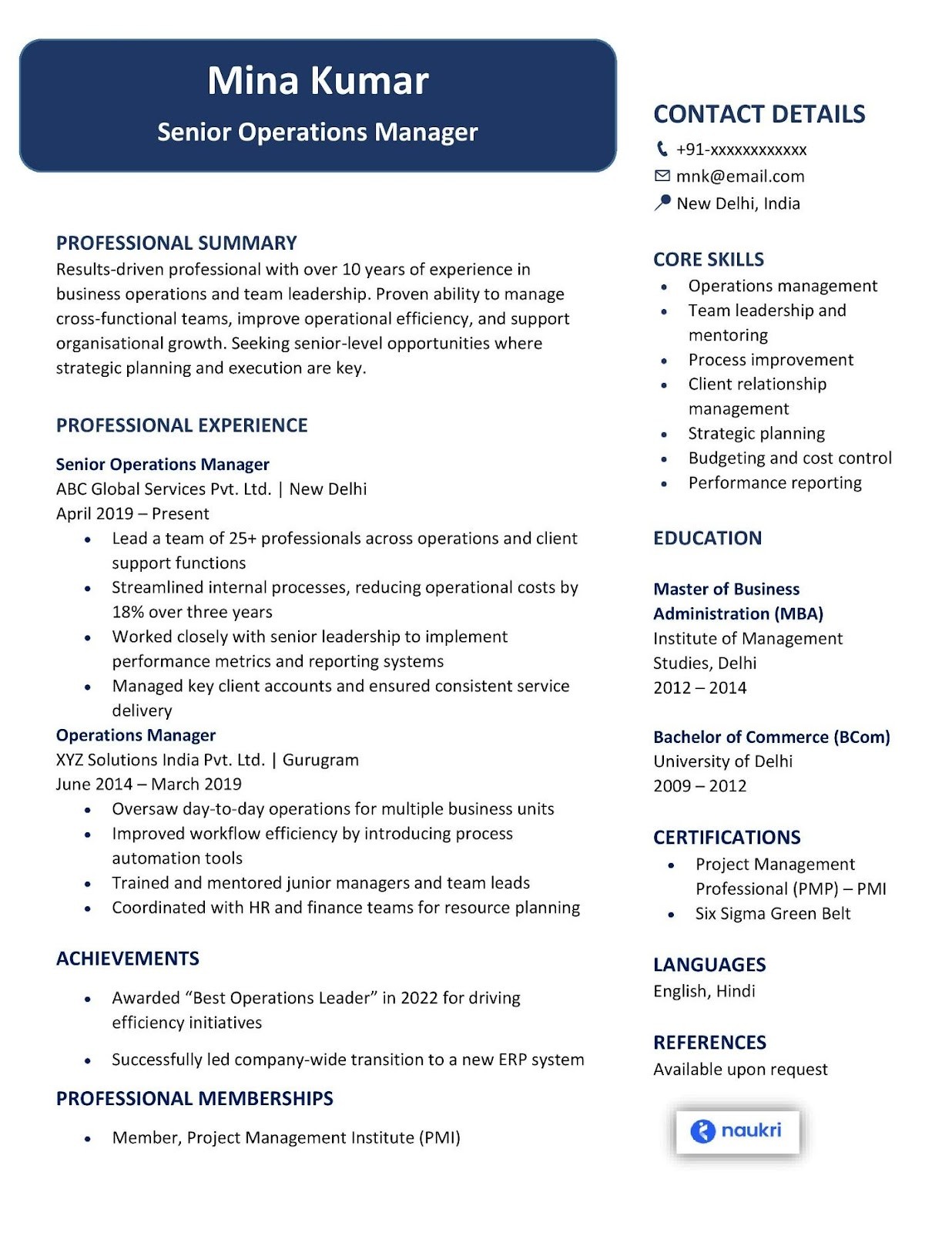
2. CV sample for experienced professional
Here's an executive CV template example for an experienced professional. It follows a reverse-chronological format to focus on the most recent work experience.
 Tips to format your CV and make it ATS-friendly
Proper formatting helps your CV get read correctly by both recruiters and Applicant Tracking Systems. Follow these CV formatting and ATS tips:
● Use standard fonts such as Arial Calibri or Times New Roman
● Keep font size between 10 and 12 for body text
● Use clear section headings like Education Work Experience and Skills
● Avoid tables graphics images and text boxes
● Save your CV in PDF or Word format unless stated otherwise
● Use bullet points instead of long paragraphs
● Adjust your CV for each application
● Include relevant keywords from the job description
● Use strong action verbs like implemented led or increased
● Add numbers percentages or results wherever possible
● Use white space to improve readability
● Keep length appropriate for your experience and role
● Proofread your CV carefully to avoid errors
Free CV template to create your CV
Here is a free CV or curriculum vitae template you can use as a reference to create a professional CV on your own. This creative and modern CV template follows an ATS-friendly CV format.
[Full Name]
[Address] | [Phone Number] | [Email] | [LinkedIn Profile or Portfolio]
PROFILE SUMMARY
A brief 2 to 3 line overview highlighting your professional background, key skills, and career focus. Customize this section to the role you are applying for.
EDUCATION
[Degree] in [Field of Study]
[University or Institution Name] | [Year of Graduation]
● Relevant coursework projects or academic achievements
● Honours awards or distinctions if applicable
EXPERIENCE
[Job Title]
[Company Name] | [Start Year – End Year]
● Describe your main responsibilities and contributions
● Highlight measurable achievements or outcomes
● Use action-focused statements to show impact
(Repeat for additional roles if applicable)
SKILLS
● Technical skills tools or software
● Languages or certifications
● Job-relevant professional skills
ADDITIONAL SECTIONS (Optional)
Include only if relevant to the role:
● Certifications and training
● Research publications or projects
● Volunteer experience
● Awards and recognitions
● Languages
ACTIVITIES AND INTERESTS (Optional)
Mention extracurricular activities or interests that demonstrate transferable skills or leadership qualities.